
Session Information
Session Type: ACR Poster Session A
Session Time: 9:00AM-11:00AM
Background/Purpose: Hydroxychloroquine (HCQ) is a mainstay of treatment in patients with SLE. It has been demonstrated to reduce disease activity and prevent damage accrual and suggested to give benefits on thrombosis prevention [1-2]. We have recently pointed out a role of low dose aspirin (ASA) in the primary prophylaxis of cardiovascular disease (CVD) in SLE [3]. In that study, we did not detect any time and dose-independent protective effect of antimalarials. The present analysis was performed to investigate the role of distinct HCQ cumulative dosages and treatment durations.
Methods: patients consecutively admitted to a tertiary center, who, at baseline, satisfied 1992 ACR and/or 2012 SLICC classification criteria for SLE and had not experienced any CV event, were enrolled. ASA treatment, daily and cumulative dosages of HCQ and treatment duration were noticed. A number of attempts were performed to identify the dosage of HCQ and its treatment duration associated with a lower incidence of CV events as assessed by evaluating CV events free survival by Kaplan-Meier curves.
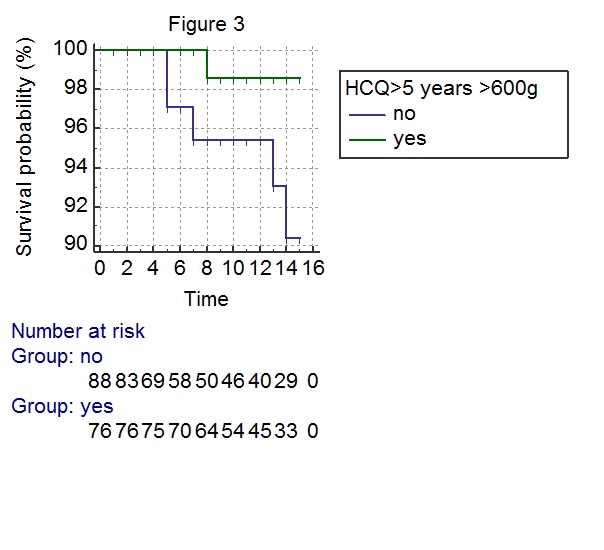
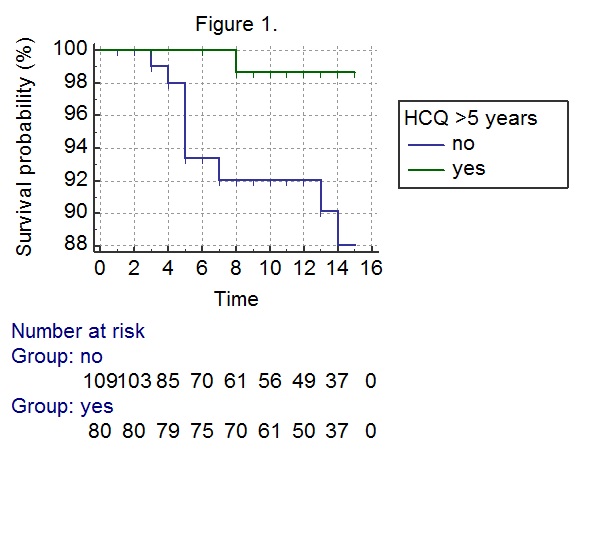
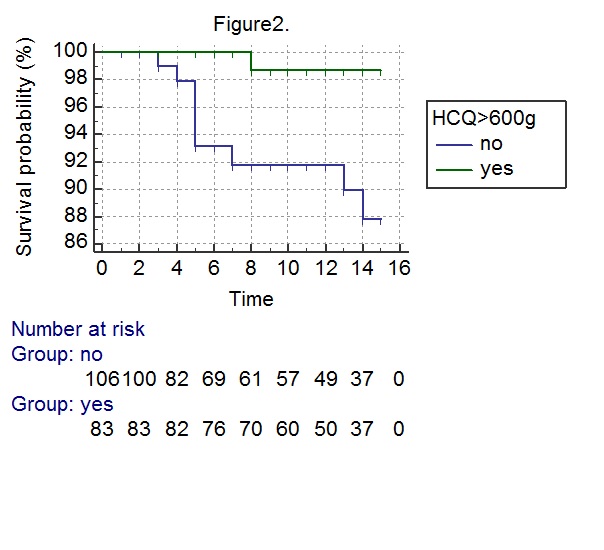
Results: 189 consecutive SLE patients were enrolled and followed up for a median of 13 years (range 1-15 years). Out of them, 80.9% (153/189) had ever used HCQ, with a median treatment duration of 4 years (range 1-15). 80/153 (52.2%) had a treatment duration >5 years and 83/153 (54.2%) patients had cumulative HCQ dosages>600g. Out of the 189 patients, 31(16.4%) were treated with ASA alone and 134 (70.8%) were treated with both ASA and HCQ. During follow-up, there were 10 CV events (1 stroke, 5 TIA, and 4 MI). CV event-free rate was higher in patients treated with HCQ for more than 5 years (log-rank test χ2 = 6.10; p= 0.01) and in patients with a cumulative HCQ dosage >600g (log-rank test χ2 = 6.45; p= 0.01) [figure1-2]. Comparing the 76 patients treated by ASA and HCQ with a cumulative dosage>600g and a treatment duration >5 years with 87 the patients treated by ASA and either no HCQ or HCQ of a dosage<600g and a treatment duration <5 years, a nearly significant difference was detected in CV events free rates (p=0.069) [figure 3].
Conclusion: Antimalarials, when administered for more than 5 years at a cumulative dosage>600g, may furtherly reduce the CV risk in SLE patients. Larger, prospective studies are needed to fully address this topic.
To cite this abstract in AMA style:
Fasano S, Iudici M, Pantano I, Pierro L, Valentini G. Long-Term Hydroxychloroquine Therapy and Low-Dose Aspirin May Have an Additive Effectiveness in the Primary Prevention of Cardiovascular Events in Patients with Systemic Lupus Erythematosus [abstract]. Arthritis Rheumatol. 2016; 68 (suppl 10). https://acrabstracts.org/abstract/long-term-hydroxychloroquine-therapy-and-low-dose-aspirin-may-have-an-additive-effectiveness-in-the-primary-prevention-of-cardiovascular-events-in-patients-with-systemic-lupus-erythematosus/. Accessed .« Back to 2016 ACR/ARHP Annual Meeting
ACR Meeting Abstracts - https://acrabstracts.org/abstract/long-term-hydroxychloroquine-therapy-and-low-dose-aspirin-may-have-an-additive-effectiveness-in-the-primary-prevention-of-cardiovascular-events-in-patients-with-systemic-lupus-erythematosus/