
Session Information
The 2020 Pediatric Rheumatology Symposium, originally scheduled for April 29 – May 2, was postponed due to COVID-19; therefore, abstracts were not presented as scheduled.
Date: Thursday, April 30, 2020
Title: Poster Session 1
Session Type: ACR Abstract Session
Session Time: 6:00PM-7:00PM
Background/Purpose: Children with chronic diseases have higher rates of mental health issues and less favorable outcomes than the general pediatric population. Children with JIA experience pain and limited mobility which may affect their mental health. Prior studies of mental health and the relationship to disease manifestations in JIA have had variable results, partly due to a lack of a standard assessment tool. PROMIS has recently been developed to help standardize and validate assessments on patient-reported outcomes. The aims of this study are to describe the levels of anxiety and depressive symptoms in JIA patients using PROMIS measures and examine the association with disease manifestations.
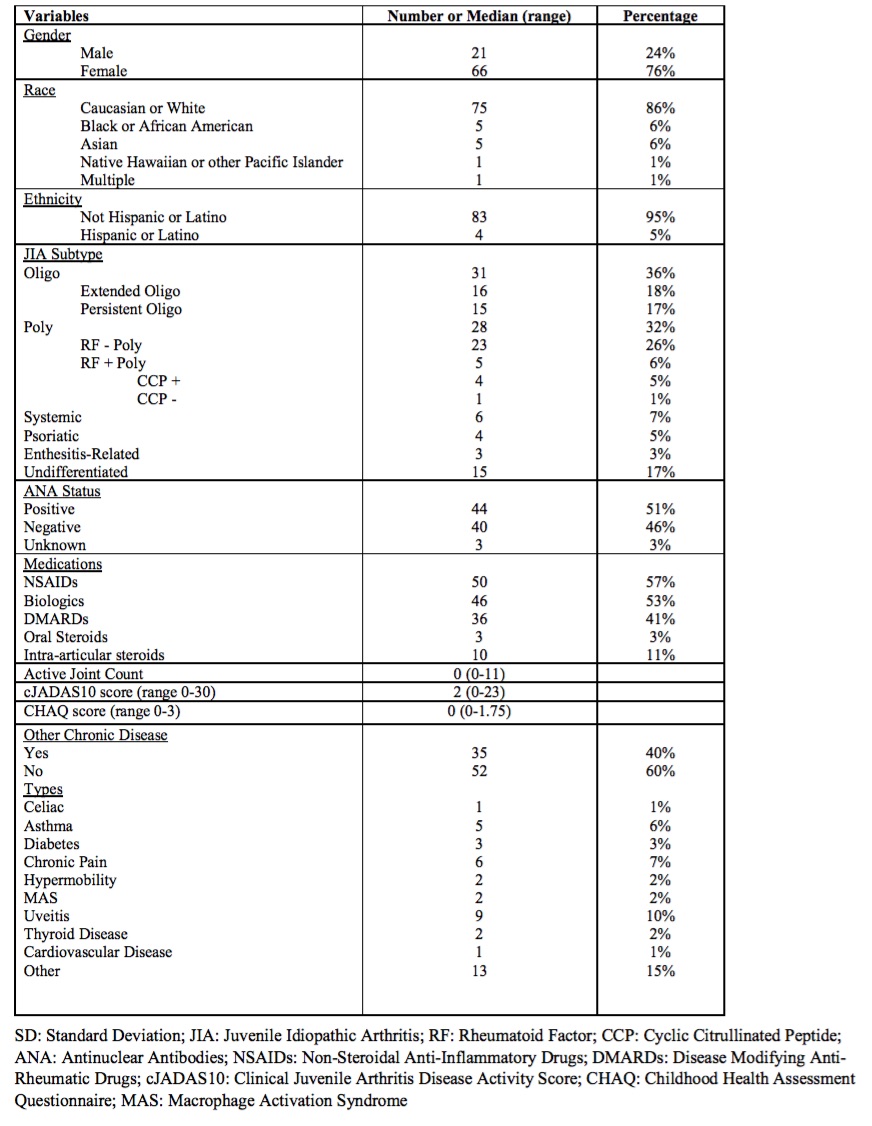
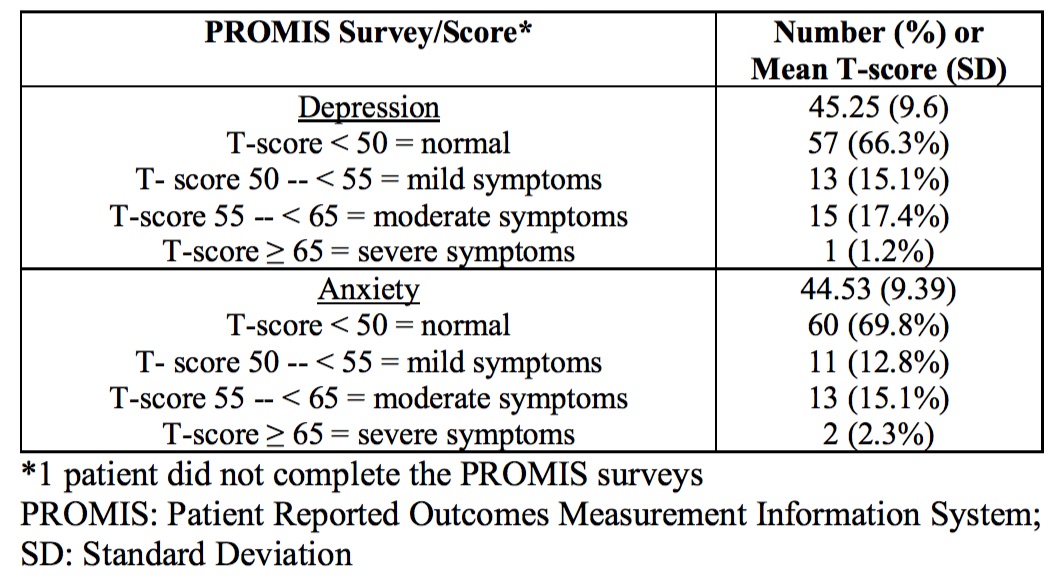
Methods: We conducted a two-center, cross-sectional study of 87 JIA patients and their parents. JIA ILAR subtypes included: 36% oligoarticular (52% extended; 48% persistent), 32% polyarticular (82% RF –; 18% RF +), 7% systemic, 5% psoriatic, 3% enthesitis-related, and 17% undifferentiated. Patients and parents completed PROMIS surveys in depression, anxiety, psychological stress, and pain domains to assess psychosocial functioning and the Childhood Health Assessment Questionnaire (CHAQ) to assess physical functioning. Disease activity was determined by the clinical juvenile arthritis disease activity score (cJADAS10). T-scores are calculated for PROMIS measures (mean=50; standard deviation=10). PROMIS defines T-scores for depressive and anxiety symptoms as T-score < 50 = normal, T-score 50 – < 55 = mild, T-score 55 – < 65 = moderate, and T-score ≥ 65 = severe. The Pearson’s correlation and Kruskal-Wallis tests were used to determine the relationship between mental health PROMIS T-scores and disease manifestations.
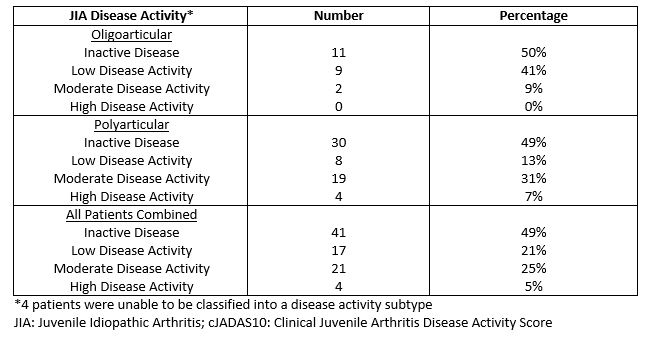
Results: Eighty-six JIA patients completed the study; 76% female, 86% Caucasian, and median age of 14 years. Patients had a median active joint count of 0 joints (range 0-11) and a median cJADAS10 score of 2 (range 0-23). The median CHAQ score was 0 (range 0-1.75) (Table 1). Using the cJADAS10, disease activity was classified as 49% inactive, 21% low, 25% moderate, and 5% high (Table 2). The mean PROMIS T-scores for depressive and anxiety symptoms were significantly lower in JIA patients compared to the general pediatric population (p< 0.0001). One patient (1.2%) had severe symptoms, and 15 patients (17.4%) had moderate symptoms in the PROMIS depressive domain. Two patients (2.3%) had severe symptoms, and 13 patients (15.1%) had moderate symptoms in the PROMIS anxiety domain (Table 3). The correlations between depressive (r=0.66; p< 0.0001) and anxiety (r=0.49;p< 0.0001) symptoms with pain interference were significantly different from zero. Total active joint count and cJADAS10 scores did not correlate with depressive or anxiety symptoms.
Conclusion: Using PROMIS, 36% of JIA patients had moderate to severe symptoms of anxiety and/or depression. JIA patients in our study experienced less anxiety and depressive symptoms compared to healthy children. Levels of depressive and anxiety symptoms in JIA patients are associated with pain, but they are not associated with disease activity markers such as total active joint count or cJADAS10 scores.
To cite this abstract in AMA style:
Fair D, Olson J, Lemke J, Protopapas S, Yan K, Zhang J. Levels of Anxiety and Depressive Symptoms in Juvenile Idiopathic Arthritis (JIA) and Their Correlation to Disease Manifestations Using Patient-Reported Outcomes Measurement Information System (PROMIS®) Measures [abstract]. Arthritis Rheumatol. 2020; 72 (suppl 4). https://acrabstracts.org/abstract/levels-of-anxiety-and-depressive-symptoms-in-juvenile-idiopathic-arthritis-jia-and-their-correlation-to-disease-manifestations-using-patient-reported-outcomes-measurement-information-system-promis/. Accessed .« Back to 2020 Pediatric Rheumatology Symposium
ACR Meeting Abstracts - https://acrabstracts.org/abstract/levels-of-anxiety-and-depressive-symptoms-in-juvenile-idiopathic-arthritis-jia-and-their-correlation-to-disease-manifestations-using-patient-reported-outcomes-measurement-information-system-promis/