
Session Information
Session Type: Poster Session A
Session Time: 10:30AM-12:30PM
Background/Purpose: Juvenile Idiopathic Arthritis (JIA) is the most prevalent chronic arthritis in children, but its diagnosis is often challenging due to overlapping symptoms with other conditions that mimic it.Among these mimics, Progressive Pseudo-Rheumatoid Dysplasia (PRD) and Camptodactyly – Arthropathy-Coxa Vara-Pericarditis (CACP) syndrome are particularly noteworthy due to their potential to cause significant diagnostic confusion and subsequent mismanagement.
Methods: This study aims to elucidate the clinical and genetic characteristics of pediatric patients diagnosed with PRD and CACP syndrome, highlighting the critical need for accurate differential diagnosis to avoid misdiagnosis and improve management strategies.–A retrospective case series was conducted at NIMS Hospital, Hyderabad,reviewing pediatric patients who presented to the outpatient department over a two-year period with symptoms initially suggestive of JIA.Seven patients with clinical presentations, including multiple joint pains and back pain, were evaluated. Comprehensive clinical assessments, imaging studies, and Whole Exome Sequencing (WES) were utilized to establish definitive diagnoses.
Results: RESULTS – Out of the seven patients evaluated, five were diagnosed with PPD and two with CACP syndrome.The age of onset ranged from 1 to 10 years, with a mean age of 4.7 years.3 rd degree consanguinity was found in all patients, and 2 nd brothers were of same family, 2 females and 3 male children in PPD and 1 male and 1 female child in CACP cluster Clinically, all patients presented with chronic joint pain; additional features included back pain, bilateral knee joint swelling, and, in CACP patients, characteristiccamptodactyly, joint contractures.Inflammatory markers were normal Genetic analysis done for 5 patients , it identified mutations in the CCN6 gene in three PRD patients and in the PRG4 gene in the two CACP patients.
Conclusion: PPD and CACP syndrome are critical differential diagnoses in pediatric patients presenting with JIA-like symptoms, especially in cases that deviate from typical JIA presentations or are unresponsive to standard treatments. These disorders were inherited inAR pattern with non-inflammatory arthropathy and deformities with early age of onset and atypical radiological features.This case series underscores the importance of a thorough diagnostic approach that includes detailed clinical assessment, imaging, and genetic testing. In all of these cases the correct diagnosis was made due to careful, longitudinal clinical phenotyping and a close working relationship between rheumatology, radiology and clinical genetics; highlighting the importance of the multidisciplinary team in managing complex patients
.jpg) PPD SYNDROME- ENLARGED EPIPHYSES, WIDENED METAPHYSES, PLATYSPONDYLY WITH ANTERIOR BEAKING OF VERTEBRAE
PPD SYNDROME- ENLARGED EPIPHYSES, WIDENED METAPHYSES, PLATYSPONDYLY WITH ANTERIOR BEAKING OF VERTEBRAE
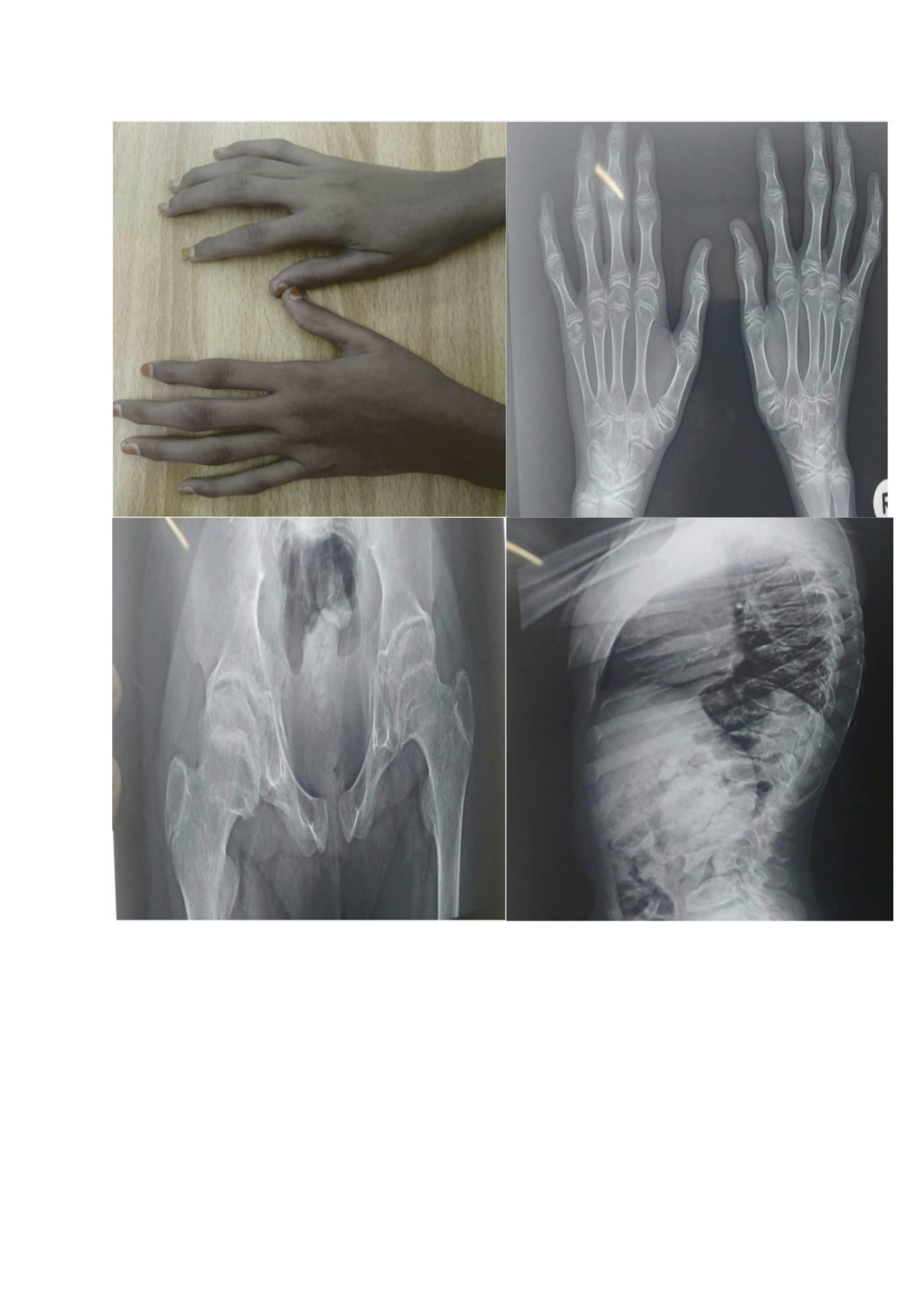
.jpg) CACP – CLINICAL AND RADIOLOGY IMAGES – CAMPTODACTYLY , KNEE AND WRIST SWELLING, KNEE EFFUSION , OSTEOPENIA, COXAVARA
CACP – CLINICAL AND RADIOLOGY IMAGES – CAMPTODACTYLY , KNEE AND WRIST SWELLING, KNEE EFFUSION , OSTEOPENIA, COXAVARA
To cite this abstract in AMA style:
Kambhampati S, yerram k, Meesala K, Devarasetti P, rajasekhar L. Juvenile Idiopathic Arthritis Mimics: A Case Series on Progressive Pseudo-Rheumatoid Dysplasia and CACP Syndrome in Pediatric Patients from a Tertiary Center in South India [abstract]. Arthritis Rheumatol. 2025; 77 (suppl 9). https://acrabstracts.org/abstract/juvenile-idiopathic-arthritis-mimics-a-case-series-on-progressive-pseudo-rheumatoid-dysplasia-and-cacp-syndrome-in-pediatric-patients-from-a-tertiary-center-in-south-india/. Accessed .« Back to ACR Convergence 2025
ACR Meeting Abstracts - https://acrabstracts.org/abstract/juvenile-idiopathic-arthritis-mimics-a-case-series-on-progressive-pseudo-rheumatoid-dysplasia-and-cacp-syndrome-in-pediatric-patients-from-a-tertiary-center-in-south-india/