
Session Information
Date: Monday, November 18, 2024
Title: SpA Including PsA – Diagnosis, Manifestations, & Outcomes Poster III
Session Type: Poster Session C
Session Time: 10:30AM-12:30PM
Background/Purpose: Accurate assessment of disease patterns may be important for appropriate management of psoriatic arthritis (PsA). Ultrasonography (USG) is a highly accurate, sensitive, and non-invasive tool for disease activity assessment and determining the musculoskeletal (MSK) disease pattern of patients with PsA. Detailed USG of peripheral MSK structures is not feasible in routine practice. A metabolomics-based approach may elucidate potential biomarkers associated with USG-determined PsA patterns. Therefore, we aimed to use solid phase microextraction (SPME) with liquid chromatography coupled with mass spectrometry (LC-MS) to explore metabolome differences among PsA patients according to their USG-based patterns.
Methods: PsA patients were assessed and assigned corresponding domain scores for synovitis, enthesitis, peritenonitis, and tenosynovitis determined by USG of the MSK system. Hierarchical clustering was performed to determine USG-based patterns based on these domains. Serum samples collected at the time of USG scans were prepared using SPME, and the resulting extracts were used for analysis via LC-MS. Machine Learning (ML) models were used to evaluate associations between metabolite levels and MSK disease patterns. Model performances were summarized using Area under Receiver Operator Characteristic curves (AUROC). Models with predictive performance greater than 0.7 were considered, and potential metabolite candidates were tentatively identified.
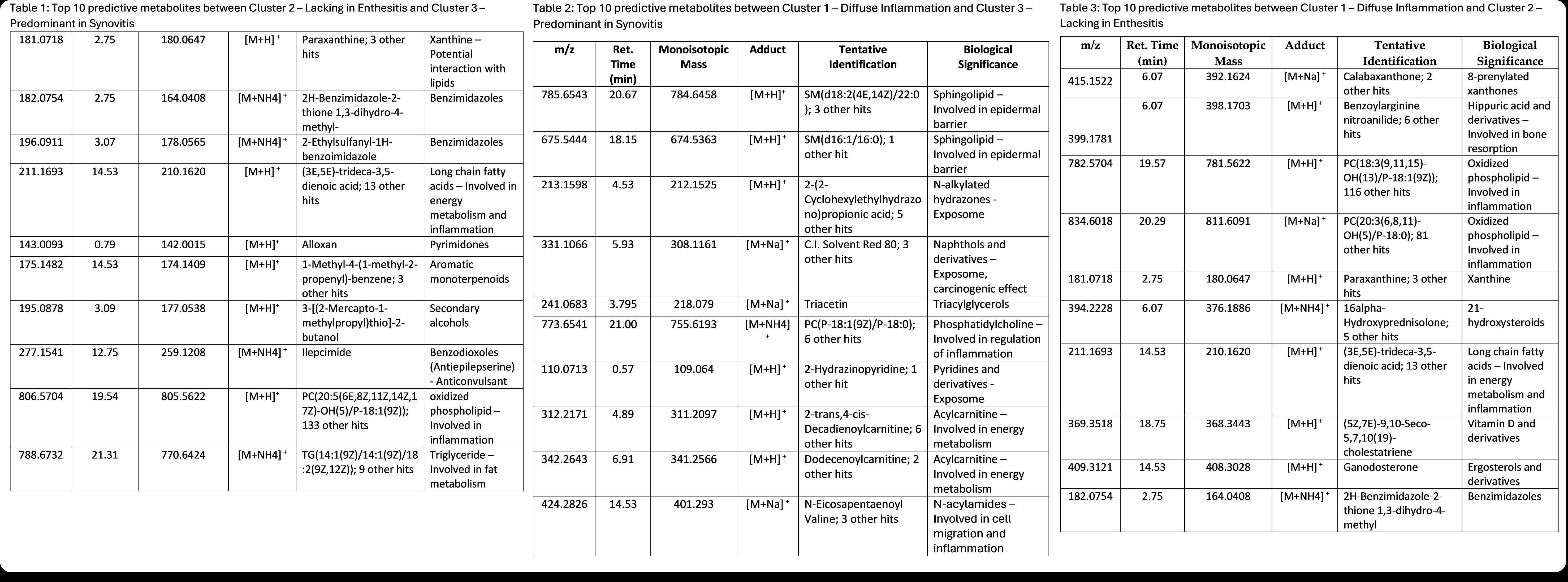
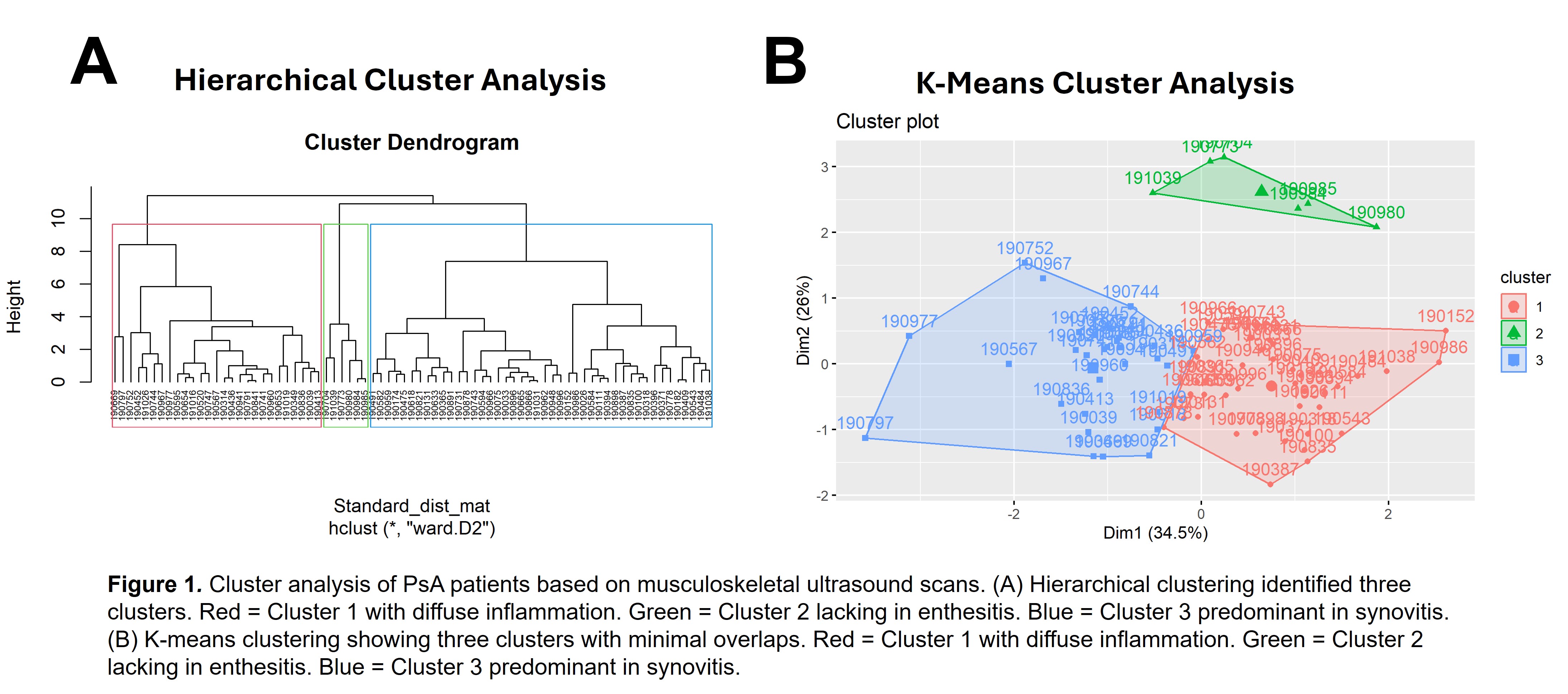
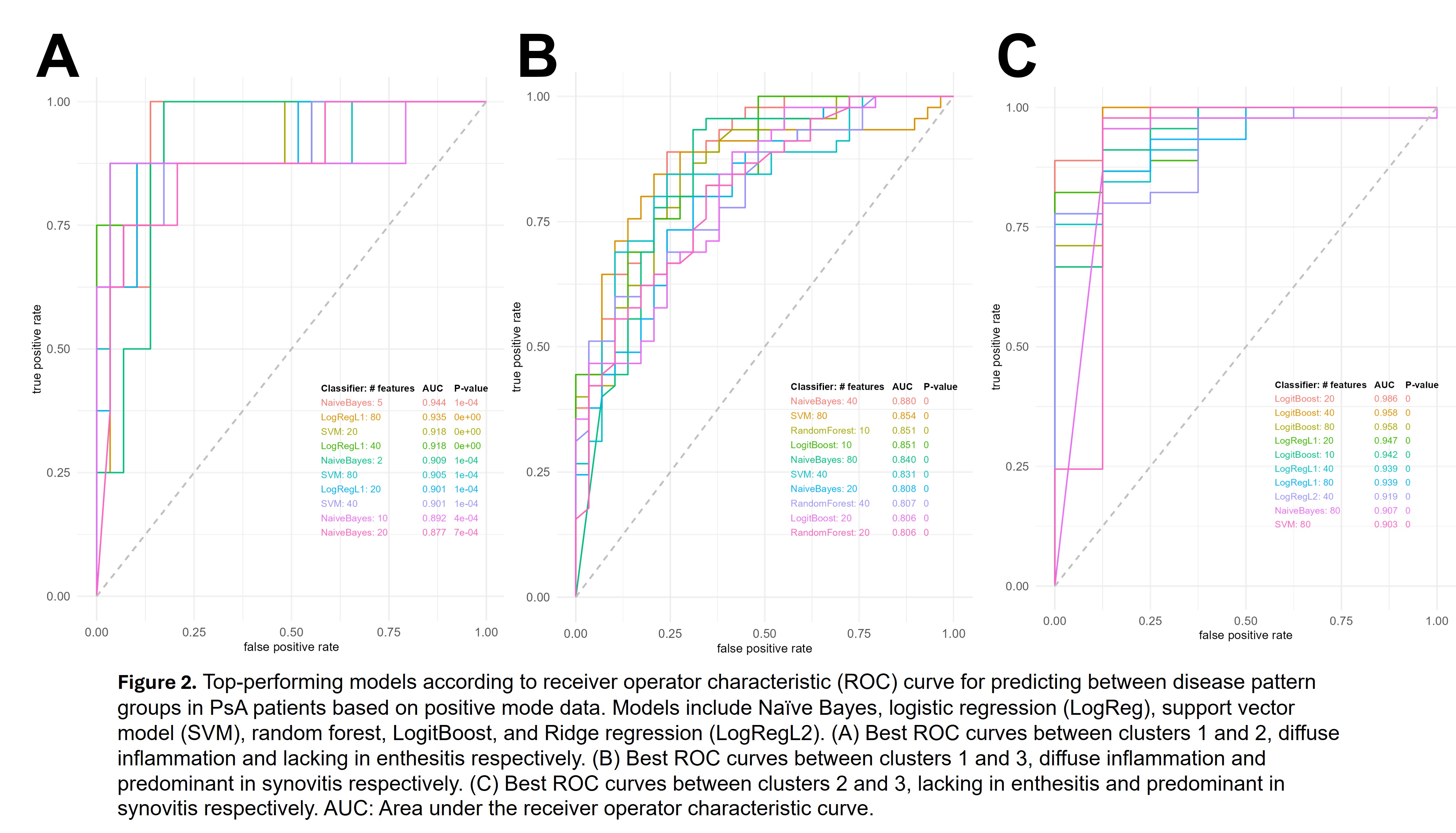
Results: 76 patients (37 females) with mean age of 47.4 years (standard deviation (SD) 14.5), and mean PsA and psoriasis duration of 6.5 (SD 11.6) and 16.6 (SD 12.7) years respectively were recruited. The patients had a mean active (tender or swollen) joint count of 7.6 (SD 6.2) and swollen joint count of 4.4 (SD 4.0). 38.2% had dactylitis, and 63.2% had clinical enthesitis. Hierarchical clustering based on the USG data identified 3 different USG-based patterns (Figure 1): Cluster 1 (n=27) exhibited diffuse inflammation; Cluster 2 (n=6) lacked enthesitis; and Cluster 3 (n=43) had predominant synovitis. ML models were able to distinguish between USG-based patterns. The best performing models were- a LogitBoost model with 20 features (AUC of 0.986 between cluster 2 and 3), a NaïveBayes model with 40 features (AUC of 0.88 between cluster 1 and 3), and a NaïveBayes model with 5 features (AUC of 0.944 between cluster 1 and 2) (Figure 2). The features used in best performing models were associated with dysregulation of fatty acid metabolism. Tentatively identified metabolites include sphingomyelin (d18:0/16:0) which belongs to the sphingolipid class implicated in PsA skin lesions and are precursors to ceramides that can modulate the immune response. Other tentatively identified features belong to compound classes, phospholipids, diglycerides, and long-chain fatty acids (Tables 1-3).
Conclusion: An untargeted serum metabolomics approach found several fatty acid and lipid class metabolites associated with USG-based MSK disease patterns. A closer examination and validation of the circulating metabolites to reveal potential biomarkers associated PsA disease patterns and disease activity is underway.
To cite this abstract in AMA style:
Li S, Looby N, Kotiyar M, Eder L, Jurisica I, Kulasingam V, Chandran v. Investigating the Association of Serum Metabolites with Psoriatic Arthritis Musculoskeletal Disease Patterns [abstract]. Arthritis Rheumatol. 2024; 76 (suppl 9). https://acrabstracts.org/abstract/investigating-the-association-of-serum-metabolites-with-psoriatic-arthritis-musculoskeletal-disease-patterns/. Accessed .« Back to ACR Convergence 2024
ACR Meeting Abstracts - https://acrabstracts.org/abstract/investigating-the-association-of-serum-metabolites-with-psoriatic-arthritis-musculoskeletal-disease-patterns/