
Session Information
Session Type: Abstract Session
Session Time: 4:15PM-4:30PM
Background/Purpose: Cognitive impairment is a prevalent neuropsychiatric manifestation of SLE. Studies have primarily focused on the prevalence of cognitive impairment cross-sectionally; however, there remain gaps in understanding how SLE affects patients’ cognition longitudinally and more importantly at the intra-individual level. We studied if and how cognitive function changes in SLE on repeated assessments (intra-individual change) and examined what factors influence cognitive change.
Methods: Data was drawn from a single centre longitudinal study that followed 1281 patients with SLE using annual telephone interviews. The Hopkins Verbal Learning Test-Revised (HVTL-R-verbal learning and memory) and the Controlled Oral Word Association Test (COWAT-verbal fluency) were the measures of cognition. The Systemic Lupus Activity Questionnaire (SLAQ) and Center of Epidemiologic Studies Depression Scale (CES-D) were used to assess disease severity and depressive symptoms respectively. A two-state Markov Analysis was used to model probabilities of transition between cognitive states: lower cognitive function [Z score ≤ -1.5] and higher cognitive function [Z score > -1.5] (Figure 1). Logistic regression analyses were used to examine what factors were associated with cognitive change.
Results: Most SLE patients demonstrated stability in cognition overtime. However, among those with change as assessed by the COWAT, individuals with SLE were 18 times more likely to improve in cognition than to experience cognitive decline over time (Improvement Intensity of 0.91 vs. Decline Intensity of 0.05). Higher levels of depressive symptoms by CES-D were associated with less likelihood of experiencing improvement in cognition (RR 0.98; 95% CI 0.96-0.99); and greater disease severity by SLAQ was associated with an increased risk of cognitive decline (RR 1.05; 95% CI 1.02-1.09) (Table 1). As assessed by the HVLT-R, individuals were 3 times as likely to improve in cognition than to experience cognitive decline over time (Improvement Intensity of 0.20 vs. Decline Intensity of 0.07). Increasing age (RR 1.02; 95% CI 1.01-1.03) and higher education level (RR 1.82; 95% CI 1.29-2.58) were associated with a greater likelihood of improving cognition assessed by HVLT-R. Higher disease severity by SLAQ (RR 1.05; 95% CI 1.03-1.07) and depressive symptoms by CES-D (RR 1.02; 95% CI 1.01-1.03) were also associated with an increased risk of worsening cognition (Table 2).
Conclusion: This study demonstrates that the majority of individuals with SLE experience stability in cognitive function over time. However, among those SLE patients that do experience change in cognition, improvement in cognition was more common than decline. Cognitive improvement over time was more noticeable in the verbal fluency domain (COWAT) than in the learning and memory domain (HVLT-R). Increasing age and higher education levels were associated with a greater chance of cognitive improvement. Self-reported higher levels of SLE disease severity and depressive symptoms were barriers to experiencing cognitive improvement and were risk factors for experiencing cognitive decline in both assessments.
 Figure 1. Two-state reversible Markov model for HVLT-R & COWAT to model the probabilities of transition between cognitive states
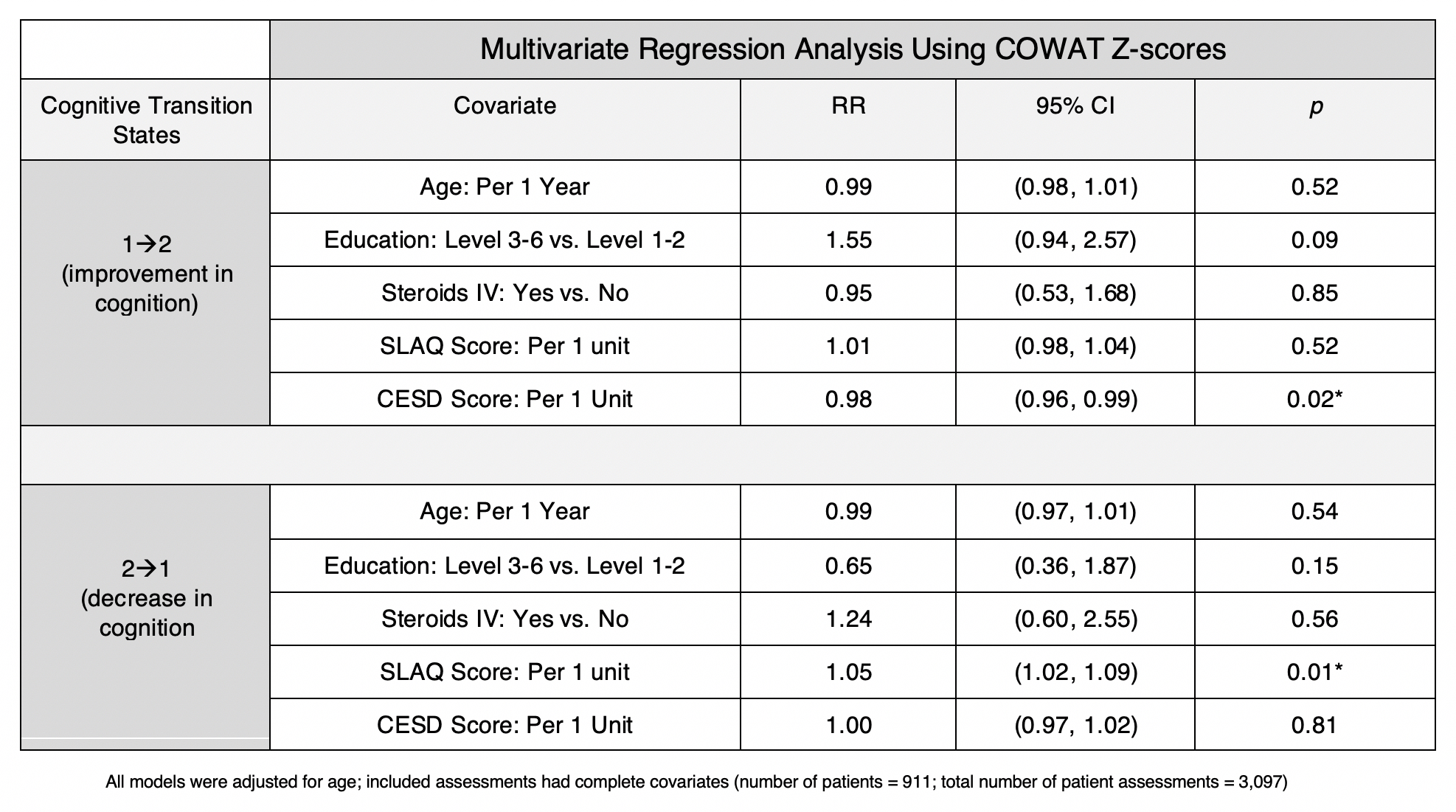 Table 1. Multi-state regression model with COWAT
 Table 2. Multi-state regression model with HVLT-R
To cite this abstract in AMA style:
Perera S, Cook R, Lee K, Katz P, Touma Z. Intra-Individual Change in Cognitive Function Among Adults with Systemic Lupus Erythematosus: A Markov Analysis over 7 Years [abstract]. Arthritis Rheumatol. 2021; 73 (suppl 9). https://acrabstracts.org/abstract/intra-individual-change-in-cognitive-function-among-adults-with-systemic-lupus-erythematosus-a-markov-analysis-over-7-years/. Accessed .« Back to ACR Convergence 2021
ACR Meeting Abstracts - https://acrabstracts.org/abstract/intra-individual-change-in-cognitive-function-among-adults-with-systemic-lupus-erythematosus-a-markov-analysis-over-7-years/