
Session Information
Date: Tuesday, October 23, 2018
Title: Systemic Sclerosis and Related Disorders – Clinical Poster III
Session Type: ACR Poster Session C
Session Time: 9:00AM-11:00AM
Background/Purpose:
Angiogenic pathways are likely to contribute to pathogenesis of both vasculopathy and fibrosis in Systemic sclerosis (SSc). The angiogenic actions of Angiopoietins (pro-angiogenic Ang1 and divergent Ang2) through competitive Tie2 binding could be attractive biomarkers in SSc. We report the association between Ang1, Ang 2 and Tie2 with objective assessments of peripheral vasculopathy and cutaneous fibrosis in SSc.
Methods:
Fifty-one SSc patients (2013 ACR/EULAR criteria) and fifteen healthy controls (HC) underwent functional assessment of post-occlusive digital vascular responses using Laser Speckle Contrast Imaging (LSCI), morphological capillary assessment using nailfold capillaroscopy (NC) and High Frequency Ultrasound (HFUS) assessment of cutaneous fibrosis and digital vasculopathy. Modified Rodnan Skin Score (mRSS) and Raynaud’s Condition Score were assessed in SSc. Plasma Ang 1, Ang 2 and Tie2 levels were measured using ELISA.
Results:
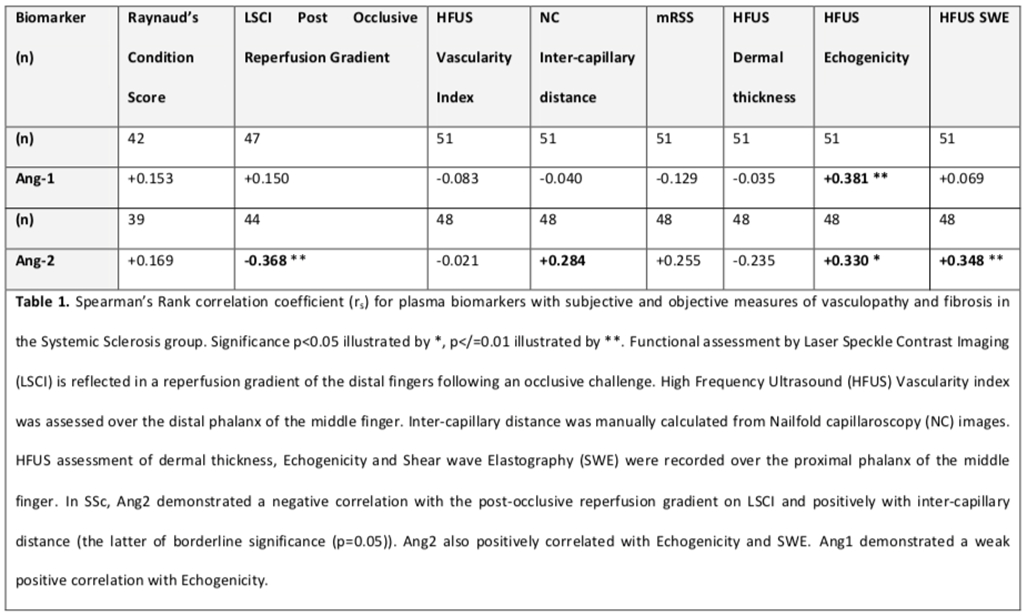
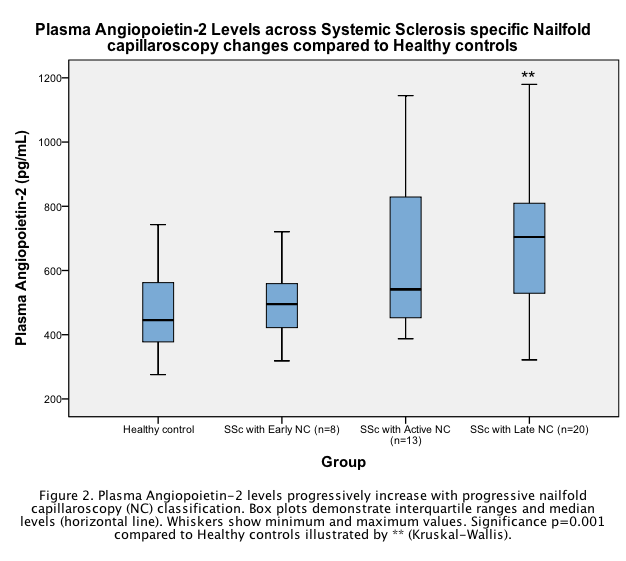
Ang2 was significantly increased in SSc compared to HC (Figure 1). There was no significant difference in Ang1 or soluble Tie2, however Ang1/2 ratio was significantly reduced in SSc compared to HC (median 4.4 versus 6.2, p=0.018). In SSc, Ang2 demonstrated a weak negative correlation with the post-occlusive reperfusion gradient on LSCI and a weak positive correlation with inter-capillary distance (Table 1), suggesting an association between impaired functional and structural microangiopathy and increased Ang2. Ang2 progressively increased with progressive NC qualitative classification (early, active and late, Figure 2). Interestingly, Ang2 also correlated weakly with Echogenicity and Shear wave Elastography on HFUS, suggesting an association with skin fibrosis. Ang1 had a weak positive correlation with Echogenicity only suggesting that as the oedematous phase of SSc skin disease resolves, Ang1 increases. The lack of significant correlation between Ang1 and Elastography suggests there is no clear association with fibrosis (Table 1).
Conclusion:
Our findings suggest that Ang2 may reflect anti-angiogenic and pro-fibrotic mechanisms in SSc. Further study is warranted to explore the relative expression of Angiopoietins in well phenotyped SSc patients and evaluate their role as novel biomarkers.

To cite this abstract in AMA style:
Flower V, Barratt S, Hart D, MacKenzie A, Shipley J, Ward S, Pauling J. Increased Plasma Angiopoietin-2 in Systemic Sclerosis: Potential for Use As a Biomarker of Vasculopathy and Fibrosis [abstract]. Arthritis Rheumatol. 2018; 70 (suppl 9). https://acrabstracts.org/abstract/increased-plasma-angiopoietin-2-in-systemic-sclerosis-potential-for-use-as-a-biomarker-of-vasculopathy-and-fibrosis/. Accessed .« Back to 2018 ACR/ARHP Annual Meeting
ACR Meeting Abstracts - https://acrabstracts.org/abstract/increased-plasma-angiopoietin-2-in-systemic-sclerosis-potential-for-use-as-a-biomarker-of-vasculopathy-and-fibrosis/