
Session Information
Date: Sunday, November 7, 2021
Title: Metabolic & Crystal Arthropathies – Basic & Clinical Science Poster I (0660–0682)
Session Type: Poster Session B
Session Time: 8:30AM-10:30AM
Background/Purpose: Recurrent gout flares are the most crucial outcome in studies of gout treatment. However, gout flares is challenging to identify in a large population because it is episodic with limited data to distinguish encounters for a gout flare vs routine follow-up for gout. The objective of this study was to determine whether integrating information extracted from the narrative notes from the electronic health record (EHR) data using natural language processing (NLP) can improve the efficiency for identifying gout glares over claims data alone.
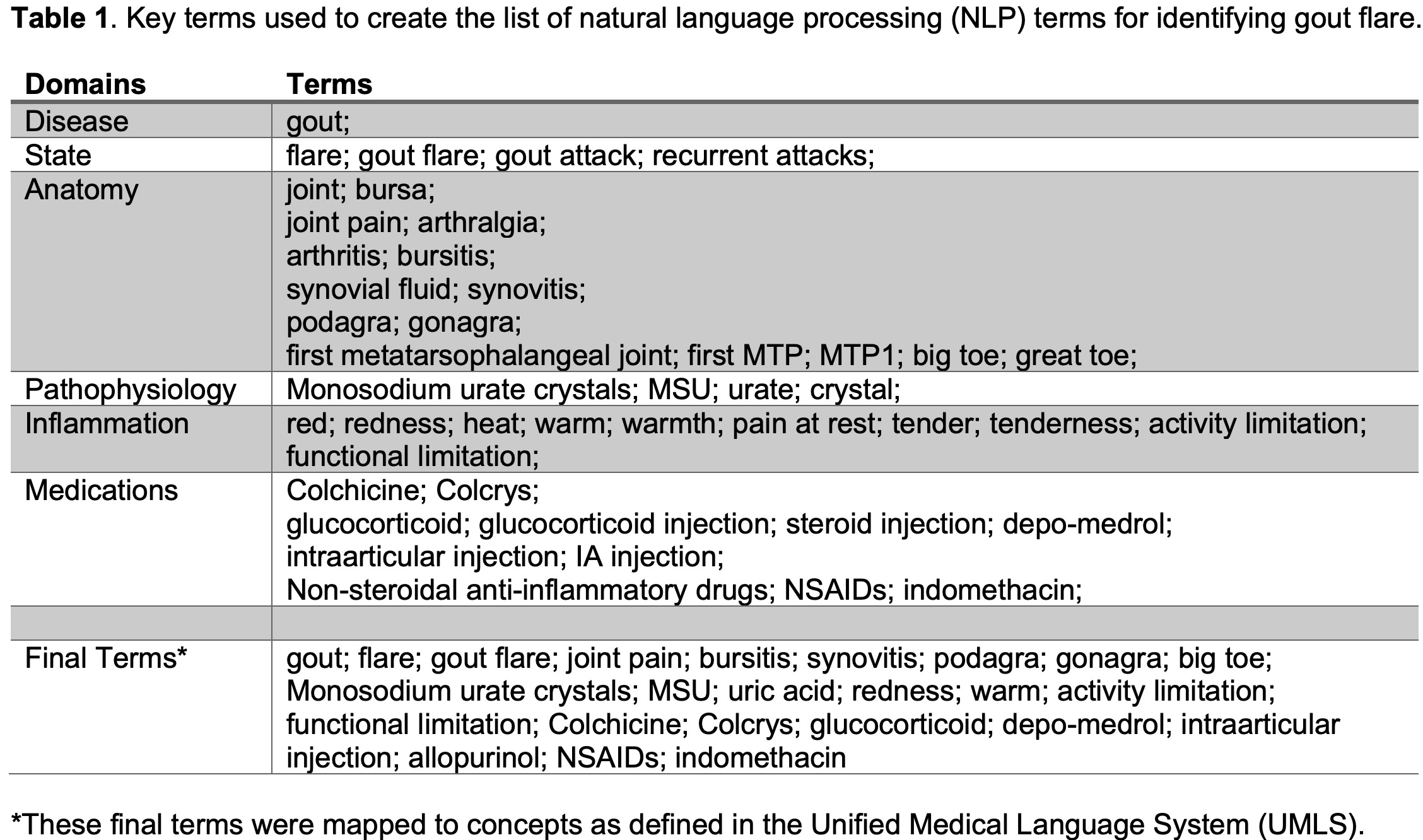
Methods: The study population was defined by first linking Medicare claims data (2007-16) with EHR data from two tertiary care centers. Subjects with age≥65, ≥1 gout ICD9/10 code, and initiated the urate-lowering therapy (ULT; allopurinol or febuxostat) were included in the study. Chart reviews were performed on a random sample of the study population to create a gold standard set of notes describing gout flare. A list of terms related to gout flare was created informed by the chart review (Table 1). Terms were further mapped to concepts as defined by the Unified Medical Language System (UMLS). Narrative notes for all subjects were processed using NLP to identify all notes containing terms/concepts related to gout flare. Claims data were also used to segment notes by time period in two ways (claims time filter): (1) identify notes within the 12-month baseline before date of ULT initiation through ULT discontinuation; (2) notes occurring in months with ≥1 ICD9/10 gout code from claims within (1). We tested whether NLP and the application of temporally based claims-based rules could improve the prevalence of notes describing gout flares compared to ICD alone.
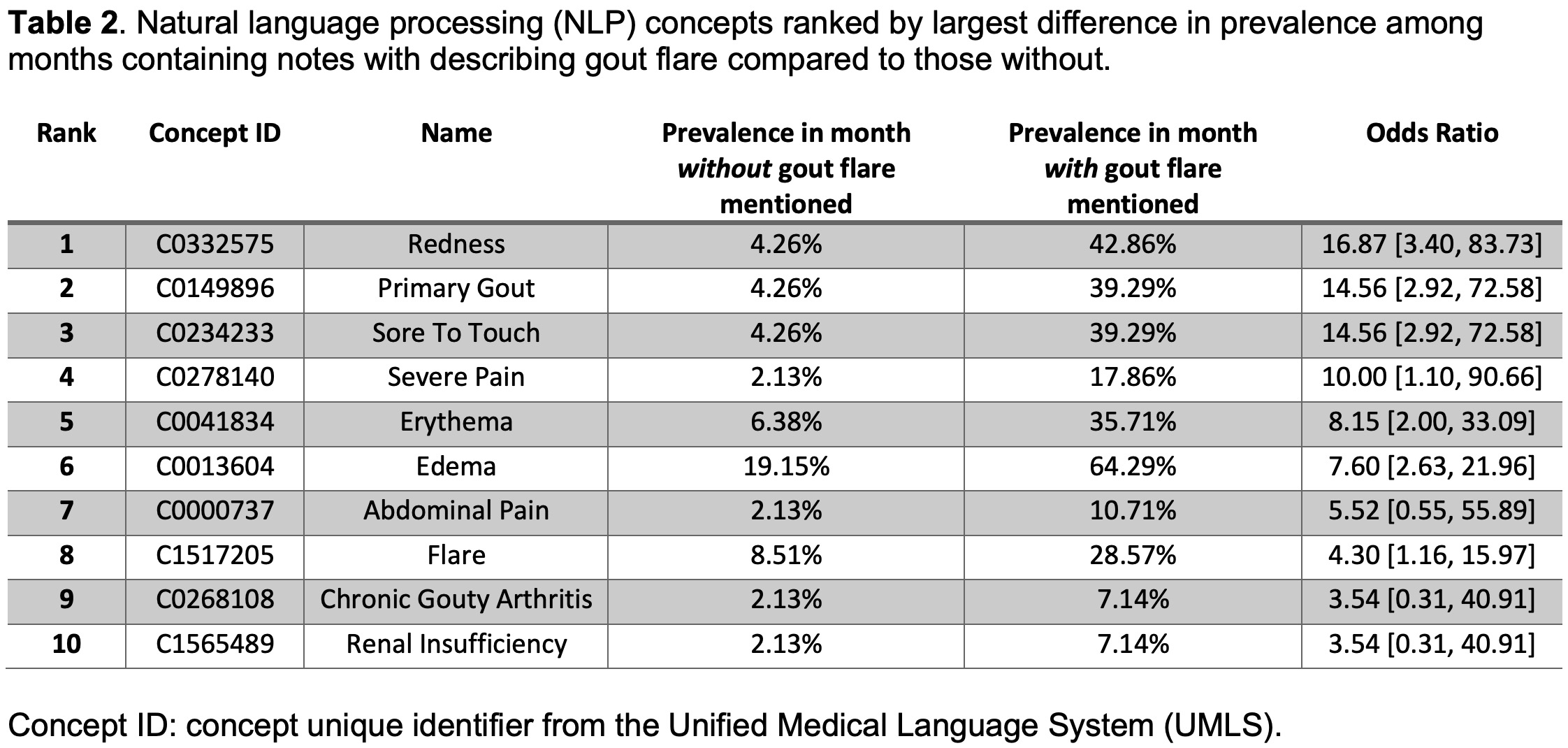
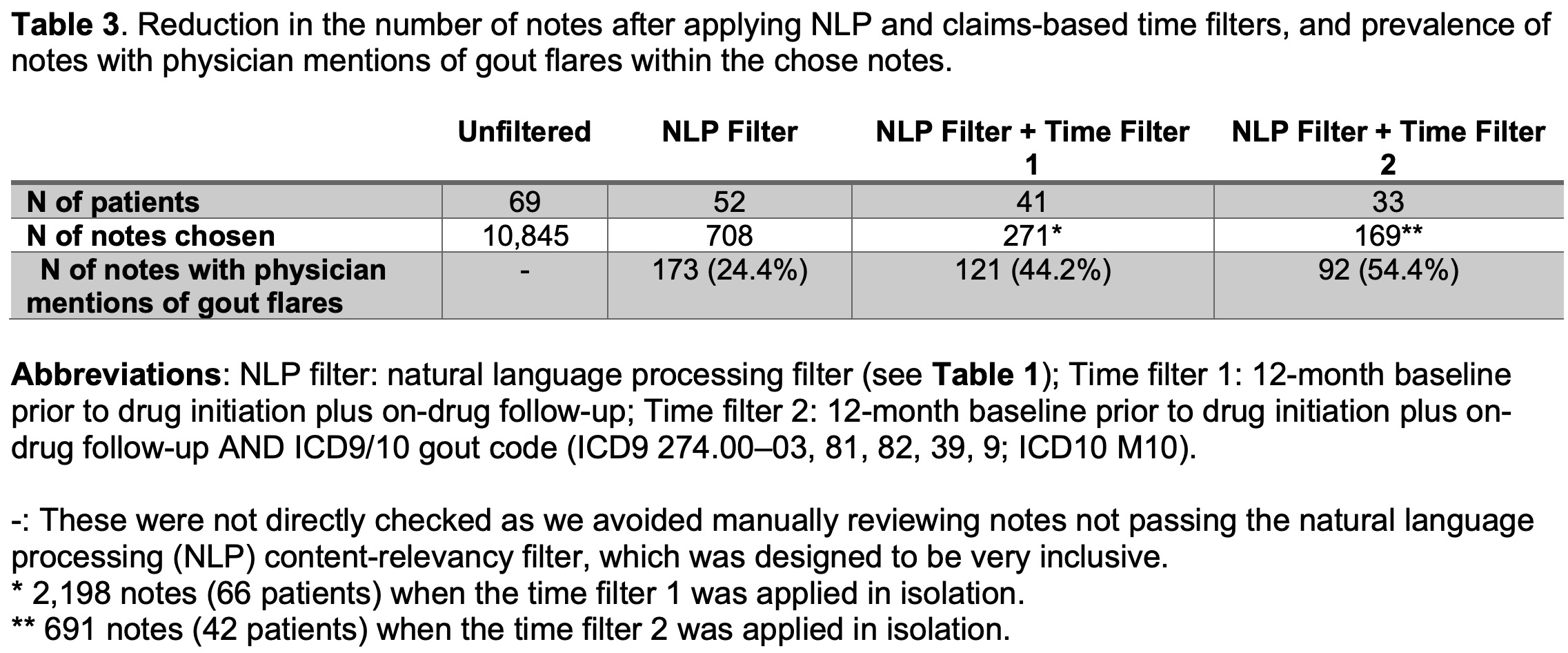
Results: A random sample of 69 patients with 10,845 notes was examined. NLP concepts representing signs and symptoms of a gout flare, e.g. redness, severe pain, differed the most among notes describing gout flares compared to those that were not (Table 2). After processing notes using NLP, 708 (6.5%) of 10,845 notes had concepts relevant to gout flare (Table 3); of the 708 notes, 24.4% described a gout flare. Applying claims time filter 1 alone to the 10,845 notes selected 2,198 (20%), of which 271 also had relevant NLP concepts. Claims time filter 2 selected 691 notes (6.4%), of which 169 also had relevant NLP concepts. Using a combination of NLP and claims time filter 2, which gave notes in months where an ICD9/10 gout code was used (nested within the 12-month baseline and during ULT use), resulted in 54% prevalence of gout flares among the selected notes.
Conclusion: Certain NLP concepts may be useful in discriminating notes describing gout flare among a population of subjects with gout on ULT therapy. The combination of NLP as well as the use of claims data with a time component, e.g., segmented by months, can assist in selecting relevant notes describing a gout flare. Together, these provide data for the development of a gout flare phenotyping algorithm with month-level precision.
To cite this abstract in AMA style:
Yoshida K, Cai T, Bessette L, Kim E, Lee S, Zabotka L, Sun A, Liu J, Solomon D, Liao K, Kim S. Improving the Gout Flare Chart Review Using Linked Claims-EHR Data [abstract]. Arthritis Rheumatol. 2021; 73 (suppl 9). https://acrabstracts.org/abstract/improving-the-gout-flare-chart-review-using-linked-claims-ehr-data/. Accessed .« Back to ACR Convergence 2021
ACR Meeting Abstracts - https://acrabstracts.org/abstract/improving-the-gout-flare-chart-review-using-linked-claims-ehr-data/