
Session Information
Date: Monday, October 22, 2018
Title: Rheumatoid Arthritis – Diagnosis, Manifestations, and Outcomes Poster II: Diagnosis and Prognosis
Session Type: ACR Poster Session B
Session Time: 9:00AM-11:00AM
Methods: Newly diagnosed patients with a clinical diagnosis of RA, ≥3 months follow-up and available data on ACPA, erosions and medication use were identified in the international, observational METEOR registry (n patients=4623). Timing and frequency of follow-up visits were non-protocolled and according to daily practice. We focussed at results after a maximum follow-up duration of 6 months or of 1 year from baseline. Associations between the presence of erosions and/or ACPA (4 groups) with the change of DAS and HAQ over time were assessed using linear mixed models. Missing data were imputed using multiple chained equations (40 cycles) and models were adjusted for the potential confounders age, gender, smoking, symptom duration, BMI, initial medication and country. In case of statistically significant effect modification (p<0.20) by country, medication group (csDMARD monotherapy, csDMARD combination therapy, csDMARD + glucocorticoid and other) or symptom duration group (<1 year, 1-2 years, 2-5 years and >5 years), results were stratified.
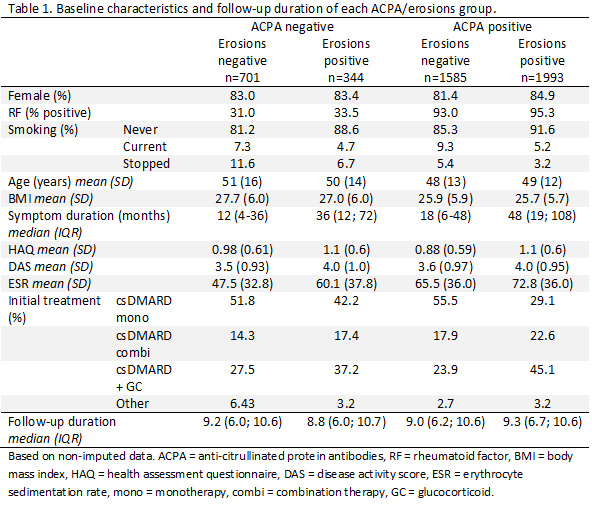
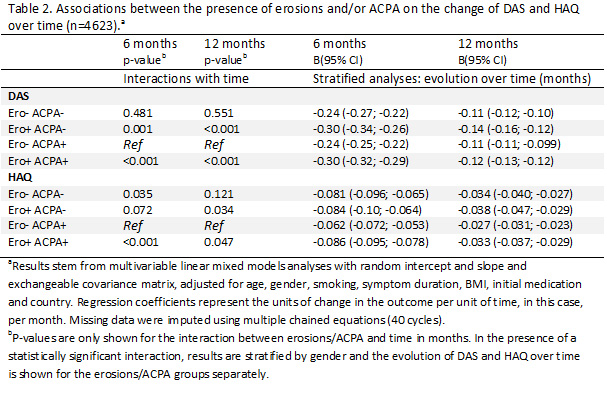
Results: Baseline characteristics and follow-up duration of each ACPA/erosions group are shown in table 1. Baseline DAS and HAQ were slightly higher in erosions+ patients. Follow-up was similar between the 4 groups. We found statistically significant differences in DAS and HAQ change over time between the 4 groups, both after maximum follow-up durations of 6 months and 1 year (table 1). The adjusted change in DAS over time was slightly larger in the erosions+ groups and the adjusted change in HAQ over time was slightly smaller in the erosions-/ACPA+ group, but differences were small and not clinically relevant. No effect modification was found by country, medication or symptom duration.
Conclusion: In this analysis of worldwide real life data, we found statistically significant, but no clinically relevant differences in treatment response to initial DMARD therapies as measured by DAS and HAQ in ACPA-/erosions-, ACPA-/erosions+, ACPA+/erosions- and ACPA+/erosions+ RA patients. Instead, all groups had a similar response to initial treatment.
Disclosure: S. A. Bergstra, Bristol-Myers Squibb, 2; M. Couto, None; N. Govind, None; A. Chopra, None; K. Salomon-Escoto, None; E. Murphy, Roche, 5,AbbVie and UCB, 9; T. W. J. Huizinga, BMS, 2,EU, 2,Arthritis Foundation, 2,IMI, 2,LUMC, 3,Abblynx, 5,Merck & Co., 5,UCB, Inc., 5,BMS, 5,Biotest AG, 5,Janssen, 5,Pfizer, Inc., 5,Novartis, 5,Roche, 5,Sanofi-Aventis, 5,Abbott, 5,Consulting Bioscience, 5,Galapagos, 5,Nycomed, 5,Boeringher, 5,Takeda, 5,Zydus, 5,Epirus, 5,Eli Lilly and Co., 5; C. F. Allaart, None.
To cite this abstract in AMA style:
Bergstra SA, Couto M, Govind N, Chopra A, Salomon-Escoto K, Murphy E, Huizinga TWJ, Allaart CF. Impact of the Joint Presence of Erosions and ACPA on Rheumatoid Arthritis Disease Activity over Time: Results from the Meteor Registry [abstract]. Arthritis Rheumatol. 2018; 70 (suppl 9). https://acrabstracts.org/abstract/impact-of-the-joint-presence-of-erosions-and-acpa-on-rheumatoid-arthritis-disease-activity-over-time-results-from-the-meteor-registry/. Accessed .« Back to 2018 ACR/ARHP Annual Meeting
ACR Meeting Abstracts - https://acrabstracts.org/abstract/impact-of-the-joint-presence-of-erosions-and-acpa-on-rheumatoid-arthritis-disease-activity-over-time-results-from-the-meteor-registry/