
Session Information
Session Type: Poster Session D
Session Time: 1:00PM-3:00PM
Background/Purpose: Psoriatic arthritis (PsA) is a progressive condition with chronic inflammation and joint destruction impacting quality of life.1 Dactylitis and enthesitis are clinically relevant domains of PsA and identifiable upon clinical examination.2 Risankizumab (RZB) is a humanized immunoglobulin G1 monoclonal antibody that specifically inhibits IL-23 by binding to its p19 subunit.1,3 The efficacy of RZB to achieve resolution of enthesitis and dactylitis was demonstrated in patients who had an inadequate response or intolerance to ≥ 1 conventional synthetic disease-modifying antirheumatic drug (KEEPsAKE 1 and 2) and/or ≤ 2 biological therapies (KEEPsAKE 2).1,3 Here, we evaluated complete resolution of enthesitis, complete resolution of dactylitis, or composite resolution of both manifestations in patients with active PsA.
Methods: Study design and primary results of KEEPsAKE 1 (NCT03675308) and KEEPsAKE 2 (NCT03671148) have been previously reported.1,3 Briefly, patients were randomized to receive RZB 150 mg or placebo (PBO) subcutaneously at weeks 0, 4, and 16; starting at week 24, all patients received open-label RZB 150 mg. Patients with enthesitis (Leeds Enthesitis Index [LEI] > 0), dactylitis (Leeds Dactylitis Index [LDI] > 0), or both manifestations (LEI and LDI > 0) at baseline were included in this integrated post hoc analysis. The proportion of patients achieving resolution of enthesitis (LEI = 0), dactylitis (LDI = 0), or both (LEI and LDI = 0) at weeks 24 and 52 and median time to resolution were evaluated.
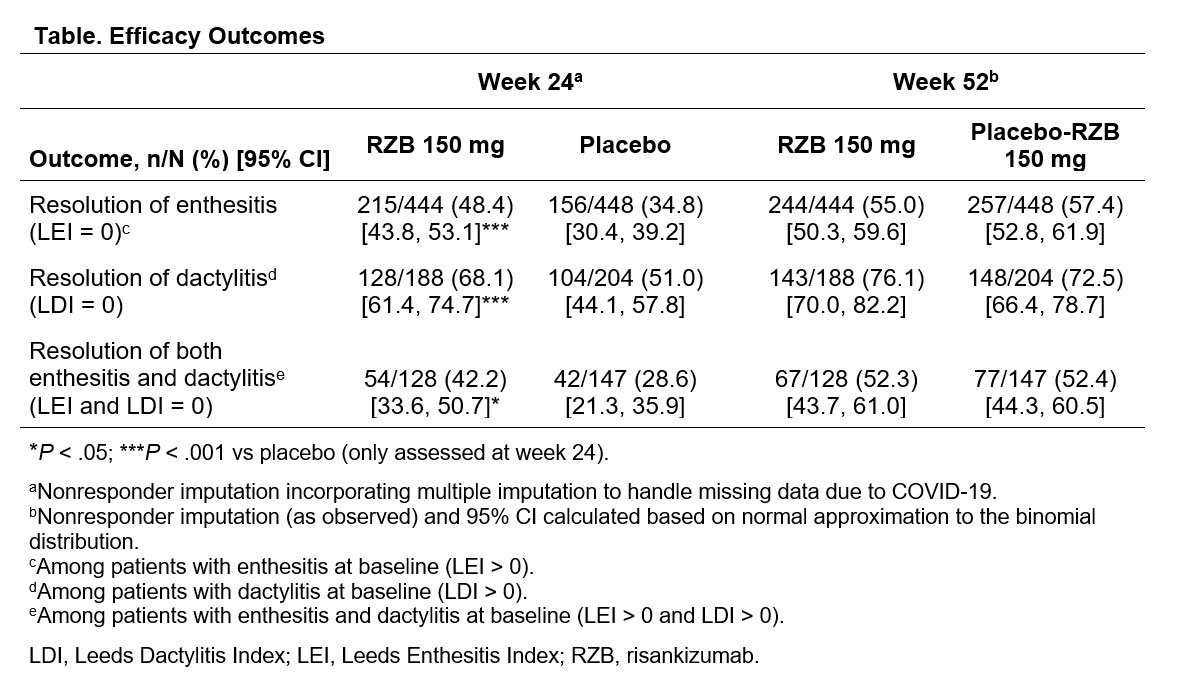
Results: Of the 1407 patients evaluated, approximately 63%, 28%, and 20% of patients had enthesitis, dactylitis, and both enthesitis/dactylitis at baseline, respectively. The proportion of patients achieving resolution of enthesitis (LEI = 0), dactylitis (LDI = 0), and both enthesitis/dactylitis (LEI and LDI = 0) are described in the Table. At week 24, higher response rates were observed for RZB vs PBO for resolution of enthesitis (LEI = 0), dactylitis (LDI = 0), and both enthesitis and dactylitis (LEI and LDI = 0) (differences of 13.9% [P < .001], 16.9% [P < .001], and 13.3% [P < .05], respectively). Median (95% CI) time to first resolution of enthesitis (LEI = 0) was shorter (hazard ratio [HR] = 1.2; P < .05) for RZB (23 [16–24] weeks) vs PBO (24 [17–24] weeks). Median (95% CI) time to first resolution of dactylitis (LDI = 0) was also shorter (HR = 1.4; P < .01) for RZB (12 [12–13] weeks) vs PBO (16 [13–17] weeks). At week 52, 55% of patients treated with RZB achieved enthesitis resolution (LEI = 0), 76.1% achieved dactylitis resolution (LDI = 0), and 52.3% achieved resolution of both enthesitis and dactylitis (LEI and LDI = 0).
Conclusion: Treatment with RZB resulted in a higher proportion of patients achieving resolution of enthesitis, dactylitis, or both manifestations compared with PBO at week 24. The improvements noted in these PsA domains were maintained through week 52 with continued RZB treatment.
References
- Kristensen LE, et al. Ann Rheum Dis. 2021;81(2):225–231.
- Bagel J and Schwartzman S. Am J Clin Dermatol. 2018;19:839–852.
- Östör A, et al. Ann Rheum Dis. 2022;81(3):351–358.
To cite this abstract in AMA style:
Kwatra S, Khattri S, Amin A, Photowala H, Liu R, Padilla B, Kaplan B, McGonagle D. Impact of Risankizumab on Enthesitis and Dactylitis: Integrated Analysis of the Phase 3, Randomized, Double-Blind KEEPsAKE 1 and 2 Trials [abstract]. Arthritis Rheumatol. 2022; 74 (suppl 9). https://acrabstracts.org/abstract/impact-of-risankizumab-on-enthesitis-and-dactylitis-integrated-analysis-of-the-phase-3-randomized-double-blind-keepsake-1-and-2-trials/. Accessed .« Back to ACR Convergence 2022
ACR Meeting Abstracts - https://acrabstracts.org/abstract/impact-of-risankizumab-on-enthesitis-and-dactylitis-integrated-analysis-of-the-phase-3-randomized-double-blind-keepsake-1-and-2-trials/