
Session Information
Date: Tuesday, November 14, 2023
Title: (1895–1912) Measures & Measurement of Healthcare Quality Poster II
Session Type: Poster Session C
Session Time: 9:00AM-11:00AM
Background/Purpose: Given the progressive joint damage and physical disability associated with uncontrolled Rheumatoid arthritis (RA), a treat-to target-strategy through the early utilization of disease-modifying antirheumatic drugs (DMARD) provides patients with the best opportunity to control their disease earlier. Biologic and targeted DMARDs are specialty medications, and while there is not a single defining aspect of specialty medications, most are high cost and involve complexity in storage requirements, handling and delivery, patient management and manufacturer restrictions. While specialty medications have brought successful treatment options to diseases that previously had limited options, they have also made the prior authorization system increasingly complex, often leading to a delay in treatment. Pharmacist-led specialty medication approval programs, such as Specialty Medication Services (SMS), complete prior authorizations, appeals, and aid in financial assistance for specialty medications. This study will examine the impact of a pharmacist-led SMS on time-to-dispense for DMARDs in patients with Rheumatoid Arthritis. The primary endpoint of this study will be to compare time-to-dispense for DMARDs before and after implementation of specialty medication services.
Methods: This study was conducted in a retrospective cohort manner, evaluating the time-to-dispense of specialty rheumatologic medications before and after implementation of SMS. Data was generated from the electronic medical record (EMR).Therapy initiation orders entered through the EMR for any of the included specialty medications prescribed by Rheumatology for the same 6-month period in April 2016- October 2016 (control group, pre-SMS), compared to April 2019-October 2019 (study group, post-SMS). Each patient’s EMR was reviewed to collect information on dispensing pharmacy, prior authorization, indication for treatment, and if financial assistance was needed. A total of 100 patients were included in the study, 50 of whom underwent medication approval prior to the implementation of SMS (2016), and 50 of whom underwent medication approval after implementation of SMS (2019).
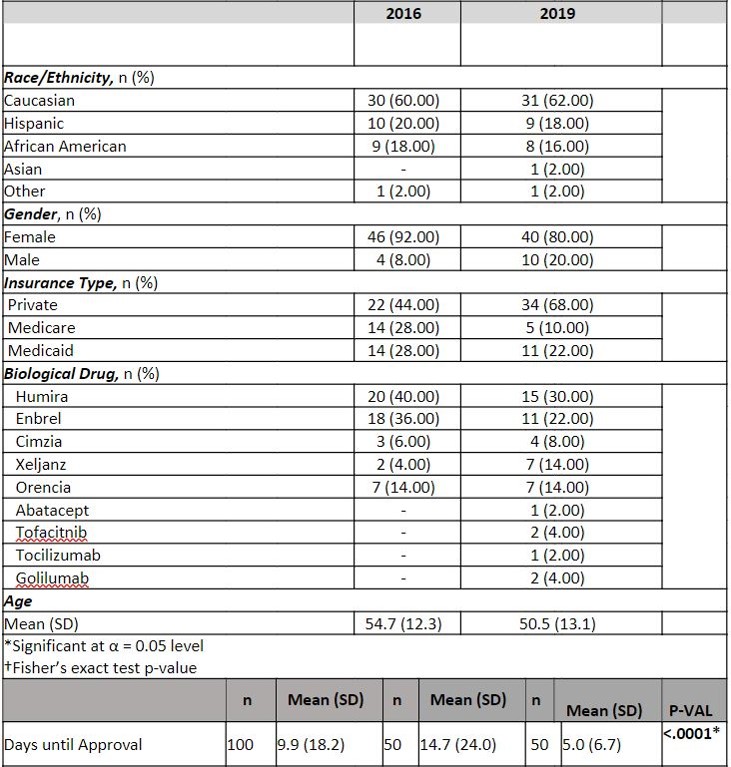
Results: Among the pre-SMS implementation group (2016), the mean time-to-dispense- was 14.7 days (SD +/- 24 days), while mean time-to-medication dispense for the post-SMS establishment group (2019) was 5 days (+/- 6.7 days). There is a statistically significant difference in days until medication dispensed (p< 0.001) for 2016 versus 2019. The two groups demographics and insurance carriers were comparable, though more patients had private insurance in the 2019 group (68%), as compared to the 2016 group (44%, Table 1)
Conclusion: This study shows that the implementation of Pharmacist-led specialty medication approval programs, such as Specialty Medication Services, significantly reduced the number of days until specialty medications were dispensed in a university health system. While there is a difference in the average time to dispense with the utilization of Specialty Medication Services, further studies are needed to determine the impact of early medication approval and dispensing and how this corresponds to patient clinical outcomes.
To cite this abstract in AMA style:
Ahmadmehrabi K, Ravishankar N, Mekhiel D, Aouhab Z. Impact of Pharmacist-Led Specialty Medication Management Service on Time-to-Dispense for Specialty Rheumatologic Medications in a University Health System [abstract]. Arthritis Rheumatol. 2023; 75 (suppl 9). https://acrabstracts.org/abstract/impact-of-pharmacist-led-specialty-medication-management-service-on-time-to-dispense-for-specialty-rheumatologic-medications-in-a-university-health-system/. Accessed .« Back to ACR Convergence 2023
ACR Meeting Abstracts - https://acrabstracts.org/abstract/impact-of-pharmacist-led-specialty-medication-management-service-on-time-to-dispense-for-specialty-rheumatologic-medications-in-a-university-health-system/