
Session Information
Date: Sunday, October 26, 2025
Title: (0387–0429) Pediatric Rheumatology – Clinical Poster I
Session Type: Poster Session A
Session Time: 10:30AM-12:30PM
Background/Purpose: Cardiovascular disease remains the leading cause of mortality in patients with Rheumatoid Arthritis (RA). Normally, high density lipoprotein (HDL) acts in a cardioprotective capacity through various anti-inflammatory and anti-oxidative functions. Research has shown that the antiinflammatory capacity of HDL is impaired in states of chronic inflammation, such as RA. Abnormal lipid profiles have been described in patients with JIA, however, qualitative studies on HDL in this population are lacking. We aim to investigate if the antiinflammatory function of HDL is impaired in JIA patients as compared to healthy controls. We also aim to investigate if HDL dysfunction correlates with JIA subtype and disease activity.
Methods: We performed a cross-sectional study on 30 patients with JIA and 15 controls between 9 and 17 years of age. Disease activity was assessed based on the juvenile arthritis disease activity score (JADAS-10) and the childhood health assessment questionnaire (CHAQ). HDL’s antiinflammatory function (HII) was measured using a cell-free assay assessing the ability of the patient’s HDL to inhibit oxidation of low-density lipoprotein. Circulating oxidized biproducts of arachidonic and linoleic acid were measured by liquid chromatography-electrospray ionization, tandem mass spectroscopy. HDL-associated apoprotein A-1 (ApoA1) levels were measured by sandwich ELISA. Levels and activity of HDL associated antioxidant enzymes PON-1 (paraoxonase, arylesterase and lactonase) were quantified using spectrophotometry.
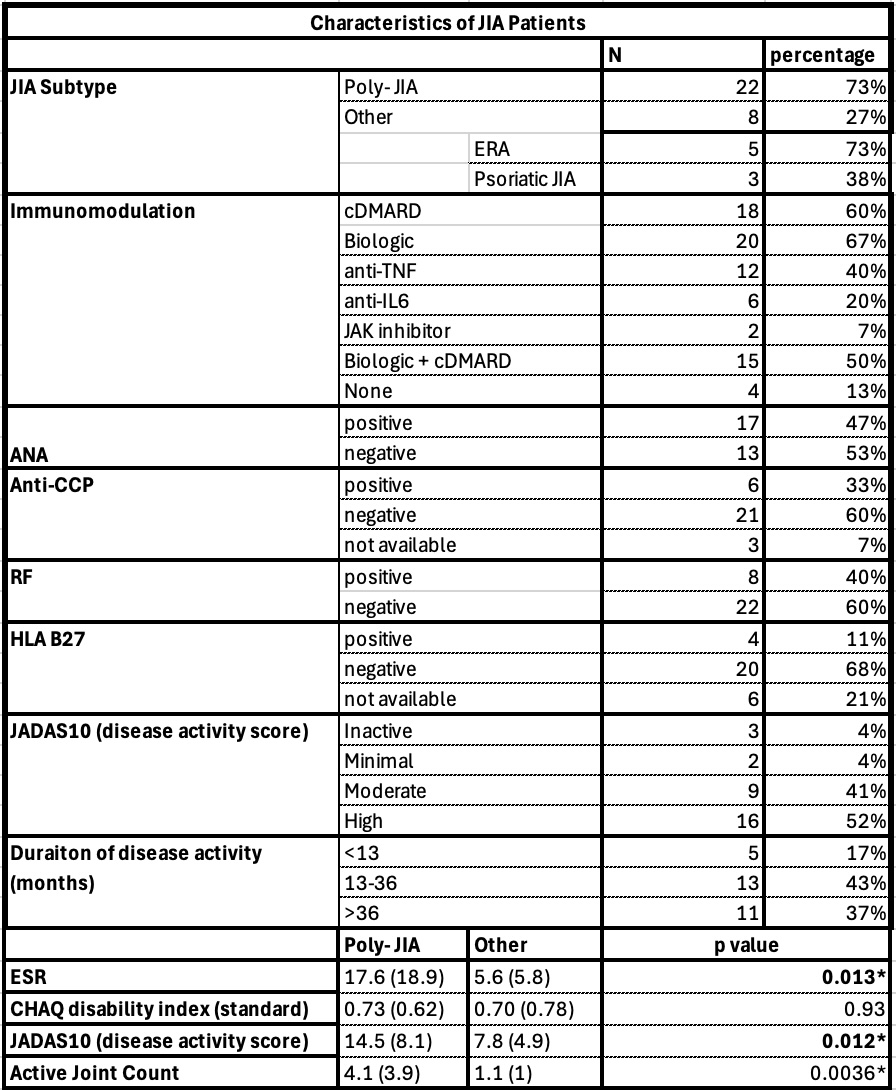
Results: Total HDL and total cholesterol were not significantly different between cases and controls. Joint count in the 22 patients with poly-JIA was higher than the 8 patients with other subtypes of JIA (63% ERA, 38% psoriatic JIA) [mean (s.d.)] (4.5 (4.3), 1.1 (1), p=0.002). ESR was significantly higher in the poly JIA group (17 (19), 6 (6), p=0.022). The HII was higher JIA subtypes associated with spondyloarthropathy as compared to poly-JIA and controls (p=0.0447, p=0.0179). HDL concentration correlated significantly with the HII (rs= -0.63, p= 0.0003) in all JIA patients and correlated with disease activity. Several circulating bioactive lipid mediators were significantly higher in JIA patients compared with controls with 9HODE,15HODE and 11HETE showing positive correlation with the HII (rs = 0.36-0.44, p= 0.05-0.02). Arylesterase and Lactonase activity negatively correlated with joint count (rs= -0.41, p=0.026; rs=-0.38, p=0.041) and ESR (rs=-0.40, p=0.027; rs=-0.41, p= 0.023) respectively in all JIA patients.
Conclusion: This pilot study demonstrates that chronic inflammation in patients with JIA may contribute to HDL dysfunction, particularly in patients with axial involvement. Larger cohort studies are needed to further characterize patients with axial disease as well as aide in our understanding of how PON-1 changes over time in children with chronic inflammation.


To cite this abstract in AMA style:
Spoden T, Nazzar Romero S, McCurdy D, Hoftman A, Bae S, Wang J, Shahbazian A, Charles-Schoeman C. High Density Lipoprotein Dysfunction in Juvenile Idiopathic Arthritis as Compared to Children without Rheumatologic Disease [abstract]. Arthritis Rheumatol. 2025; 77 (suppl 9). https://acrabstracts.org/abstract/high-density-lipoprotein-dysfunction-in-juvenile-idiopathic-arthritis-as-compared-to-children-without-rheumatologic-disease/. Accessed .ACR Meeting Abstracts - https://acrabstracts.org/abstract/high-density-lipoprotein-dysfunction-in-juvenile-idiopathic-arthritis-as-compared-to-children-without-rheumatologic-disease/