
Session Information
Session Type: Poster Session B
Session Time: 10:30AM-12:30PM
Background/Purpose: Systemic lupus erythematosus (SLE) has a complex etiology with genetic predispositions interacting with environmental factors. Extensive environmental exposure information is now publicly available based on geocode. This study examined the relationship between the residential locations of SLE patients participating in the Oklahoma Cohort of Rheumatic Diseases and geocode-specific information about environmental and lifestyle exposures.
Methods: SLE prevalence rates were calculated for female SLE patients in the Oklahoma Cohort of Rheumatic Disease (OCRD) by county (n=689). Geographic and lifestyle exposure data were sourced from the 2020 County Health Rankings and the 2020 National Environmental Public Health Tracking Network. Explanatory variables explored included the percentage of smokers, percentage of high school graduates, percentage of rural residents, PM2.5 (atmospheric particulate matter < 2.5 um in diameter), primary care physicians per 100,000 population, silica sites, superfund sites, percentage of uninsured adults, and solar irradiance (kJ/m2). Spatial autocorrelation was assessed using a Moran’s I test, which was insignificant (p=0.7205). Therefore, a multiple linear regression model was used to analyze the explanatory variables with SLE rates, and the model with the lowest AIC was chosen. Log transformations were applied to variables exhibiting a right skewness.
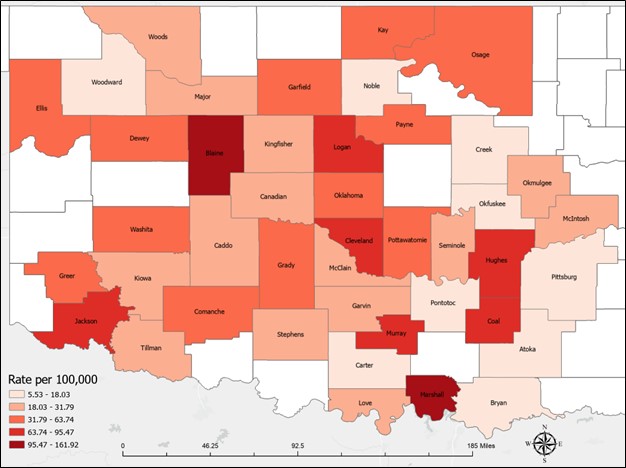
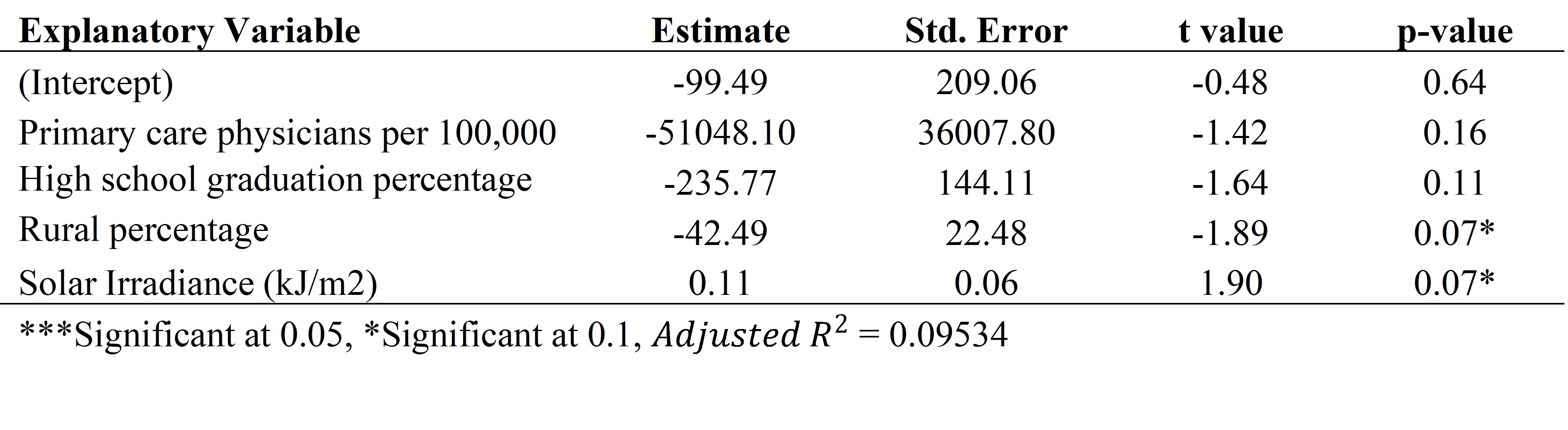
Results: The OCRD includes between 1 and 161 per 100,000 individuals from each of 44 counties in Oklahoma (Figure 1). No associations between county-specific environmental exposures and numbers of female SLE patients in the cohort were observed. However, percentages of high school graduates and the percentage of rural residents were negatively associated and solar irradiance was positively associated with numbers of SLE patients in the cohort (Table 1).
Conclusion: Environmental and lifestyle exposures do not seem to affect membership of female SLE patients in the Oklahoma Cohort of Rheumatic Diseases. The cohort is drawing greater numbers of SLE patients from counties with fewer high school graduates, less rural population and a higher UV index. The study is limited in that it is not an incidence or prevalence calculation for SLE, although factors affecting cohort membership, other than distance, may be similar throughout Oklahoma. Further direct comparison of individuals identified from relevant counties may help to determine whether exposure variables are associated with disease severity or cumulative disease activity.
To cite this abstract in AMA style:
Reed Z, Campbell J, Howard X, Aberle T, Parrish B, DeJager W, Arriens C, Merrill J, James J. Geographic and Lifestyle Exposures in Systemic Lupus Erythematosus [abstract]. Arthritis Rheumatol. 2024; 76 (suppl 9). https://acrabstracts.org/abstract/geographic-and-lifestyle-exposures-in-systemic-lupus-erythematosus/. Accessed .« Back to ACR Convergence 2024
ACR Meeting Abstracts - https://acrabstracts.org/abstract/geographic-and-lifestyle-exposures-in-systemic-lupus-erythematosus/