
Session Information
Session Type: Poster Session B
Session Time: 10:30AM-12:30PM
Background/Purpose: Previous studies have shown that female patients with spondyloarthritis (SpA) tend to experience a greater impact on their functionality, especially among women in Latin America. It has also been reported that despite this higher burden, women tend to receive less intensive treatment. The reasons for these disparities have not been fully determined. This study aims to characterize gender disparities in patients with spondyloarthritis in a Latin American country regarding their clinical characteristics, disease burden, and treatment.
Methods: A cross-sectional online survey was conducted among patients with SpA, collecting demographic data, clinical characteristics, disease burden measures (Global Impact in the last Week, BASDAI, BASFI, the Work Productivity and Activity Impairment – General Health Questionnaire, ASAS HI), suspected comorbidity with fibromyalgia (using the FiRST tool), and treatment information. Comparisons between gender groups and treatment groups in women were performed using Chi-square tests for categorical variables, Fisher’s exact test for dichotomous variables, and the Mann-Whitney test for continuous variables after demonstrating non-normal distribution of the data with Kolmogorov-Smirnov and Shapiro-Wilks tests. Analysis was performed using SPSS version 26, considering statistical significance with p-values ≤0.05 and a confidence interval of 95%.
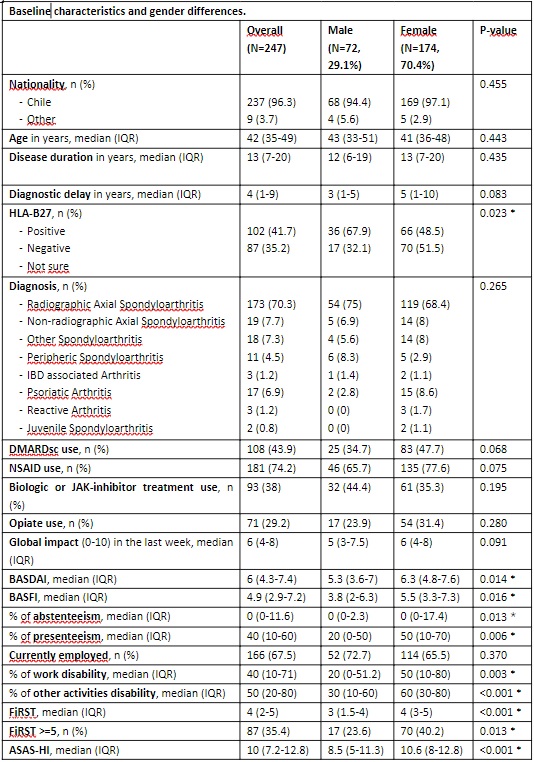
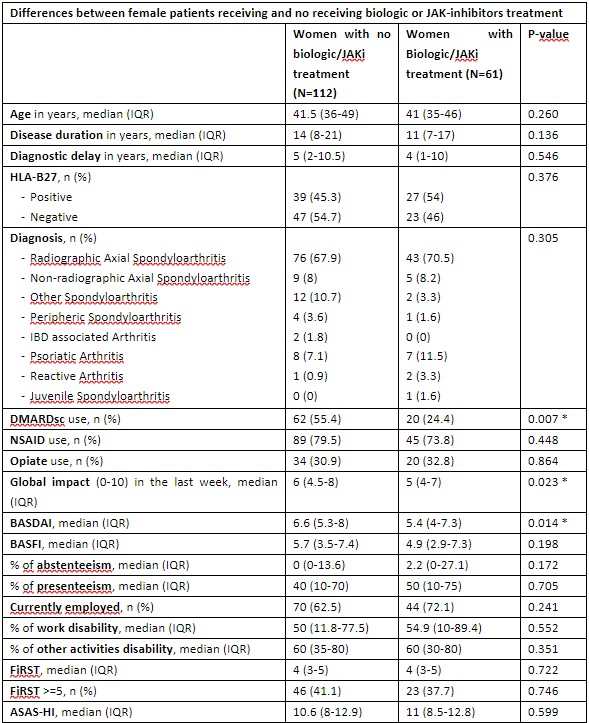
Results: A total of 247 patients responded to the survey, with a predominance of female participants (70.4%). Demographic and clinical characteristics were similar between male and female patients, except for a higher HLA-B27 positivity in men (p=0.023). Women reported a higher impact of the disease in their lives, with significantly higher BASDAI and BASFI scores, absenteeism, presenteeism, work, and general disability (p< 0.05). Female patients also scored higher on the FiRST tool (p=0.013) and had a significantly higher proportion of scores ≥5 points (p< 0.001), suggesting a higher comorbidity with fibromyalgia (Table 1). Women receiving biologics or JAK inhibitors showed a lower disease impact and reduced need for synthetic DMARDs and NSAIDs (table 2). Although there were no significant differences in therapy by gender, it is notable that despite this higher burden and better results with these treatments, there was a tendency to prescribe fewer biologics and JAK inhibitors to women (35.3% versus 44.4% in men).
Conclusion: Consistent with previous reports, this study showed that female patients with SpA tend to suffer from a higher disease impact. Those treated with biologics or JAK inhibitors showed improved outcomes. Despite these findings, women tend to receive these treatments less frequently. A possible explanation for this could be the higher comorbidity with fibromyalgia observed in our population, leading clinicians to over-attribute symptoms, in addition to factors such as inequality in treatment access regardless of equal employability.
To cite this abstract in AMA style:
Ibáñez S, García M, González N. Gender Disparities in Disease Impact and Treatment Access for Spondyloarthropathies in Latin America: Insights from a Web Survey [abstract]. Arthritis Rheumatol. 2024; 76 (suppl 9). https://acrabstracts.org/abstract/gender-disparities-in-disease-impact-and-treatment-access-for-spondyloarthropathies-in-latin-america-insights-from-a-web-survey/. Accessed .« Back to ACR Convergence 2024
ACR Meeting Abstracts - https://acrabstracts.org/abstract/gender-disparities-in-disease-impact-and-treatment-access-for-spondyloarthropathies-in-latin-america-insights-from-a-web-survey/