
Session Information
Date: Monday, November 14, 2016
Title: Education - ARHP Poster
Session Type: ACR Poster Session B
Session Time: 9:00AM-11:00AM
Background/Purpose: Premature mortality rates in individuals with rheumatoid arthritis (RA) are significantly higher in current smokers compared to those who have never smoked, making smoking cessation an important consideration in RA management. The aim of this study was to determine which aspects of a novel three-month RA smoking cessation intervention were most useful and to identify areas for improvement.
Methods: Thirty-eight current smokers (19 intervention and 19 control) with RA were enrolled in a pilot randomized controlled trial involving a novel three-month psychosocial smoking cessation intervention delivered by two community based Arthritis Educators. Nicotine replacement therapy (NRT) was offered to all participants as usual care regardless of randomization. Despite no significant difference in smoking cessation rates (26% intervention vs 21% control; p=0.70), there was a high quitting rate among all participants. Here we examine the efficacy through interviews with the participants and Arthritis Educators, using a mixed qualitative methodology. There were three sources of data: 1) interview notes from contacts between the Educators and 19 intervention participants during the smoking cessation intervention; 2) interview notes from the two follow-up interviews at three and six months post-randomization between the researcher and all study participants; and 3) exit interviews between the researcher and the two Educators. Interview data was analyzed thematically using a combination of deductive and inductive approaches to identify themes.
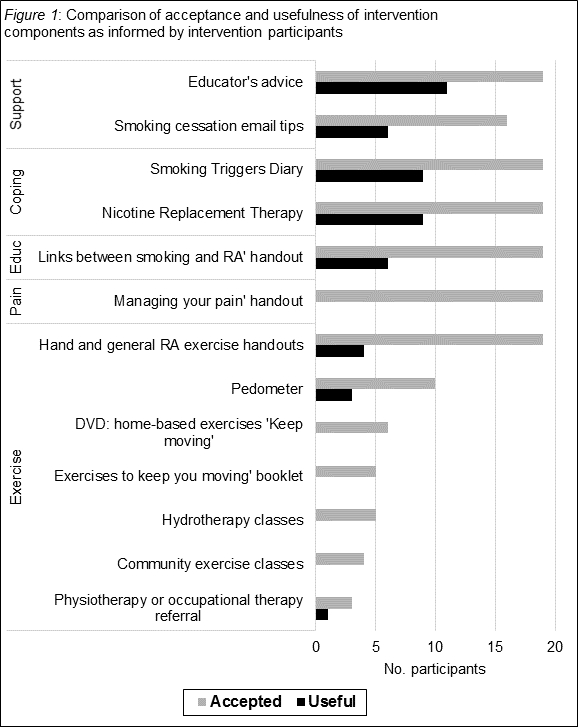
Results: Sixteen intervention and 19 control participants completed the six month follow-up. Support was individualized for each participant and their support choices were monitored by the Educators. A comparison between the acceptance and usefulness of individual intervention components as informed by the participants who accepted each component is shown in Figure 1. The individualized support and advice from the Educators were the key intervention components most valued by the participants and the Educators alike. This was followed by the generic smoking cessation components and education about the links between smoking and RA. The use of NRT as a common treatment to both intervention and control groups was the most commonly reported facilitator of smoking cessation. Participants who identified as being ready to quit smoking had more success at smoking cessation. The Educators were positive about ongoing provision of the smoking cessation intervention with minor changes.
Conclusion: This research highlights the strategies that can be focused on for improving smoking cessation rates in people with RA. Successful quitters were ready and motivated to quit smoking regardless of their randomization status. Support offered by the Educators was critical from the viewpoint of participants who received the intervention.
To cite this abstract in AMA style:
Aimer P, Stamp LK, Stebbings S, Cameron V, Kirby S, Treharne G. Exploring Perceptions of a Rheumatoid Arthritis Specific Smoking Cessation Programme [abstract]. Arthritis Rheumatol. 2016; 68 (suppl 10). https://acrabstracts.org/abstract/exploring-perceptions-of-a-rheumatoid-arthritis-specific-smoking-cessation-programme/. Accessed .« Back to 2016 ACR/ARHP Annual Meeting
ACR Meeting Abstracts - https://acrabstracts.org/abstract/exploring-perceptions-of-a-rheumatoid-arthritis-specific-smoking-cessation-programme/