
Session Information
Session Type: ACR Poster Session C
Session Time: 9:00AM-11:00AM
Background/Purpose: Physical activity guidelines for adults stipulate at least 150 minutes/week moderate-to-vigorous (MV) intensity physical activity acquired in bouts lasting 10 minutes or more (MV-bout). But, 2 in 5 adults with lower-extremity conditions not only fail to meet guidelines, they are physically inactive, not performing a single 10 minute MV-bout session of MV activity in a week. The objective of this study is to identify evidence-based thresholds related to improved low function or sustained high function (improved/high) among adults with lower limb joint symptoms.
Methods: Adults with symptomatic (pain/aching/stiffness) lower extremity joints from an Osteoarthritis Initiative accelerometer substudy had gait speed (n=1476) and self-reported SF-12 physical component score (PCS) function (n=1629) assessed two years apart. Year2 function compared to baseline assessed as improving to a better or remaining in the best (i.e., maintaining high) 2-year function quintile. Alternative physical activity metrics (sedentary, light intensity activity, total MV activity, and non-sedentary minutes/week) were evaluated against the legacy MV-bout metric to predict improved/high function using the area under the receiver operating curve (AUC). Classification tree analysis identified minimum threshold levels.
Results: Two years later 34% of adults (aged 40-83) had improved/high gait speed and 38% had improved/high SF-12 PCS function. Only total weekly MV activity was a stronger significant predictor of improved/high function (greater AUC) than the legacy MV-bout metric for both gait speed and SF-12 function and the only predictor selected by classification tree analyses (Figure 1). Meeting the 45 total MV minute/week threshold increased the relative risk (RR) for improved/high function (gait speed RR 1.8, 95% CI: 1.6 to 2.1; self-reported physical function RR 1.4, 95% CI: 1.3 to 1.6) compared to less active adults. Thresholds were consistent across sex, BMI, knee OA status and age.
Conclusion: Meeting an evidence-based threshold of 45 total MV minutes/week increased the likelihood of function preservation in high functioning persons and improvement in those with functional limitations among adults having lower limb joint symptoms. This threshold is a less demanding goal than the current guidelines in two ways. First, all time spent in MV activities contributes to attaining the 45 minute goal in contrast to the legacy MV-bout threshold which is only met through activity acquired in bouts lasting at least 10 minutes. Second, 45 minutes/week may be a more feasible goal than the current 150 minutes/week minimum. This evidence-based threshold represents an intermediate goal towards achieving the current physical activity guideline for adults with lower limb symptoms. 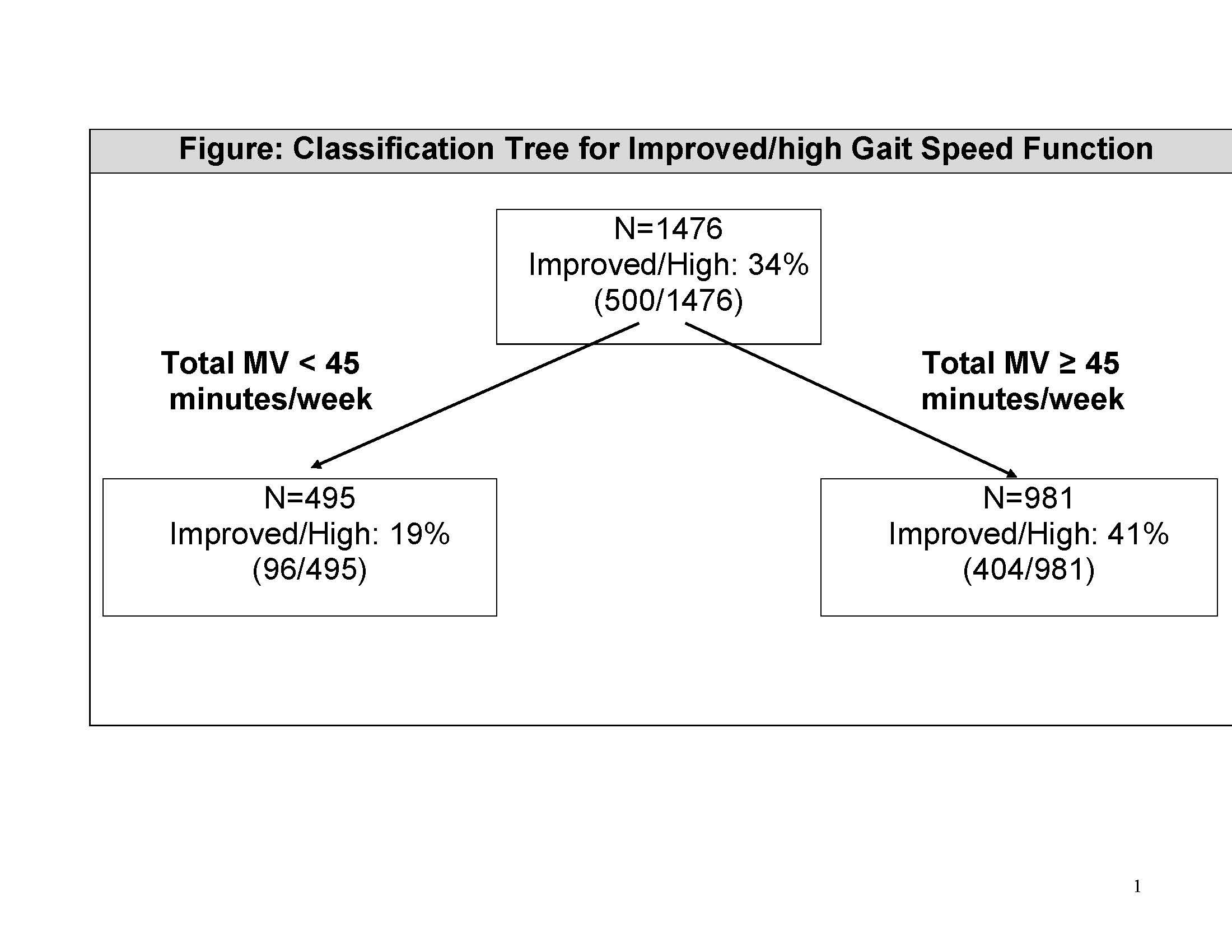
To cite this abstract in AMA style:
Song J, Lee J, Semanik P, Gilbert A, Ehrlich-Jones LS, Pellegrini C, Pinto D, Chang RW, Ainsworth B, Dunlop DD. Evidence Based Physical Activity Threshold to Predict Improved/High Function in Older Adults with Lower Extremity Conditions: The Osteoarthritis Initiative [abstract]. Arthritis Rheumatol. 2016; 68 (suppl 10). https://acrabstracts.org/abstract/evidence-based-physical-activity-threshold-to-predict-improvedhigh-function-in-older-adults-with-lower-extremity-conditions-the-osteoarthritis-initiative/. Accessed .« Back to 2016 ACR/ARHP Annual Meeting
ACR Meeting Abstracts - https://acrabstracts.org/abstract/evidence-based-physical-activity-threshold-to-predict-improvedhigh-function-in-older-adults-with-lower-extremity-conditions-the-osteoarthritis-initiative/