
Session Information
Session Type: Poster Session C
Session Time: 1:00PM-3:00PM
Background/Purpose: As the number of bariatric procedures increases, surgeons will encounter more patients on long-term immunosuppressive medications that may increase post-operative complications. Currently, there are no established society guidelines available that direct the bariatric surgeon on the optimal strategy to manage these immunosuppressive medications perioperatively while balancing the risk of flare-ups. The purpose of this project is to identify the preferred practices among bariatric surgeons for the peri-operative management of immunosuppressives.
Methods: An anonymous questionnaire was sent via an online survey to board-certified bariatric surgeons in well-established social media groups. The goal was to assess their preferences in the perioperative management of chronic immunosuppressive therapy (steroids, Disease-Modifying Antirheumatic Drugs [DMARDs], and biologics) and to ascertain the surgeons’ perception regarding the need for standardized societal guidelines. The responses were reported as percentages.
Results: There was a total of 53 total responses. 73.6% of the surgeons reported that the patient’s immunosuppressive therapy influences their decision to operate. However, only 2 individuals (3.8%) of the surveyed reported having institution-based guidelines on this with 84.3% of the surveyed surgeons reporting that they believe that standardized guidelines for perioperative management of this patient population is necessary for optimal outcomes.
The responses showed that the patient’s dose of steroids influences 84.9% of the surgeon’s decision to operate with 83% of the surveyed surgeons reporting that they would postpone surgery if the patient is on prednisone or equivalent of >15 mg/day.
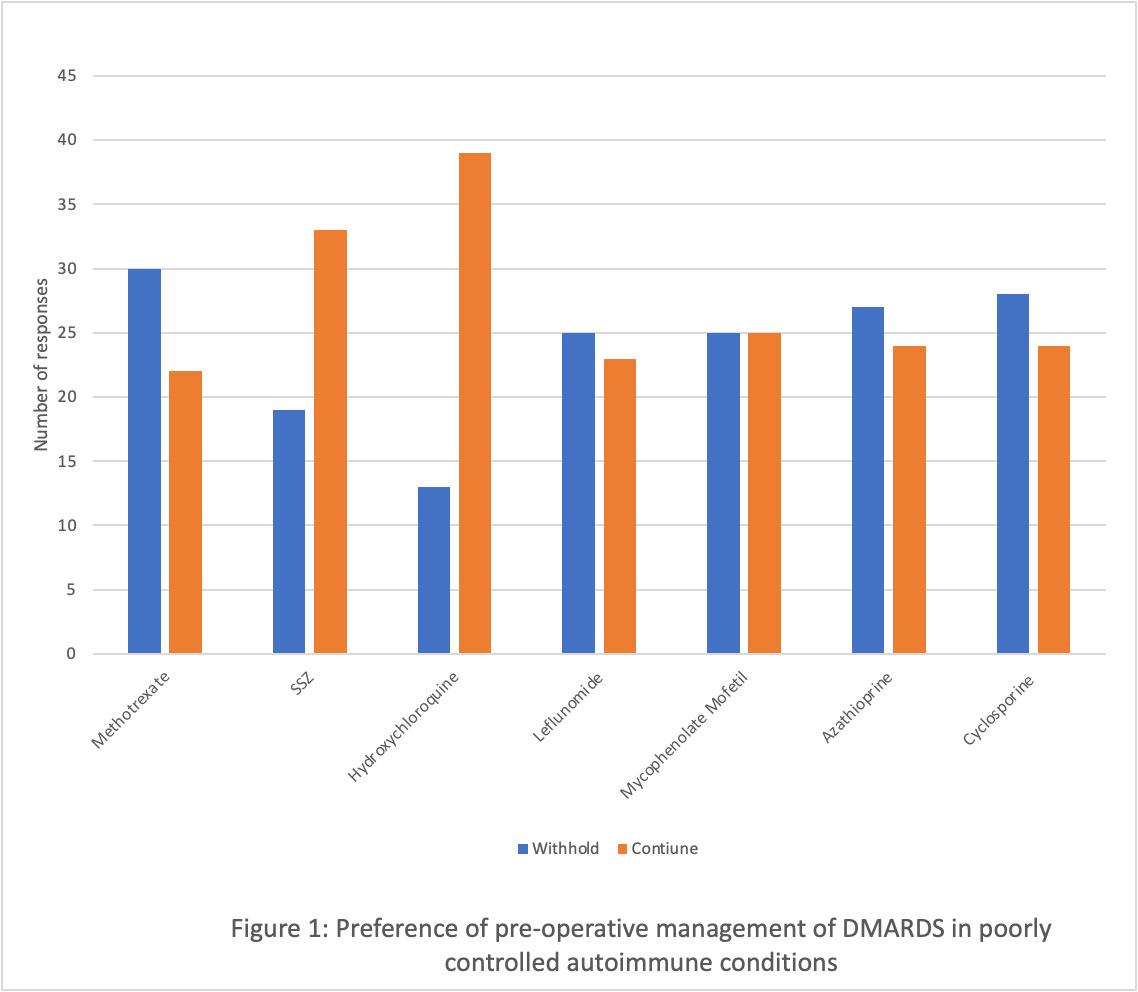
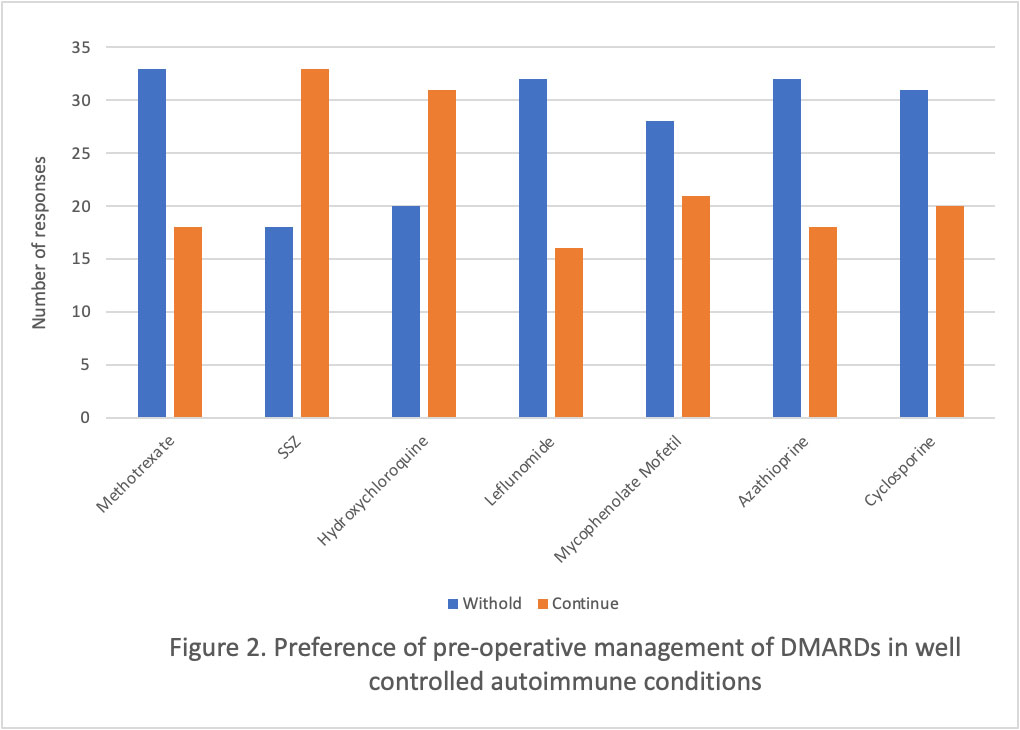
For management of DMARDs pre-operatively, the responses were variable with the majority of the surgeons only in agreement that Sulfasalazine and hydroxychloroquine should be continued (figure 1 and 2).
For biologics; 76.5% of the surveyed surgeons reported that they would consider stopping the medication and schedule the surgery at the end of the same dosing cycle while 23.5% reported that they would wait for more than one dosing cycle to schedule surgery. 70.2% of the surgeons reported they would hold off on restarting biologics for >14 days while 29.4% mentioned that they will restart biologics within 14 days of surgery in the absence of complications.
For the appropriate window to withhold JAK inhibitors pre-operatively; 19.6% of the surveyed surgeons voted < 7 days, with 39.2% mentioning holding for 7-14 days and 41.2% recommended holding for >14 days.
Conclusion: We believe that the varied responses to the surveys emphasize the need for standardized guidelines for peri-operative management of immunosuppressive therapy in patients undergoing bariatric surgery. This is further strengthened by the majority of the survey responders reporting that they believe that standardized guidelines for perioperative management of this patient population is necessary for optimal outcomes.
To cite this abstract in AMA style:
Loku Galappaththy S, Fearing N. Evaluating Peri–operative Preferences of Bariatric Surgeons in the Management of Immunosuppressive Therapy During Bariatric Surgery [abstract]. Arthritis Rheumatol. 2022; 74 (suppl 9). https://acrabstracts.org/abstract/evaluating-peri-operative-preferences-of-bariatric-surgeons-in-the-management-of-immunosuppressive-therapy-during-bariatric-surgery/. Accessed .« Back to ACR Convergence 2022
ACR Meeting Abstracts - https://acrabstracts.org/abstract/evaluating-peri-operative-preferences-of-bariatric-surgeons-in-the-management-of-immunosuppressive-therapy-during-bariatric-surgery/