
Session Information
Date: Tuesday, October 23, 2018
Title: Spondyloarthritis Including Psoriatic Arthritis – Basic Science Poster
Session Type: ACR Poster Session C
Session Time: 9:00AM-11:00AM
Background/Purpose: Psoriatic Arthritis (PsA) affects up to 30% patients with psoriasis and is characterized by widespread synovio-entheseal inflammation. Physiologically, the human gut microbiota metabolizes dietary fiber into short-chain fatty acids (FA)- which exert anti-inflammatory effects by increasing activity of regulatory T cells (Tregs). Moreover, we have previously shown decreased abundance of Akkermansia and Ruminococcus and concomitant decrease in medium-chain FA (MCFA) levels in stool of PsA patients. We therefore hypothesized that FA supplementation may have favorable effects on gut microbiome and lead to increase in tolerance, potentially serving as therapeutic target in psoriatic disease.
Methods: Wild type (WT) animals were fed SCFA-rich diet for 14 days followed by 16S rRNA sequencing and microbiota analysis of pellet specimens. We then evaluated effects of MCFA-rich diet in healthy subjects. Peripheral blood and stool samples were collected at days 0, 7 and 14 for 16s rRNA sequencing and FACS. Finally, we conducted a small, prospective, proof-of-principle study in new-onset, drug-naïve psoriatic disease patients (with or without PsA). Each participant received MCFA (1 gm 4 times a day for 6 weeks). Clinical history was obtained at baseline. Skin and joint exam were performed at baseline and follow up. Serum and stool samples were collected at baseline, weeks 3, and 6 for 16S rRNA sequencing and FACS, respectively. Wilcoxon signed-rank test was used to compare differences in Tregs before and after MCFA-rich administration.
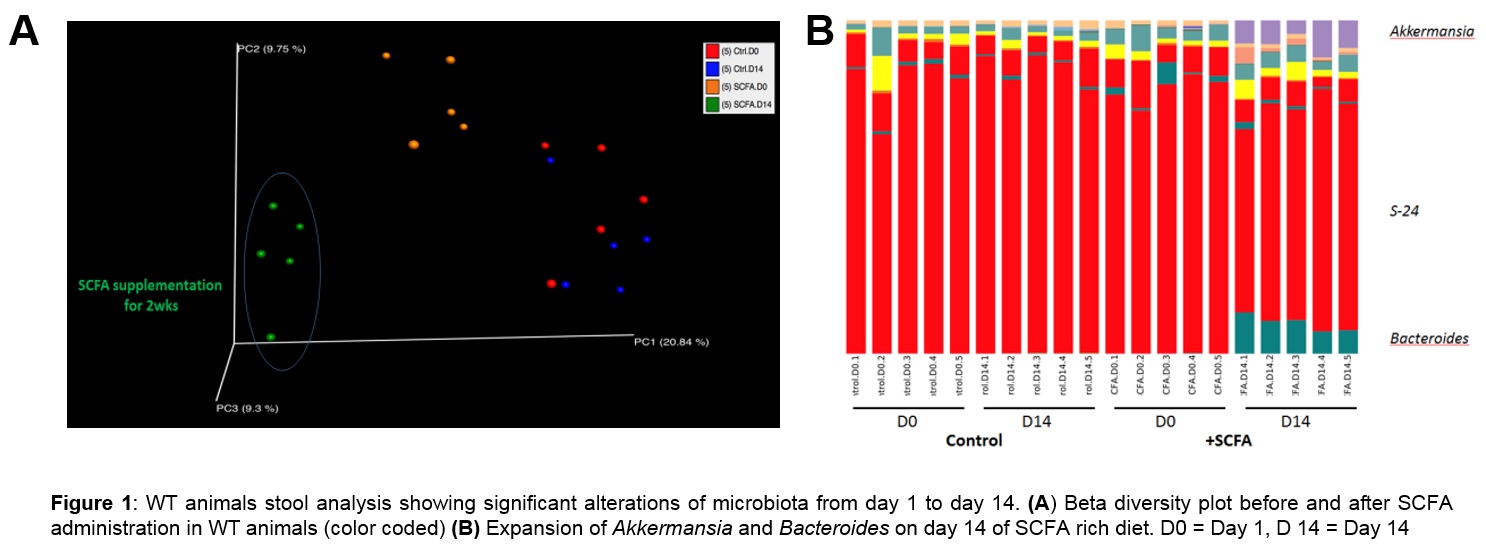
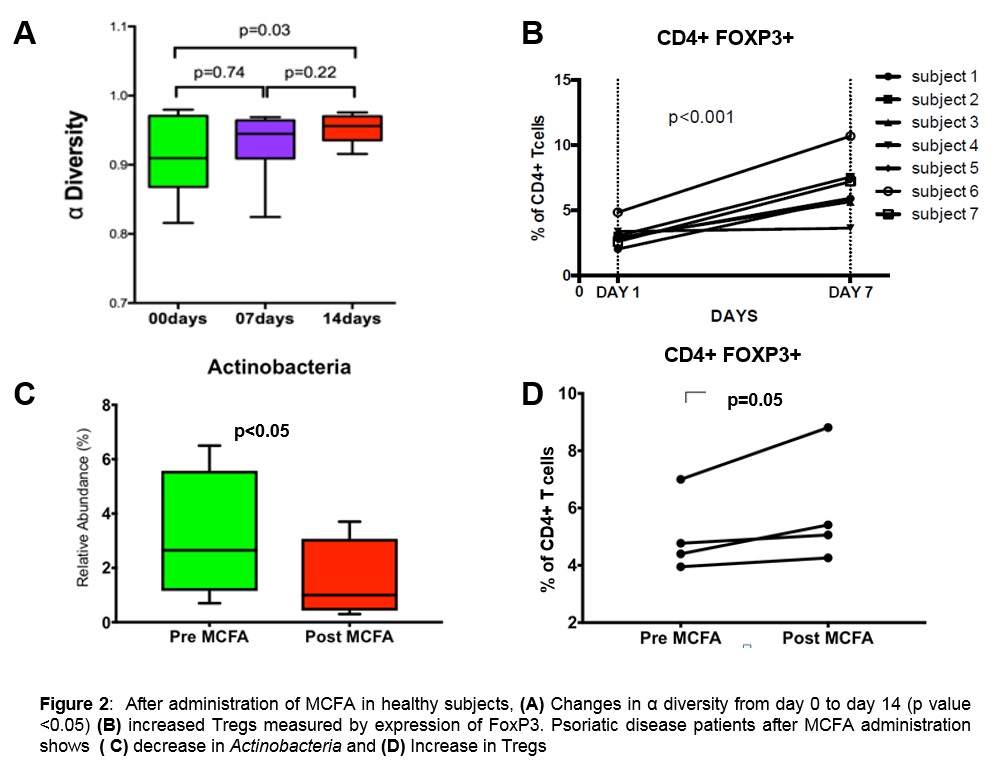
Results: SCFA rich diet in WT mice led to statistically significant perturbations in gut bacterial composition 14 days into intervention, with a dramatic increase in commensals (Fig 1A; p<0.001), most notably in Akkermansia (Fig 1B). MCFA administration to healthy subjects (n=7) also led to significant changes in community structure (Fig 2A; p=0.03) and associated increases in circulating Treg cells (Fig 2B; p<0.001). These findings were also observed in psoriatic disease patients (n=4) showing a significant alteration in specific taxa, including Actinobacteria (Fig 2 C; p<0.05) and Mollicutes (p=0.09) and concomitant increase in circulatory Treg cells (Fig 2D)
Conclusion: In both health and psoriatic disease, MCFA supplementation is associated with distinct changes in human gut microbiota composition and peripheral Treg cells. These findings rationalize the need for a larger placebo controlled, prospective trial to study the effects of MCFA in patients with psoriasis and PsA as a potential therapy alone or in combination with DMARDs.
To cite this abstract in AMA style:
Malik F, Manasson J, Herrera A, Attur M, Reddy SM, Yang L, Koralov S, Scher JU. Effects of Fatty Acid Supplementation in Modulation of Gut Microbiome and T-Regulatory Cells in Health and Psoriatic Disease [abstract]. Arthritis Rheumatol. 2018; 70 (suppl 9). https://acrabstracts.org/abstract/effects-of-fatty-acid-supplementation-in-modulation-of-gut-microbiome-and-t-regulatory-cells-in-health-and-psoriatic-disease/. Accessed .« Back to 2018 ACR/ARHP Annual Meeting
ACR Meeting Abstracts - https://acrabstracts.org/abstract/effects-of-fatty-acid-supplementation-in-modulation-of-gut-microbiome-and-t-regulatory-cells-in-health-and-psoriatic-disease/