
Session Information
Date: Sunday, November 13, 2022
Title: Research Methodology Poster
Session Type: Poster Session B
Session Time: 9:00AM-10:30AM
Background/Purpose: Fatigue is a top concern of individuals with SLE and is a leading cause of work impairment and disability in this population. Although fatigue affects over 90% of patients with SLE over the course of their illness, it is often not systematically addressed during medical visits. Both patients and physicians cite a need for patient support, including information on the drivers of fatigue and self-management strategies. To address this gap, we developed a theory-based patient-centered educational intervention focused on fatigue in patients with SLE
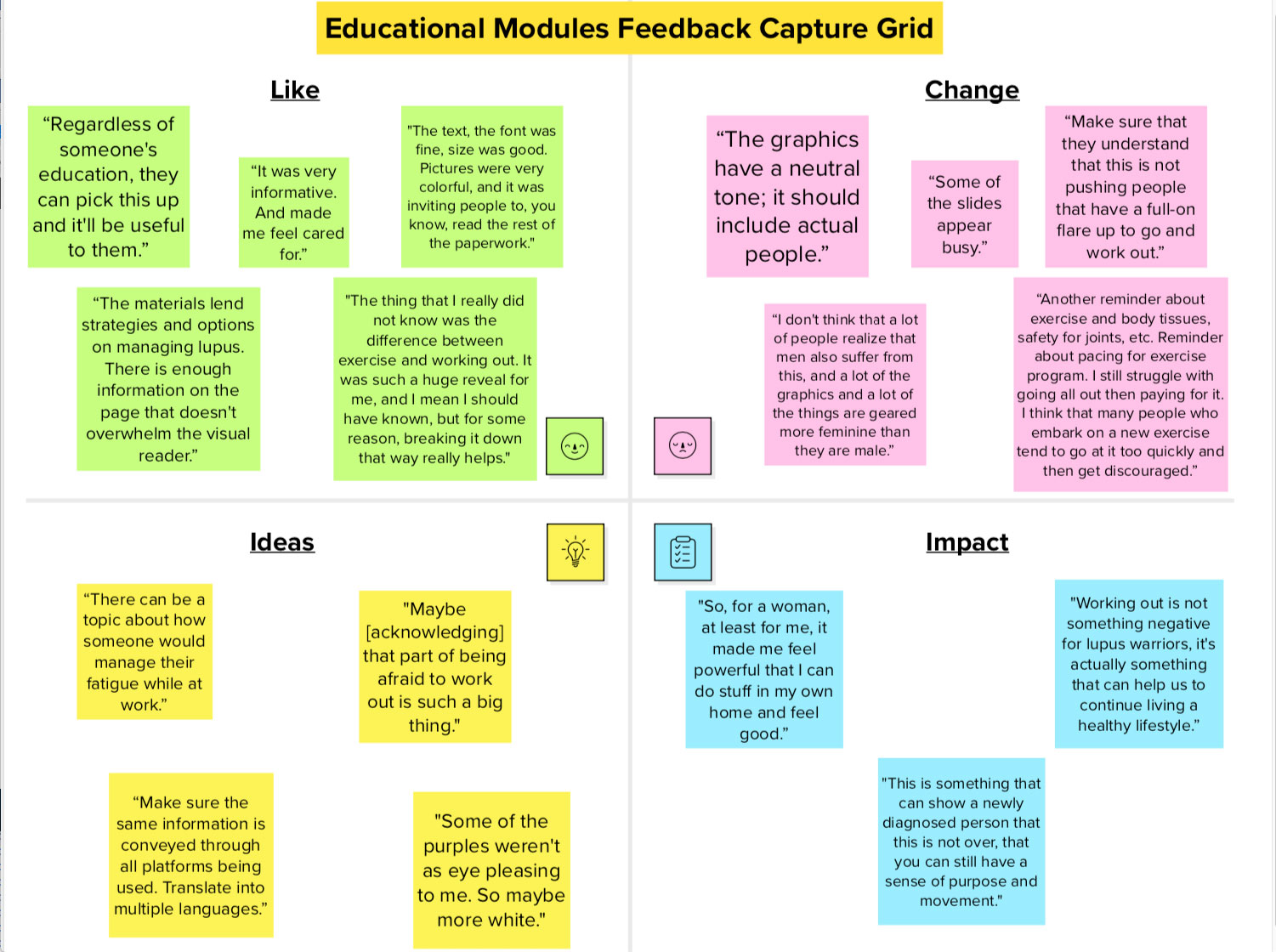
Methods: The educational intervention was developed using human-centered design methodology by a multi-disciplinary team including two patient stakeholders. Patient perspectives and needs around managing fatigue in SLE were explored in the “inspiration” phase through literature review, focus groups, and informal conversations with patients. In the “ideation” phase, barriers in fatigue knowledge and skills were identified and formulated as questions from the patient perspective. Questions were iteratively refined with the input of the patient stakeholders and organized into modules that defined the scope of the educational intervention. Modules consisted of evidence-based answers to the patient-oriented questions and incorporated: 1) core principles of adult education, including discrete learning objectives and self-assessment questions and 2) constructs from the self-determination theory of motivation, emphasizing autonomy, competence, and relatedness. They were presented as infographics, using plain language with attention to health literacy. Modules were reviewed in in-depth interviews and surveys by patients with SLE, purposefully sampled around age, sex, race, ethnicity, and disease duration. Interviews were recorded, transcribed, and analyzed using a rapid analysis protocol and feedback capture grid.
Results: An educational intervention covering four topics with over twenty patient-oriented questions was developed and iteratively refined with the input of patient stakeholders. Topics included: 1) Fatigue and Lupus; 2) Managing Fatigue in Lupus (Fatigue Modules); 3) Physical Activity and Lupus; and 4) Moving More with Lupus (Physical Activity Modules). Ten individuals with SLE (Table 1) provided feedback on the intervention. Participants rated the modules positively and were highly likely to recommend them to others with lupus (Table 2). They praised the clarity, engaging tone, and graphics of the modules and suggested adding emphasis on pacing and validation of fear related to exercise, and creating options for variable color schemes and translation into multiple languages for different audiences (Figure 1).
Conclusion: We developed a theory-based educational intervention addressing fatigue in SLE using a patient-engaged, human-centered design approach. Feedback obtained from the “ideation” phase will inform intervention refinement and pilot testing (“implementation”) to assess efficacy in improving knowledge, skills, and fatigue in individuals living with SLE.


To cite this abstract in AMA style:
Kasturi S, Tate S, Farrar T, Mandl L, LeClair A, Chiu F, Gore-Massy M, Navarro-Millan I, Folta S. Development of a Theory-based Educational Intervention for Fatigue in Systemic Lupus Erythematosus (SLE) Using Human-centered Design Methodology [abstract]. Arthritis Rheumatol. 2022; 74 (suppl 9). https://acrabstracts.org/abstract/development-of-a-theory-based-educational-intervention-for-fatigue-in-systemic-lupus-erythematosus-sle-using-human-centered-design-methodology/. Accessed .« Back to ACR Convergence 2022
ACR Meeting Abstracts - https://acrabstracts.org/abstract/development-of-a-theory-based-educational-intervention-for-fatigue-in-systemic-lupus-erythematosus-sle-using-human-centered-design-methodology/