
Session Information
Date: Sunday, November 7, 2021
Title: Pediatric Rheumatology – Clinical Poster II: SLE, JDM, & Juvenile Scleroderma (0764–0785)
Session Type: Poster Session B
Session Time: 8:30AM-10:30AM
Background/Purpose: Juvenile Dermatomyositis (JDM) is the most common inflammatory myopathy of childhood and is characterized by chronic inflammation targeting muscle and skin. Older patients who had JDM in childhood have a higher risk of atherosclerosis, documented by increased intima-media thickness. Paraoxonase 1 (PON1) is a hydrolytic enzyme associated with HDL and essential to protecting against LDL oxidation. Lower PON1 activity is linked with increased CAD risk. We hypothesize that, in JDM, dyslipidemia and HDL’s antioxidant function is associated with the severity of systemic inflammation. We focused on the association of neopterin and dyslipidemia because TNF alpha, a proinflammatory cytokine produced by activated macrophage, can lead to dyslipidemia; elevated neopterin levels document macrophages activation.
Methods: This IRB-approved retrospective study was conducted at the Ann and Robert H. Lurie Children’s Hospital of Chicago. All JDM patients (n= 143) who had fasting lipid profile, disease activity score (DAS), and neopterin level at the same visit were included. Normal, borderline and abnormal lipid profile values for children was defined based on the American Academy of Pediatrics guideline. HDL’s antioxidant function evident by paraoxonase, lactonase, and arylesterase activity was measured by Dr. Charles-Schoeman’s lab on 42 untreated JDM and 42 controls.
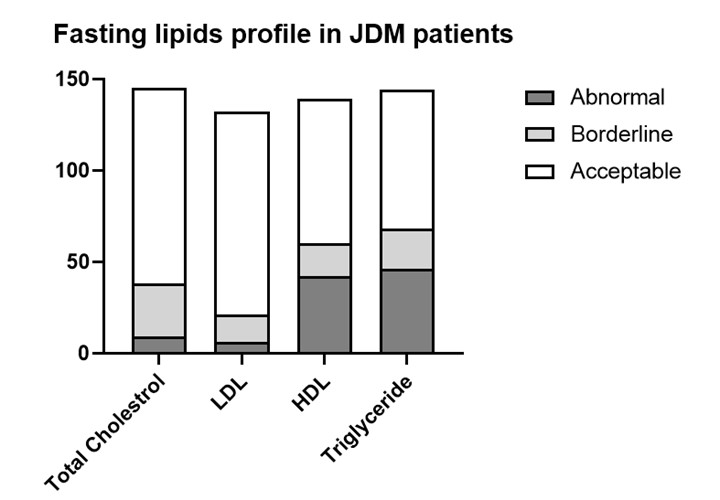
Results: Of 143 JDM patients included, 75% were female, and 70% were white. Only 12% of the subjects had lipid profiles before steroid treatment. While 88% of the untreated subject had low or borderline HDL and 75% had high or borderline triglycerides , only 13% had high or borderline LDL. Of the study population (n=143) 24% had elevated neopterin levels. Those with elevated neopterin levels had significantly lower mean HDL levels at 38.6 +/- 14.7 than JDM with normal neopterin at 51.6 +/- 14.9 and p < 0.0001. There was a significant negative correlation between HDL and various disease activity marker such as Neopterin (R2=0.17 , p < 0.0001), DAS-total (R2=0.16 p < 0.0001), DAS-Muscle Weakness (R2=0.19 , p < 0.0001) and DAS-Skin (R2=0.07 , p = 0.001). We then examined the HDL antioxidative ability in 42 untreated JDM and age-matched control. JDM patients showed significantly lower lactonase activity (19.1 U/ml vs 23.9 U/ml p =0.005) and arylesterase activity (165.3 U/ml vs 189.4 U/ml p=0.04). Furthermore, there was a significant correlation between arylesterase enzyme activity and various disease activity markers such as Neopterin (R2=0.22, p =0.004), DAS-total (R2=0.18 p 0.005), DAS-Muscle Weakness (R2=0.19, p =0.004) and CMAS (R2=0.16, p =0.01). A similar correlation was found between lactonase as disease activity markers.
Conclusion: JDM patients have an increased prevalence of elevated TG and low HDL, especially before treatment. JDM patients with low HDL levels have more disease activity, as evidenced by DAS and elevated neopterin. Of note, the antioxidant capacity of HDL appeared to be reduced in JDM compared to control, and the degree of reduction was associated with disease activity indicators. These findings suggest that early control of inflammation in JDM might improve HDL levels and their function.
To cite this abstract in AMA style:
Khojah A, Kadakia A, Charles-Schoeman C, Spitznagle J, Wang J, Shahbazian A, Morgan G, Pachman L. Decreased HDL Levels and Antioxidant Function in Juvenile Dermatomyositis [abstract]. Arthritis Rheumatol. 2021; 73 (suppl 9). https://acrabstracts.org/abstract/decreased-hdl-levels-and-antioxidant-function-in-juvenile-dermatomyositis/. Accessed .« Back to ACR Convergence 2021
ACR Meeting Abstracts - https://acrabstracts.org/abstract/decreased-hdl-levels-and-antioxidant-function-in-juvenile-dermatomyositis/