
Session Information
Session Type: Poster Session C
Session Time: 10:30AM-12:30PM
Background/Purpose: To determine clinical features of autoimmune uveitis (AU) and the associated factors with the reactivation subtype
Methods: A transversal analysis from single center cohort (ophthalmologic/rheumatologic outpatients’ clinic) between 2018 to 2023. Presence of AU and its clinical subtype (acute, chronic or reactivation) were defined according with the Standardization of Uveitis Nomenclature (SUN) Project (1). Patients with at least 18 years (or with a previous parents IC in child) and with no infectious suspicious or pregnant, were included. Sociodemographic and clinical features were desfined by descriptive statistics. A multivariable binary regression model was performed to determine associated factors with AU reactivation subtype adjusted by gender, age, education, disease duration, uveitis localization, idiopathic versus secondary causes, type of autoimmune systemic disease (ASD) associated such as spondylarthritis, vasculitis -and other vessel disease, rheumatoid arthritis, and idiopathic juvenile arthritis, and the treatment prescribed [glucocorticoids (GCs) dose , GCs pulse therapy , c-DMARDs and b-DMARDs].
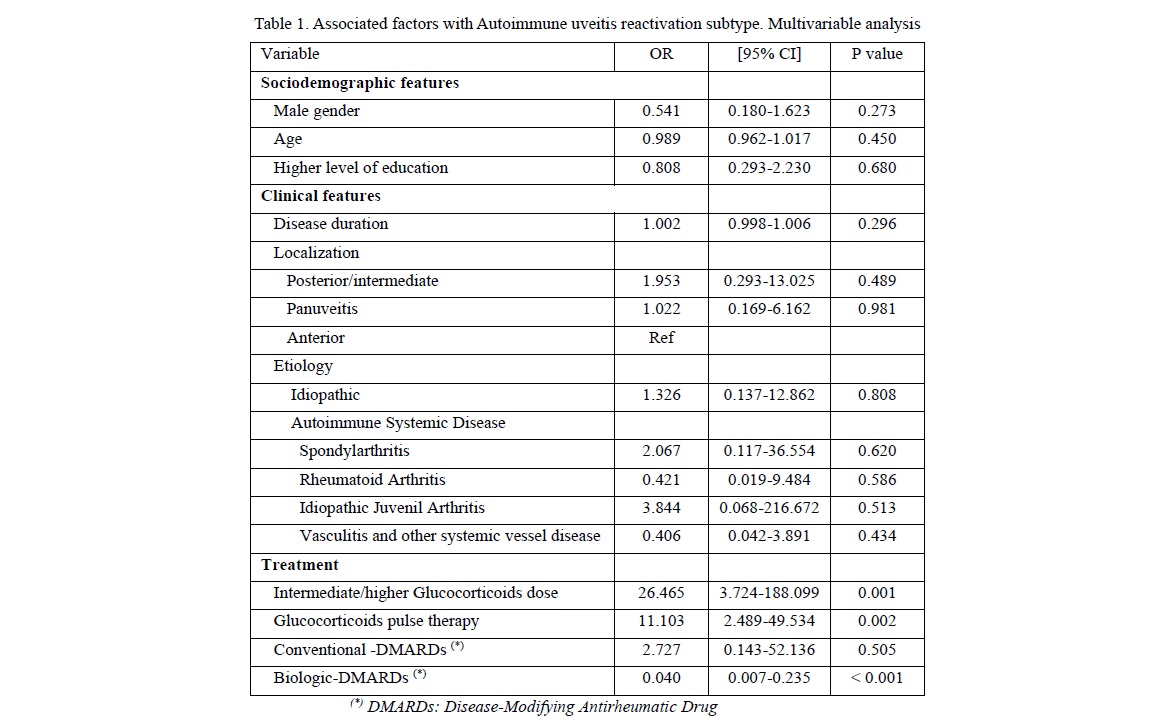
Results: From 459 patients, 120 were included; most patients were females 65(54.17%); Only 20 (16.67%) patients had idiopathic AU. Spondylarthritis was the most frequent ASD in the secundary AU: 49 (40.83%). Reactivation was the most frequent AU subtype :56 (46.67%). In the MV analysis variables associated with reactivation subtype were the use of intermediate/higher GCs dose (OR=26.465; p=0.001), GCs pulse therapy (OR=11.10; p=0.002) and b-DMARDs use (OR=0.040; p< 0.001) (Table 1)
Conclusion: In our AU cohort anterior uveitis and the presence of ASD (specially spondylarthritis) intead of idiophatic uveitis, were frequent. The AU reactivation subtype was associated with a more intensive treatment prescription.
(1) Trusko B, Methods Inf Med. 2013;52(3):259-65, S1-6.
To cite this abstract in AMA style:
Madariaga.Ch H, Ascuña V, Gamboa-Cardenas R. Clinical Features of Autoimmune Uveitis and Associated Factors with Reactivation Subtype Presentation from a Peruvian Multidisciplinary Reference Center [abstract]. Arthritis Rheumatol. 2024; 76 (suppl 9). https://acrabstracts.org/abstract/clinical-features-of-autoimmune-uveitis-and-associated-factors-with-reactivation-subtype-presentation-from-a-peruvian-multidisciplinary-reference-center/. Accessed .« Back to ACR Convergence 2024
ACR Meeting Abstracts - https://acrabstracts.org/abstract/clinical-features-of-autoimmune-uveitis-and-associated-factors-with-reactivation-subtype-presentation-from-a-peruvian-multidisciplinary-reference-center/