
Session Information
Session Type: Poster Session B
Session Time: 10:30AM-12:30PM
Background/Purpose: Rheumatoid arthritis (RA) is a multisystem disease with a strong genetic component and multiple comorbidities. Genome wide association studies (GWAS) have identified single nucleotide polymorphisms (SNPs) associated with the risk of RA; these can be combined into a polygenic risk score (PRS) to provide an estimate of an individual’s genetic risk for RA. Health care data linked with biobanks provide unprecedented resources for precision medicine through genomic studies in real-world settings. We set out to define whether a PRS for RA identifies comorbidities associated with RA in people with and without RA in real-world settings.
Methods: The study was conducted in two large biobanks containing de-identified electronic health records (EHR) and linked genetic data: Vanderbilt’s BioVU and the NIH-funded All of Us (AoU) program. The case definition for RA required an eligible ICD9 and/or ICD10 code on three different dates plus use of a drug for RA. Non-RA controls included participants without any ICD9/ICD10 codes for RA and no record of use of any RA drugs. Patients with common conditions that could be mistaken for RA (e.g., psoriatic arthritis) were excluded from RA cases and controls. Two investigators reviewed a random sample of 35 potential RA patients in BioVU to define the positive predictive value (PPV) of the RA case definition. We used the largest existing GWAS for RA in patients of European ancestry to construct an RA-PRS; thus, we only studied individuals of reported White race. A phenome-wide association study (PheWAS) adjusting for sex, age, and 2 ancestry specific principal components was performed with a P-value < 5e-05 regarded as significant to test which clinical conditions were associated with the RA-PRS in individuals with and without RA.
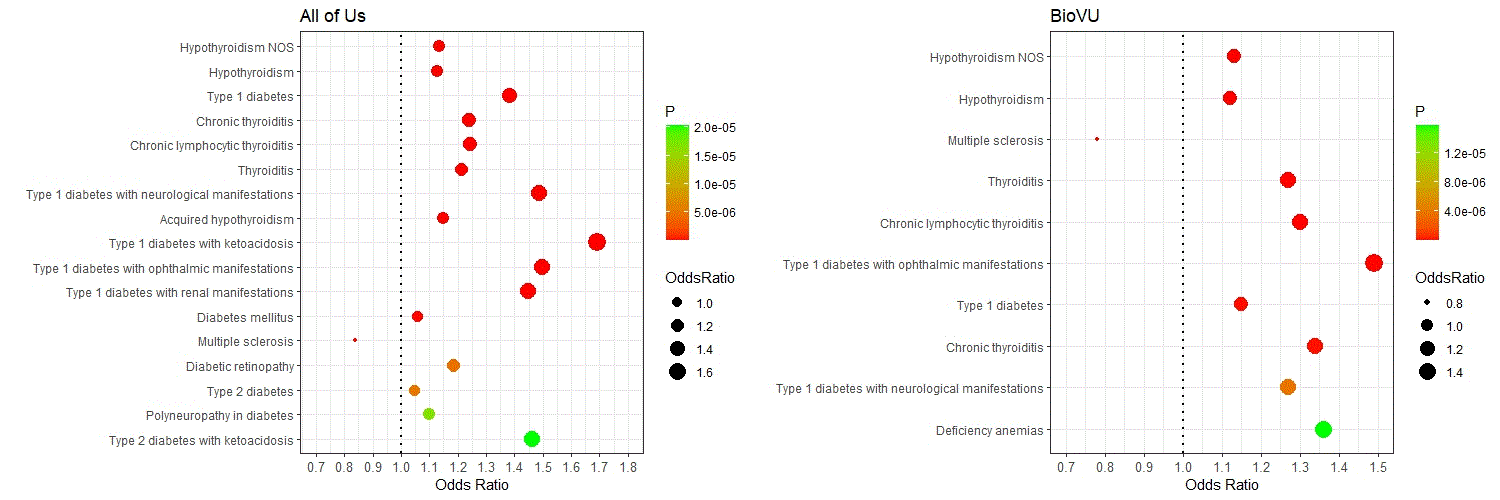
Results: The case definition for RA had a PPV of 89%. The algorithm identified 1,124 patients with RA in BioVU and 921 in AoU, respectively. The majority (74.6% in BioVU and 76.5% in AoU) of patients with RA were women. When RA and non-RA controls were analyzed together, the RA-PRS, as expected, was associated with RA (OR=1.58, P= 1.6e-44 and OR=1.58, P= 2.1e-46 for BioVU and AoU, respectively) in a PheWAS. In the RA cohort, the PRS was associated with “Unspecified myalgia” and “Back pain” in BioVU, but there were no statistically significant associations in AoU. Among individuals without RA, the RA-PRS was associated with hypothyroidism, type I diabetes, thyroiditis, and multiple sclerosis (P< 5.0e-06) in both BioVU and AoU (Figure 1)
Conclusion: A PRS for RA is associated with multiple autoimmune conditions including type I diabetes, thyroiditis, and multiple sclerosis among individuals without RA in large US-based cohorts of participants.
To cite this abstract in AMA style:
Yu H, Nepal P, Daniel L, Barbero Mota M, Karakoc G, Carpintero M, Stein C, Chung C, Guo Y, Kawai V. Clinical Conditions Associated with Genetic Predisposition to Rheumatoid Arthritis in Real-World Settings [abstract]. Arthritis Rheumatol. 2024; 76 (suppl 9). https://acrabstracts.org/abstract/clinical-conditions-associated-with-genetic-predisposition-to-rheumatoid-arthritis-in-real-world-settings/. Accessed .« Back to ACR Convergence 2024
ACR Meeting Abstracts - https://acrabstracts.org/abstract/clinical-conditions-associated-with-genetic-predisposition-to-rheumatoid-arthritis-in-real-world-settings/