
Session Information
The 2020 Pediatric Rheumatology Symposium, originally scheduled for April 29 – May 2, was postponed due to COVID-19; therefore, abstracts were not presented as scheduled.
Date: Saturday, May 2, 2020
Title: Poster Session 3
Session Type: ACR Abstract Session
Session Time: 4:15PM-5:15PM
Background/Purpose: Chronic Fatigue Syndrome (CFS)/Myalgic encephalomyelitis (ME) affects roughly 2.5 million people in the United States, and is challenging both in diagnosis and treatment. Many case definitions have been used in reporting the prevalence of CFS/ME in children and adolescents. Criteria in common include post-exertional malaise, a prolonged period of unexplained fatigue or unrefreshing sleep, pain, and autonomic manifestations. These features may overlap with some psychiatric symptoms, e.g., depression and pain amplification, which are also commonly seen in children with abrupt early-onset obsessive compulsive disorder (AEO-OCD). We define AEO-OCD as sudden-onset OCD which develops to full symptom severity within 72 hours in childhood, and is diagnosed by a psychiatrist. Pediatric Acute-onset Neuropsychiatric Syndrome (PANS) is characterized by AEO-OCD and/or severe eating restriction plus additional neuropsychiatric symptoms. To date, no studies have described the prevalence of chronic fatigue symptoms in children with AEO-OCD and/or PANS.
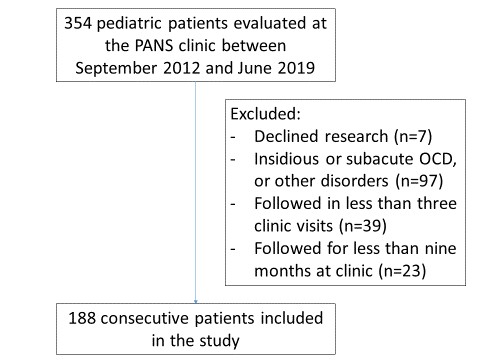
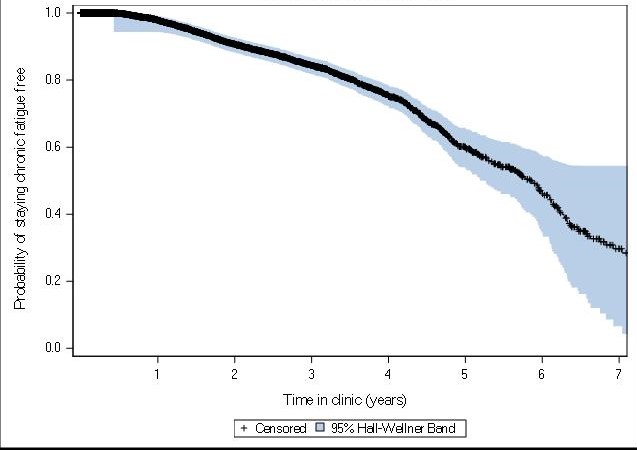
Methods: We performed a retrospective cohort study of patients evaluated at the PANS clinic between September 2012 and June 2019. We included patients meeting our definition of AEO-OCD, and excluded some cases (Fig.1). Data were drawn from patient questionnaires which caregivers and patients fill out before each clinic visit. The questionnaire queries symptoms including exercise intolerance, post exertional malaise, daytime fatigue, waking unrefreshed, cognitive symptoms, and psychometric scale ratings for their psychiatric symptoms. Missing data on questionnaires were replaced by data closest to the visit occurring within ten days of the missing data. We also reviewed charts to supplement data on exercise intolerance. We reported numbers/proportions of patients meeting CFS symptoms and the 2015 Institute of Medicine (IOM) diagnostic criteria for CFS/ME which require more than six months of fatigue, moderate or severe problems with waking unrefreshed, moderate or severe cognitive problems, and exercise intolerance. Kaplan Meier curve was used to determine the time-dependent risk of developing CFS/ME in our sample. Patients were censored at their last follow-up.
Results: Our study cohort was comprised of 188 patients: mean (SD) age of OCD onset was 8.7 (8.3) years; 115 (61%) were male and 152 (81%) were White. Table 1 shows the number of patients who reported different chronic fatigue symptoms. Using the 2015 IOM criteria, 32 (17%) patients in our sample were diagnosed with CFS/ME. From the Kaplan Meier curve, the median time to diagnosis of CFS/ME was 5.8 (95% CI, 5.6-6.1) years in clinic (Fig.2).
Conclusion: Our study shows that CFS/ME occurs in 1 in 6 patients with AEO-OCD. The prevalence rate is much higher than the general adolescent population (1 in 100-200). This underscores the need to systematically assess fatigue in this group of patients. Future studies should determine possible shared biological underpinnings between AEO-OCD/PANS and CFS/ME.

To cite this abstract in AMA style:
Chan A, Truong A, Farhadian B, Willett T, Silverman M, Tran P, Thienemann M, Frankovich J. Chronic Fatigue Symptoms in Children with Abrupt Early-onset OCD And/or PANS [abstract]. Arthritis Rheumatol. 2020; 72 (suppl 4). https://acrabstracts.org/abstract/chronic-fatigue-symptoms-in-children-with-abrupt-early-onset-ocd-and-or-pans/. Accessed .« Back to 2020 Pediatric Rheumatology Symposium
ACR Meeting Abstracts - https://acrabstracts.org/abstract/chronic-fatigue-symptoms-in-children-with-abrupt-early-onset-ocd-and-or-pans/