
Session Information
Session Type: Abstract Submissions (ACR)
Background/Purpose : IgG4-related disease (IgG4-RD) is a systemic disease that is characterized by the infiltration of IgG4-positive plasma cells and T cells into various organs. However, the characteristic and pathological role of immune cell subsets remains unclear. We have characterized peripheral blood immune cell subsets in patients with IgG4-RD by comparing with patients with primary Sjögren syndrome (pSS) and healthy controls (HC).
Methods : PBMCs were obtained from 8 IgG4-RD and 4 pSS patients as well as from 8 HC. The phenotype of immune cells was analyzed by 8-color staining flow cytometry. T helper cells were categorized as naive, central memory, effector memory and effector T cells by expression of CCR7 and CD45RA. B cells were categorized as naive, IgM memory, switched memory, effector B cell and plasmablast (PB) by expression of IgD, CD27 and CD38. DCs were categorized as myeloid and plasmacytoid DC by expression of CD11c and CD123. The proportion of immune cell subsets was assessed for correlations with serological parameters, including serum IgG, IgG4, and CRP.
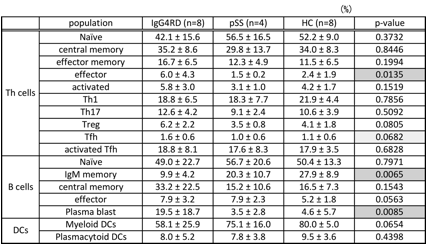
Results : Baseline characteristics of patients with IgG4-RD (mean ± SD) were; age 56 ± 20 year, symptom duration 16.3 ± 19.2 months, serum IgG4 628 ± 549 mg/dl, CRP 1.3 ± 2.6 mg/dl, respectively. There was no difference in the proportion of T helper cells (Th1, Th2, Th17, Treg), B cells or DC subsets between IgG4-RD, and pSS, HC,whereas CD3+CD4+CXCR5+CD45RA– Tfh cells were significantly higher in IgG4-RD than HC (p=0.033). In contrast, the proportion of CD3+CD4+CCR7–CD45RA+ effector T cells and CD19+CD27+CD20–CD38+ plasmablasts significantly increased in IgG4-RD compared to pSS and HC (p values: 0.008 and 0.013, respectively). Importantly, the proportion of CD3+CD4+CCR7–CD45RA– effector memory T helper cells was strongly correlated with the ratio of serum IgG4/IgG ratio (rho=0.90, p=0.002), whereas it was not with that of plasmablasts (rho=0.17, p=0.67).
Conclusion : These results revealed that the higher proportion of effector T cells including Tfh cells and the increase of plasmablasts possibly induced by Tfh are characteristically observed in IgG4-RD, but not in pSS. Moreover, serum IgG4/IgG ratio was strongly correlated with ratio of effector memory T cells, but not plasmablasts. Taken together, IgG4 overproduction may be conducted by matured effector phase helper T cells, suggesting a pivotal role of effector phase T cells in pathogenesis of IgG4RD, especially in IgG4 specific production. Further studies are required to elucidate the detailed role of effector phase T cells in the pathogenesis of IgG4-RD.
Disclosure:
S. Hirata,
None;
S. Nakayamada,
None;
S. Kubo,
None;
M. Yoshikawa,
None;
N. Yunoue,
None;
K. Nakano,
None;
K. Yamaoka,
None;
K. Saito,
None;
Y. Tanaka,
BMS, MSD, Chugai, Mitsubishi-Tanabe, Astellas, Abbvie, Daiichi-Sankyo,
2,
UCB Pharma, Mitsubishi-Tanabe, Abbott, Abbvie, Eisai, Chugai, Janssen, Pfizer, Takeda, Astellas, Daiichi-Sankyo, GSK, AstraZeneca, Eli Lilly, Quintiles, MSD, Asahi Kasei,
5,
UCB, Mitsubishi-Tanabe, Abbott, Abbvie, Eisai, Chugai, Janssen, Pfizer, Takeda, Astellas, Daiichi-Sankyo, GSK, AstraZeneca, Eli Lilly, Quintiles, MSD, Asahi Kasei,
8.
« Back to 2014 ACR/ARHP Annual Meeting
ACR Meeting Abstracts - https://acrabstracts.org/abstract/characteristic-phenotype-of-peripheral-blood-lymphocytes-in-patients-with-igg4-related-disease-comparing-to-primary-sjogren-syndrome-and-healthy-controls/