ACR Meeting Abstracts

ACR Meeting Abstracts

  • Meeting Abstracts
    • All Meetings
    • PRSYM 2026
    • ACR Convergence 2025
    • Download Abstract Supplements
  • Keyword Index
  • Search
  • My Favorites
    • View and print all favorites
    • Clear all favorites

Abstract Number: 1601

Changing Spectrum of Systemic Therapies for Eosinophilic Granulomatosis with Polyangiitis from 2006-2023

Lynn Fussner1, Christian Pagnoux2, David Cuthbertson3, Thomas Corbridge4, Nader Khalidi5, Curry Koening6, Carol Langford7, Carol McAlear8, Paul Monach9, Larry Moreland10, Rennie Rhee8, Philip Seo11, Anat Shavit12, Jared Silver13, Ulrich Specks14, Kenneth Warrington14, Michael Wechsler15 and Peter Merkel8, and for the Vasculitis Clinical Research Consortium, 1The Ohio State University, Columbus, OH, 2Mount Sinai Hospital, Toronto, ON, Canada, 3University of South Florida, Tampa, FL, 4US Value Evidence and Outcomes, GSK, Durham, NC, 5McMaster University, Hamilton, ON, Canada, 6University of Texas Dell Medical School, Austin, TX, 7Cleveland Clinic, Moreland Hills, OH, 8University of Pennsylvania, Philadelphia, PA, 9VA Boston Healthcare System, Boston, MA, 10University of Colorado, Denver, CO, 11Johns Hopkins University, Baltimore, MD, 12BioPharmaceuticals Medical, AstraZeneca, Cambridge, United Kingdom, 13US Medical Affairs - Respiratory, GSK, Durham, 14Mayo Clinic, Rochester, MN, 15National Jewish Health, Denver, CO

Meeting: ACR Convergence 2024

Keywords: ANCA, ANCA associated vasculitis, Biologicals, Eosinophilic Granulomatosus with Polyangiitis (Churg-Strauss), Vasculitis

  • Tweet
  • Email a link to a friend (Opens in new window) Email
  • Print (Opens in new window) Print
Session Information

Date: Sunday, November 17, 2024

Title: Vasculitis – ANCA-Associated Poster II

Session Type: Poster Session B

Session Time: 10:30AM-12:30PM

Background/Purpose: The emergence of biologic therapies targeting eosinophils via the IL-5 pathway provided new options for treatment in eosinophilic granulomatosis with polyangiitis (EGPA). There has also been an increase in biologic therapies targeting other pathways for severe asthma, a prominent feature of EGPA. This study evaluated the evolution of systemic therapies utilized in patients with EGPA before and after introduction of these biologic agents in North America.

Methods: Clinical data were examined from 326 participants in a longitudinal cohort at 11 academic centers in the USA and Canada. Participants were grouped based on the timing of their enrollment in the cohort, using three separate periods: (A) April 2006 — April 2011; (B) May 2011 (first full month after FDA approval of rituximab for use in other forms of antineutrophil cytoplasmic antibody (ANCA)-associated vasculitis) — December 2017; (C) January 2018 (first full month after FDA approval of mepolizumab for use in EGPA) — October 2023.

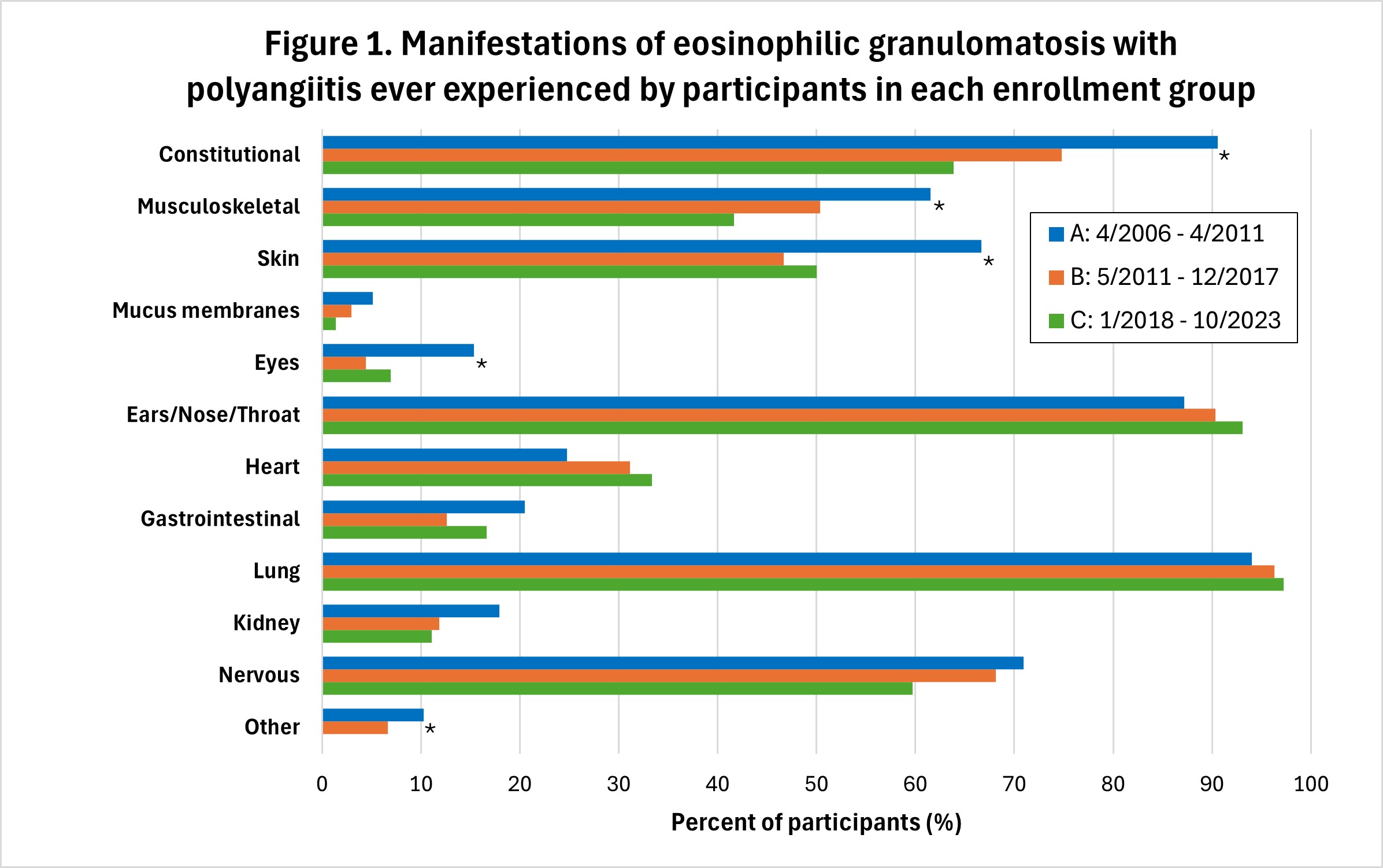
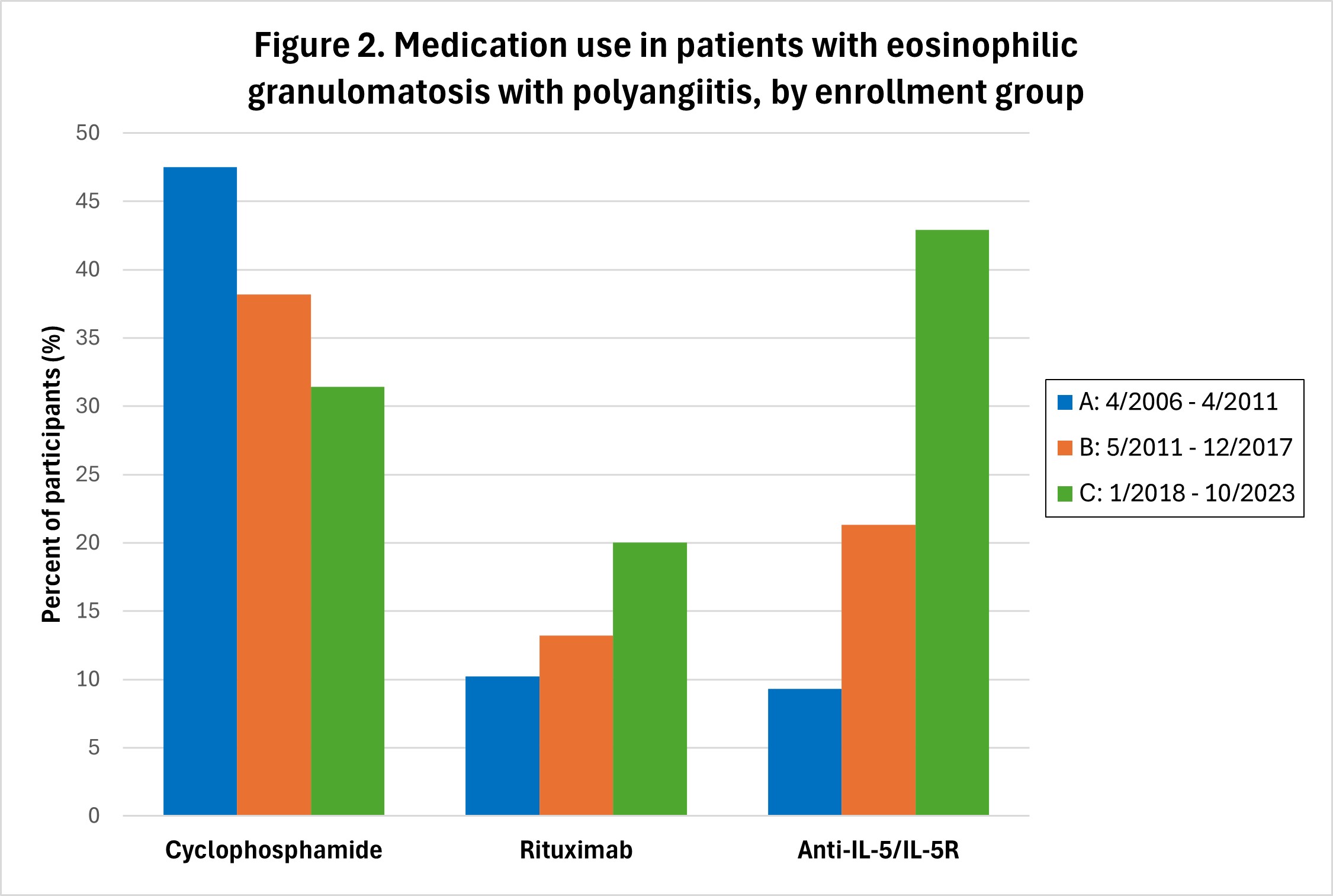
Results: Enrollment per period: A-118 participants; B-136; C-72. Sex and age distribution were similar across all time periods, with 187 (57.4%) females, and mean ± SD age at enrollment = 53.4 ± 14.2 years. Median disease duration at enrollment = 1.5 years; 127/326 (40.0%) were ANCA-positive. Manifestations of EGPA experienced by the participants at any point during their disease course were generally similar across the three enrollment periods (Figure 1). Cyclophosphamide (IV or oral) was used during the treatment course of 56 (47.5%) participants enrolled during A, 52 (38.2%) during B, and 22 (31.4%) during C (p=0.0792) (Figure 2). Rituximab was used in 12 (10.2%) patients enrolled in period A, 18 (13.2%) during B, and 14 (20.0%) during C (p=0.1762). 70 (21.6%) participants received an anti-IL-5 or anti-IL5R agent (mepolizumab, benralizumab, or reslizumab) during their course, most commonly mepolizumab (n=53). Use of these three agents increased over time, with 11 (9.3%) participants enrolled in period A ultimately receiving one of these agents, versus 29 (21.3%) in group B, and 30 (42.9%) in group C (p< 0.0001). Two participants received concurrent treatment with mepolizumab and rituximab (1 each in groups B and C). One participant, enrolled during period B, received concurrent cyclophosphamide and mepolizumab. 14 participants (4.3%) received a non-IL5/IL5R biologic asthma therapy (omalizumab or dupilumab; none with tezepelumab), of whom 12 started prior to enrollment in the study cohort (one received both prior). Participants receiving omalizumab were distributed across all 3 enrollment groups (A=4, B=5, C=2), while all 4 participants receiving dupilumab were in enrollment group C and started this drug prior to enrollment.

Conclusion: Treatment regimens for EGPA evolved substantially over time, with changes in prescribing patterns closely linked to availability of biologic immunomodulatory agents. Further analyses are warranted to investigate the efficacy and safety of these agents for management of specific disease features of EGPA.
Supporting image 1

*=p<.05 for difference among time periods using the likelihood ratio chi-square test.

Supporting image 2

IL-5, interleukin-5; IL-5R, IL-5 receptor.


Disclosures: L. Fussner: Amgen, 2, Takeda, 12, Fudning to VCRC (collaborative body); C. Pagnoux: AstraZeneca, 2, 6, CSL Vifor, 2, GSK, 2, 6, Otsuka, 2, 6; D. Cuthbertson: None; T. Corbridge: GlaxoSmithKlein(GSK), 3, 12, financial equities; N. Khalidi: AbbVie/Abbott, 5, Bristol-Myers Squibb(BMS), 5, GlaxoSmithKlein(GSK), 6, Otsuka, 1, Roche, 1; C. Koening: Amgen, 6; C. Langford: AbbVie/Abbott, 12, Non-paid consultant, AstraZeneca, 5, 12, Non-paid consultant, Bristol-Myers Squibb(BMS), 5, 12, Non-paid consultant, GlaxoSmithKlein(GSK), 5; C. McAlear: None; P. Monach: HI-Bio, 2; L. Moreland: None; R. Rhee: None; P. Seo: None; A. Shavit: AstraZeneca, 3, 11; J. Silver: GSK, 3, 12, Financial equities; U. Specks: Amgen, 2, 5, Argenx, 2, AstraZeneca, 1, 2, 5, Boehringer-Ingelheim, 1, 2, Bristol-Myers Squibb(BMS), 5, CSL Vifor, 1, Genentech, 5, GlaxoSmithKline(GSK), 5, Northstar Medical Radioisotopes, 5, Novartis, 5, NS Pharma, 5; K. Warrington: Amgen, 2, Bristol-Myers Squibb(BMS), 5, Eli Lilly, 5, sanofi, 2; M. Wechsler: Amgen, 2, AstraZeneca, 2, Boehringer-Ingelheim, 2, Cohero Health, 2, Equillium, 2, Genentech, 2, GlaxoSmithKline, 2, Novartis, 2, Regeneron Pharmaceuticals, 2, Sanofi–Genzyme, 2, Sentien Biotechnologies, 2, Teva, 2; P. Merkel: AbbVie/Abbott, 2, 5, Amgen, 2, 5, argenx, 2, AstraZeneca, 2, 5, Boehringer Ingelheim, 3, 5, Bristol Myers Squibb, 2, 5, Cabaletta, 2, ChemoCentryx, 2, 5, CSL Behring, 2, Dynacure, 2, Eicos, 5, Electra, 5, EMDSerano, 2, Forbius, 2, 5, Genentech/Roche, 2, 5, Genzyme/Sanofi, 2, 5, GSK, 2, 5, HiBio, 2, Immagene, 2, InflaRx, 2, 5, Jannsen, 2, Kiniksa, 2, Kyverna, 2, Magenta, 2, MiroBio, 2, Neutrolis, 2, Novartis, 2, NS Pharma, 2, Pfizer, 2, Q32, 2, 11, Regeneron, 2, Sanofi, 5, Sparrow, 2, 11, Takeda, 2, 5, Talaris, 2, UpToDate, 9, Visterra, 2.

To cite this abstract in AMA style:

Fussner L, Pagnoux C, Cuthbertson D, Corbridge T, Khalidi N, Koening C, Langford C, McAlear C, Monach P, Moreland L, Rhee R, Seo P, Shavit A, Silver J, Specks U, Warrington K, Wechsler M, Merkel P. Changing Spectrum of Systemic Therapies for Eosinophilic Granulomatosis with Polyangiitis from 2006-2023 [abstract]. Arthritis Rheumatol. 2024; 76 (suppl 9). https://acrabstracts.org/abstract/changing-spectrum-of-systemic-therapies-for-eosinophilic-granulomatosis-with-polyangiitis-from-2006-2023/. Accessed .
  • Tweet
  • Email a link to a friend (Opens in new window) Email
  • Print (Opens in new window) Print

« Back to ACR Convergence 2024

ACR Meeting Abstracts - https://acrabstracts.org/abstract/changing-spectrum-of-systemic-therapies-for-eosinophilic-granulomatosis-with-polyangiitis-from-2006-2023/

Advanced Search

My Favorites

Save and print abstracts during your browser session by clicking the “Favorite” button at the bottom of any abstract (must have cookies enabled in browser). See saved favorites.

Abstract Policies

  • ACR Convergence Abstract Embargo Policies
  • ACR Convergence Abstract Permissions & Reprints
  • PRSYM Abstract Policies

ACR Convergence. Where Rheumatology Meets

ACR Convergence 2026

Join us November 6-11 in Orlando, Florida.
See Registration Information

  • Contact ACR
  • Privacy Policy
  • ACR Policies
  • Cookie Preferences

© Copyright 2026 American College of Rheumatology