
Session Information
Session Type: Poster Session C
Session Time: 10:30AM-12:30PM
Background/Purpose: Osteoarthritis (OA) is a leading cause of disability. The 2019 American College of Rheumatology (ACR)/Arthritis Foundation (AF) Guideline for the Management of OA recommends treating pain due to OA with analgesic therapy as part of a multi-modal treatment program. This study aimed to evaluate whether analgesic prescribing practices for the treatment of OA changed during the COVID-19 pandemic.
Methods: A retrospective analysis was performed at the University of California Davis Medical Center with data extracted from the medical center’s electronic medical record. OA encounters from July 2019 to June 2021 were identified using 206 International Classification of Diseases, 10th Revision (ICD-10) codes for OA. New prescriptions (“orders”) and refills of 73 topical and oral analgesics were identified from encounters for OA. Analgesics provided during encounters for OA in 2019 were considered pre-COVID-19 pandemic while those provided in 2020 and 2021 were categorized as during the COVID-19 pandemic. Counts of new prescriptions and refills by fiscal quarter were analyzed using a two-factor Poisson Regression with an interaction between quarter and year with corresponding contrasts to detect a difference between 2019 and 2020 as well as between 2019 and 2021 and quarters between these years. A follow-up Šidák step-down p-value adjustment was used to correct for type I error. All statistical analyses were done with a two-sided alpha of 0.05. The Poisson Regression was performed with SAS® software for Windows® version 9.4 (SAS Institute Inc., Cary, NC).
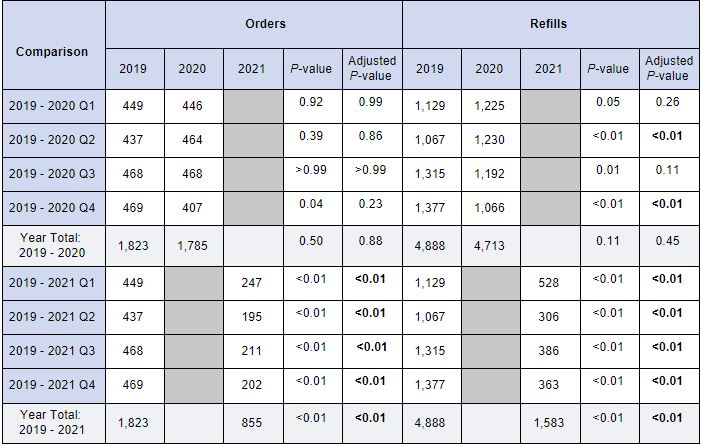
Results: For oral NSAIDs (table 1), all quarters of 2021 and 2021 as a whole had significantly less orders and refills than corresponding quarters in 2019 and 2019 as a whole (adjusted p value < 0.01). However, a significant increase in refills was observed in Q2 of 2020 (adjusted p value < 0.01) and a significant decrease in Q4 of 2020 (adjusted p value < 0.01).
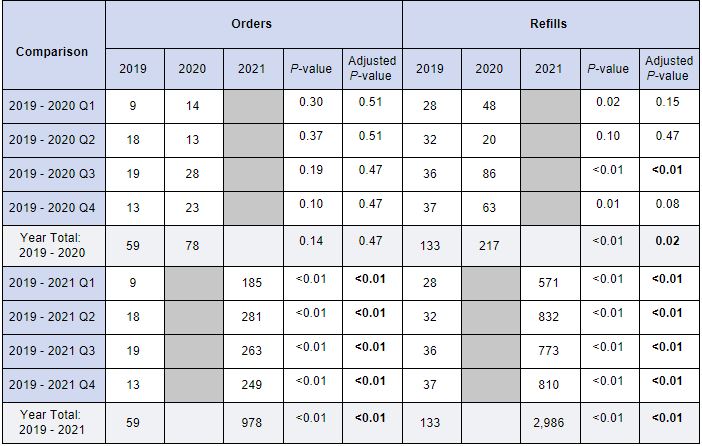
For topical NSAIDs (table 2), all quarters of 2021 and 2021 as a whole had significantly more orders and refills than corresponding quarters in 2019 and 2019 as a whole (adjusted p value < 0.01). However, a significant increase in refills was observed in Q3 of 2020 (adjusted p value < 0.01) as well as 2020 as a whole (adjusted p value 0.02).
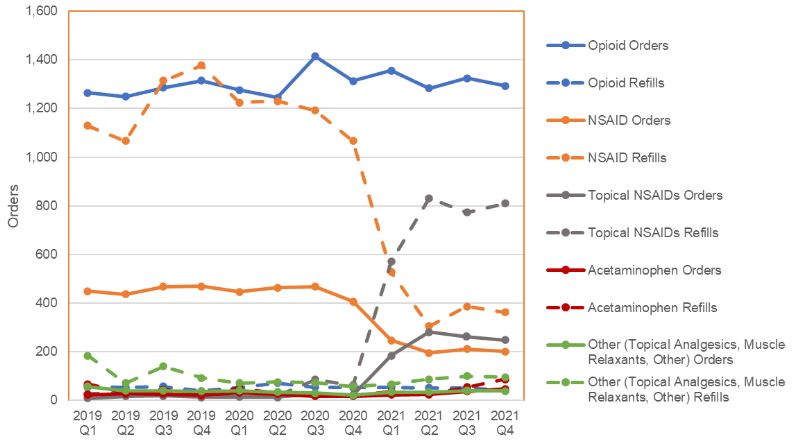
There were no differences in orders or refills of opioids, acetaminophen, or all other analgesics combined (figure 1).
Conclusion: Analgesic prescribing practices for the treatment of OA changed during the COVID-19 pandemic. Patients with OA were overall provided with significantly fewer orders and refills for oral NSAIDs and significantly more orders and refills for topical NSAIDs. There were no observed changes in opioid prescriptions for OA. In fiscal quarter 3 of 2020 a highly publicized Lancet publication theorized that oral NSAIDs may increase the risk of severe COVID-19 infection, the ACR/AF Guideline for the Management of OA was published, and the California Governor issued a statewide shelter in place order, any of which may have affected prescribing patterns. Future studies are needed to determine if the observed changes in analgesic prescribing practices have persisted post pandemic.
To cite this abstract in AMA style:
Ochi D, Pina D, Kaur M, Fine J, Black D, Wise B. Changes in Analgesic Prescriptions for the Treatment of Osteoarthritis During the COVID-19 Pandemic [abstract]. Arthritis Rheumatol. 2024; 76 (suppl 9). https://acrabstracts.org/abstract/changes-in-analgesic-prescriptions-for-the-treatment-of-osteoarthritis-during-the-covid-19-pandemic/. Accessed .« Back to ACR Convergence 2024
ACR Meeting Abstracts - https://acrabstracts.org/abstract/changes-in-analgesic-prescriptions-for-the-treatment-of-osteoarthritis-during-the-covid-19-pandemic/