
Session Information
Date: Tuesday, November 7, 2017
Title: Fibromyalgia, Soft Tissue Disorders, Regional and Specific Clinical Pain Syndromes Poster II
Session Type: ACR Poster Session C
Session Time: 9:00AM-11:00AM
Background/Purpose: Fibromyalgia patients are reported to have a straight neck on lateral x-ray views of the cervical spine. We measured the Cobb angle in fibromyalgia and non-fibromyalgia rheumatic disease patients in a rheumatology office practice.
Methods: The Cobb angle between the bottom of C2 and the top of C7 was measured in rheumatic disease patients without knowledge of the diagnosis..
Results: 121 patients, (84 fibromyalgia with a mean age of 45.3 and 37 non-fibromyalgia rheumatic disease controls with a mean age of 52.7), had radiographs of their cervical spine, which the Cobb angle was measured. We found that the cervical spine becomes noted as a “straight neck” at the 7° mark and below. There were 50 FMS and 13 controls with a cervical Cobb of 7° or below. Between 8° and 10° is where the cervical spine “straightness” becomes more prominent; there were 10 FMS and 1 control with a Cobb between 8° and 10°. There were 24 FMS and 23 control patients with a cervical Cobb angle of 11° or higher.
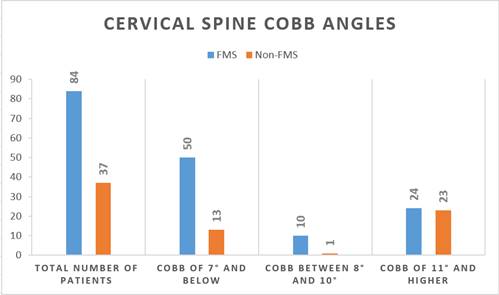
Conclusion: The Cobb angle between C2 and C7 was less than 10 degrees in fibromyalgia patients and greater than 10 degrees in rheumatic disease patients without fibromyalgia. The straight neck is present in fibromyalgia and may assist in the diagnosis. The cut-off point of 10 degrees may help to determine the presence of a significant loss of lordotic curve in future studies of fibromyalgia.
To cite this abstract in AMA style:
Katz RS, Small BJ, Katz Small A, Farkasch A. Cervical Spine Radiographs in Fibromyalgia Patients Show Reduced Cobb Angle and Suggest the Presence of Increased Muscle Pressure As a Cause of the Illness [abstract]. Arthritis Rheumatol. 2017; 69 (suppl 10). https://acrabstracts.org/abstract/cervical-spine-radiographs-in-fibromyalgia-patients-show-reduced-cobb-angle-and-suggest-the-presence-of-increased-muscle-pressure-as-a-cause-of-the-illness/. Accessed .« Back to 2017 ACR/ARHP Annual Meeting
ACR Meeting Abstracts - https://acrabstracts.org/abstract/cervical-spine-radiographs-in-fibromyalgia-patients-show-reduced-cobb-angle-and-suggest-the-presence-of-increased-muscle-pressure-as-a-cause-of-the-illness/