
Session Information
Session Type: Poster Session B
Session Time: 10:30AM-12:30PM
Background/Purpose: Cerebrovascular accidents (CVA) are one of the most devastating neurologic manifestations of childhood-onset systemic lupus erythematosus (cSLE). The spectrum of CVA in cSLE (CVAcSLE) includes thromboembolic, ischemic, and hemorrhagic events. Despite the severity and potentially disabling effects of CVA, large epidemiologic studies are lacking. Studies of adult-onset systemic lupus erythematosus (aSLE) suggest higher CVA severity and poorer outcomes with aSLE compared to other adults with CVA. Comparative studies on CVA in aSLE and cSLE are lacking. Thus, the purpose of this study was to understand the epidemiology of CVAcSLE, and compare CVA outcomes between cSLE and aSLE.
Methods: This retrospective cohort study utilized de-identified data over a 20-year period from an international federated real-world patient database (TriNetX). We included all patients with ICD-9 and/or ICD-10 codes corresponding to SLE. The TriNetX database automatically excludes patients greater than 90 years old to maintain confidentiality of the patients. We defined cSLE and aSLE as patients aged ≤ 18 years and ≥ 19 years respectively at the first recorded ICD code corresponding to SLE. We defined CVA as the presence of ICD-9 and/or ICD-10 codes corresponding to transient ischemic attack and/or CVA.
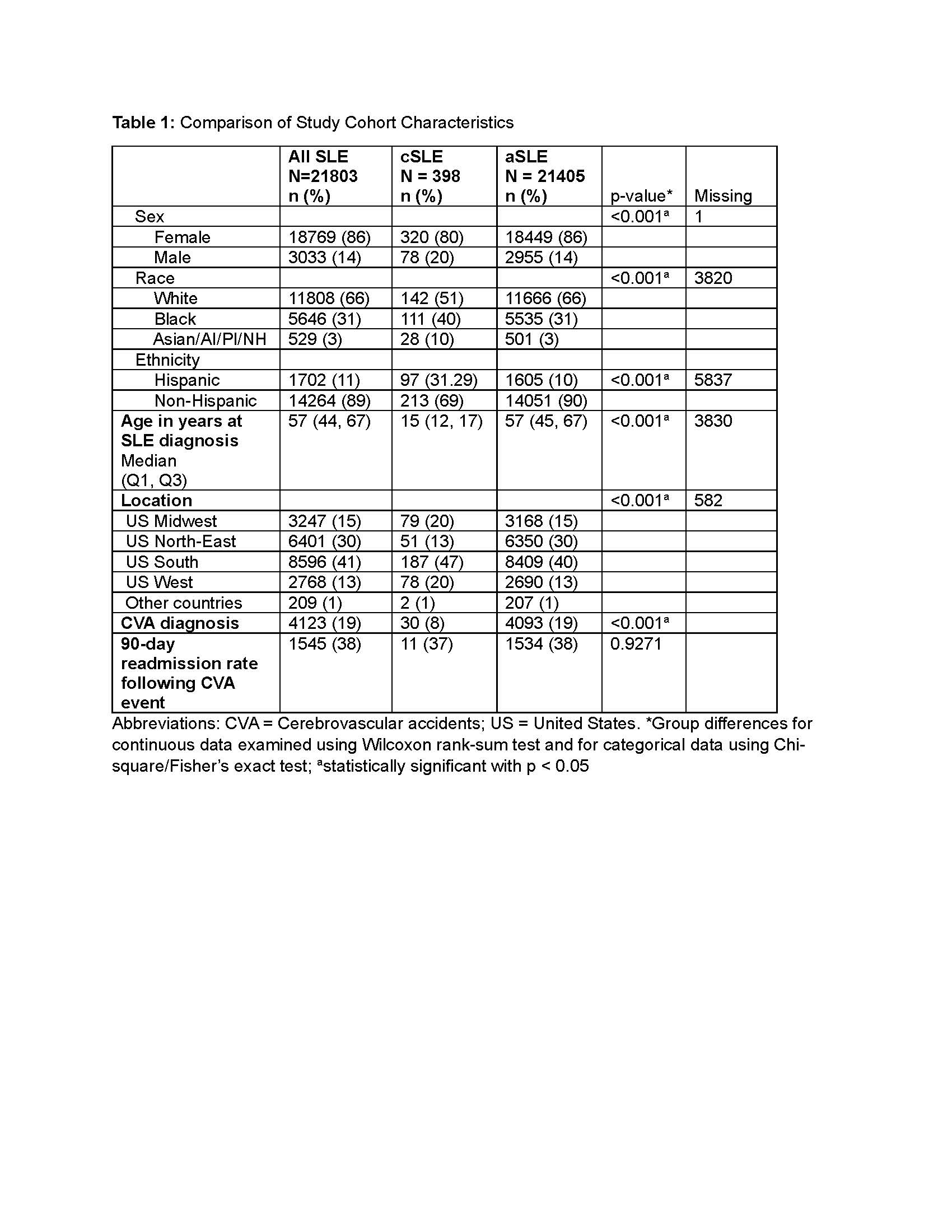
Results: Of the 112, 081, 954 patients in the TriNetX cohort, 21803 (0.02%) patients had SLE. Most patients with SLE were female (86%), White (66%) and non-Hispanic (89%) (Table 1). The prevalence of SLE was highest in the United States South compared to other regions (Table 1). The prevalence of CVA was 19% (n = 4123) in SLE patients overall, 8% (n = 30) in cSLE and 19% (n = 4093) in aSLE. In both cSLE and aSLE, the prevalence of CVA was highest in White patients followed by Black and other races; and also higher in non-Hispanic versus Hispanic patients. There was no significant difference in CVA prevalence by sex in both cSLE and aSLE. The odds of having CVA in aSLE was higher than in cSLE [OR 2.90; 95% CI (2.00, 4.21)]. The significantly higher risk in aSLE versus cSLE remained even after adjusting for age, sex, and race [OR 2.19; 95% CI (1.42 – 3.37)]. The risk of CVA was higher in females versus males [OR 1.16; 95% CI (1.05, 1.29)]. There was no significant difference in the 90-day readmission rate following CVA in cSLE compared to aSLE.
Conclusion: cSLE is associated with a high risk of CVA as 1 out of 12 children with cSLE will develop a CVA. Given that aSLE patients with CVA have a higher risk of CVA recurrence, and poorer outcomes compared to other non-SLE adults with CVA, further studies are needed on CVA risk factors and longer-term outcomes in cSLE.
To cite this abstract in AMA style:
Ogbu E, Meinzen-Derr J, Wagner M, Sahay R, Sharma D, Taylor J, Vadivelu S, Altaye M, brunner h. Cerebrovascular Accidents in Pediatric and Adult Systemic Lupus Erythematosus: A Comparison of Epidemiology and Outcomes [abstract]. Arthritis Rheumatol. 2024; 76 (suppl 9). https://acrabstracts.org/abstract/cerebrovascular-accidents-in-pediatric-and-adult-systemic-lupus-erythematosus-a-comparison-of-epidemiology-and-outcomes/. Accessed .« Back to ACR Convergence 2024
ACR Meeting Abstracts - https://acrabstracts.org/abstract/cerebrovascular-accidents-in-pediatric-and-adult-systemic-lupus-erythematosus-a-comparison-of-epidemiology-and-outcomes/