
Session Information
Session Type: Abstract Submissions (ACR)
Background/Purpose: Osteoarthritis (OA) is a chronic, prevalent disease that is a major cause of pain and disability. Pain is the primary symptom of OA, however its characteristics and pathophysiology remain poorly understood. Studies suggest that patients with knee OA have increased central sensitization, measured by pressure pain thresholds (PPTs) and temporal summation (TS) to repeated non-nociceptive stimulation. Here we evaluated the relationship between central sensitization (TS and PPTs) and pain magnitude in symptomatic knee OA.
Methods: Persons with moderate to severe radiographic (Kellgren-Lawrence (KL) grade ≥2) and symptomatic (at least 30mm on WOMAC visual analog scale) knee OA were compared with age matched controls without knee pain or OA (radiographic KL grade of 0-1, pain <20 on WOMAC VAS), and no history of diabetes, arthroplasty, or chronic widespread pain. In subjects with bilateral knee OA, the most symptomatic side was considered the “affected” side. Participants answered questionnaires regarding knee pain and function including the question “do you feel spontaneous pain in your knee?” Temporal summation (TS) was measured by application of a 60g Von Frey monofilament repeatedly (30 times) to pre-determined anatomic sites. Participants answered the question “do you consider this painful?” (yes/no) and rated their pain on a scale of 1-10. Pain pressure thresholds (PPT) were measured using a pressure algometer applied to pre-determined anatomic sites with steadily increasing pressure and recordings were taken at the first sensation of pain.
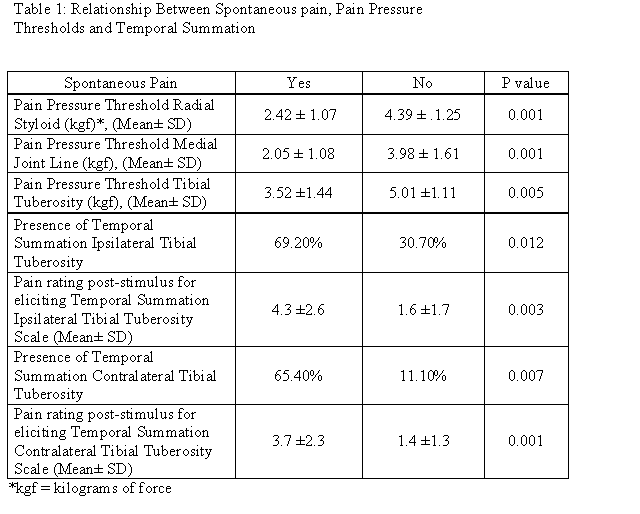
Results: 42 OA participants (mean age 54.1 ± 8.1 years) and 12 controls (mean age 52.9 ± 11.1 years) were evaluated. Significantly more OA subjects demonstrated TS compared with controls at the ipsilateral (54.8% vs 16.6%, p=0.02) and contralateral knee (49% vs 0%, p=0.005). PPTs were lower in the OA group but did not reach significance. KOOS and WOMAC pain scores did not correlate with PPT or TS at any of the several sites evaluated (rho= -0.115 to -0.139 and 0.150 to 0.286 respectively, p >0.05). Spontaneous pain in the knee was reported by those with knee OA more frequently than controls (74.3% vs 0%, p=0.001) and those with spontaneous knee pain had lower PPTs than those without spontaneous knee pain (Table 1). In patients with OA, spontaneous knee pain was also associated with the presence and pain rating of TS at the ipsilateral and contralateral tibial tuberosities (Table 1).
Conclusion: Conventional pain scales do not correlate well with measures of central sensitization. However, the presence of spontaneous pain is more frequent in OA patients than controls, and those who have spontaneous pain have generalized decreases in thresholds to pain sensation (lower PPTs) and also are more likely to demonstrate temporal summation.
Disclosure:
A. B. Dua,
None;
T. Neogi,
None;
R. A. Mikolaitis,
None;
J. A. Block,
None;
N. Shakoor,
None.
ACR Meeting Abstracts - https://acrabstracts.org/abstract/central-sensitization-is-associated-with-spontaneous-pain-in-knee-osteoarthritis/