
Session Information
Session Type: Abstract Submissions (ACR)
Background/Purpose: Cardiovascular disease is an important comorbidity in inflammatory arthritis. There is evidence that AS patients have a significant burden of cardiovascular comorbidity. This appears to correlate well with disease activity. To date, there is very little evidence of how cardiovascular disease impacts function in AS. The purpose of this study was to assess the impact of cardiovascular disease, including hypertension, ischemic heart disease and valvular heart disease on long-term functional outcomes in AS.
Methods: This is a prospective cohort of 611 AS patients, meeting the modified New York criteria followed up to 4 years. We collected cardiovascular medical history (including hypertension, angina, coronary artery disease, myocardial infarction, stent or angioplasty, bypass surgery and valvular disease, including valve replacement) in addition to other comorbidities at baseline. We also collected clinical and self-reported outcomes every 6 months. Functional outcomes were assessed by the Bath Ankylosing Spondylitis Functional Index (BASFI). Tracer comorbidities (such as pulmonary disease) were included as controls. Using mixed models, we assessed univariable associations between independent variables and function that accounted for correlation of repeated measures over time. Potential confounding and effect modifications were addressed while developing a final longitudinal multivariable model.
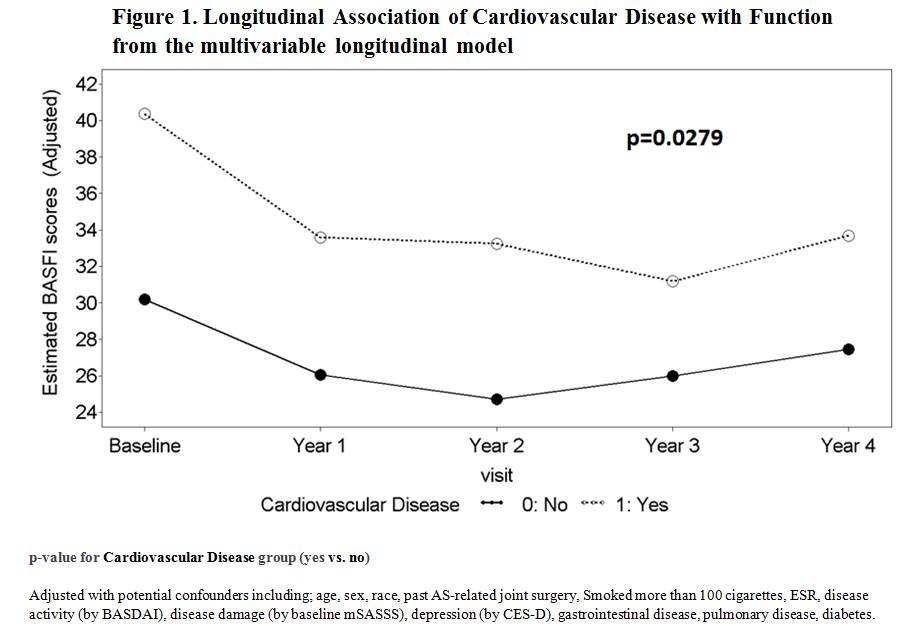
Results: There were 611 patients included with a mean age of 41.1 ± 13.6 years. The cohort comprised 71% males and 76% of patients were white. The mean disease duration was 17.6 ± 13.5 years. The mean baseline modified Stoke Ankylosing Spondylitis Spine Score (mSASSS) was 15.2 ± 21.1. At baseline, 24% of patients had any cardiovascular disease, including 4% with ischemic heart disease, 4% with valvular heart disease and 19% with hypertension. In the univariable analysis, composite cardiovascular disease ( p <0.0001), ischemic heart disease (p = 0.011) and hypertension (p <0.0001) , but not valvular heart disease were associated with BASFI longitudinally. Gastrointestinal disease was also significant (p <0.0001), but pulmonary disease and diabetes were not associated with BASFI over time. The final model also adjusted for age, gender, prior joint surgery, smoking, erythrocyte sedimentation rate, education, Bath Ankylosing Spondylitis Disease Activity Index (BASDAI), mSASSS and depression (by the Center for Epidemiologic Studies Depression Scale [CES-D]). Figure 1 shows the adjusted means of BASFI by the cardiovascular disease status which was found to be statistically significant over time (p = 0.0279).
Conclusion: AS patients with cardiovascular comorbidities have significantly worse function over time than those without cardiovascular disease.
Disclosure:
L. S. Gensler,
None;
M. M. Ward,
None;
M. Lee,
None;
M. Rahbar,
None;
M. A. Brown,
None;
J. D. Reveille,
None;
M. H. Weisman,
None.
« Back to 2013 ACR/ARHP Annual Meeting
ACR Meeting Abstracts - https://acrabstracts.org/abstract/cardiovascular-disease-is-associated-with-worse-functional-outcomes-in-ankylosing-spondylitis/