ACR Meeting Abstracts

ACR Meeting Abstracts

  • Meeting Abstracts
    • All Meetings
    • PRSYM 2026
    • ACR Convergence 2025
    • Download Abstract Supplements
  • Keyword Index
  • My Favorites
    • View & print my favorites
  • Search

Home » Meeting Abstracts » ACR Convergence 2022

Abstract Number: 0813

Canakinumab in Patients with Tumor Necrosis Factor Receptor-associated Periodic Syndrome (TRAPS) – Long-term Efficacy and Safety Data from a RELIANCE Registry Interim Analysis

Norbert Blank1, Catharina Schuetz2, Joerg Henes3, Tilmann Kallinich4, Prasad T. Oommen5, Michael Borte6, Markus Hufnagel7, Ales Janda8, Julia Weber-Arden9 and Jasmin B. Kuemmerle-Deschner10, 1Rheumatology, University Hospital Heidelberg, Heidelberg, Germany, 2Pediatrics, Medizinische Fakultaet Carl Gustav Carus, Technische Universitaet Dresden, Dresden, Germany, 3Center for Interdisciplinary Clinical Immunology, Rheumatology and Auto-inflammatory Diseases (INDIRA), University Hospital Tübingen, Tübingen, Germany, 4Charité - Universitätsmedizin Berlin, Nuremberg, Germany, 5Clinic of Pediatric Hematology, Oncology and Clinical Immunology, Heinrich-Heine-University Duesseldorf, Duesseldorf, Germany, 6ImmunoDeficiencyCenter Leipzig (IDCL), Hospital St. Georg gGmbH Leipzig, Germany, Leipzig, Sachsen, Germany, 7Division of Pediatric Infectious Diseases and Rheumatology, Department of Pediatrics and Adolescent Medicine, University Hospital Medical Center Freiburg, Medical Faculty, University of Freiburg, Freiburg, Germany, 8Department of Pediatrics, University Hospital Ulm, Ulm, Germany, 9Novartis Pharma GmbH, Nuernberg, Germany, 10Department of Pediatrics, Division of Pediatric Rheumatology, University Hospital Tübingen, Tübingen, Germany

Share on X (Twitter) Share on Facebook Share on LinkedIn Share on Email
Print

Meeting: ACR Convergence 2022

Keywords: Autoinflammatory diseases, Biologicals, Innate Immunity Rheumatic Disease, longitudinal studies

Session Information

Date: Sunday, November 13, 2022

Title: Miscellaneous Rheumatic and Inflammatory Diseases Poster II

Session Type: Poster Session B

Session Time: 9:00AM-10:30AM

Background/Purpose: TRAPS is a rare hereditary autoinflammatory disease characterized by periodic fever and severe systemic and organ inflammation. Successful treatment was achieved with the interleukin-1β inhibitor canakinumab (CAN) in a pivotal phase 3 study, in which 45% of patients achieved clinical remission after 16 weeks (primary endpoint). CAN has been approved for the treatment of TRAPS patients since 2017. The present study investigates the long-term efficacy and safety of CAN under routine clinical practice conditions in pediatric (age ≥2 years) and adult TRAPS patients.

Methods: RELIANCE is a prospective, non-interventional, multicenter observational study in Germany. Patients with a clinically confirmed diagnosis of TRAPS who routinely receive CAN will be enrolled in the study to evaluate the efficacy and safety of CAN under standard clinical conditions at baseline and at six-month intervals.

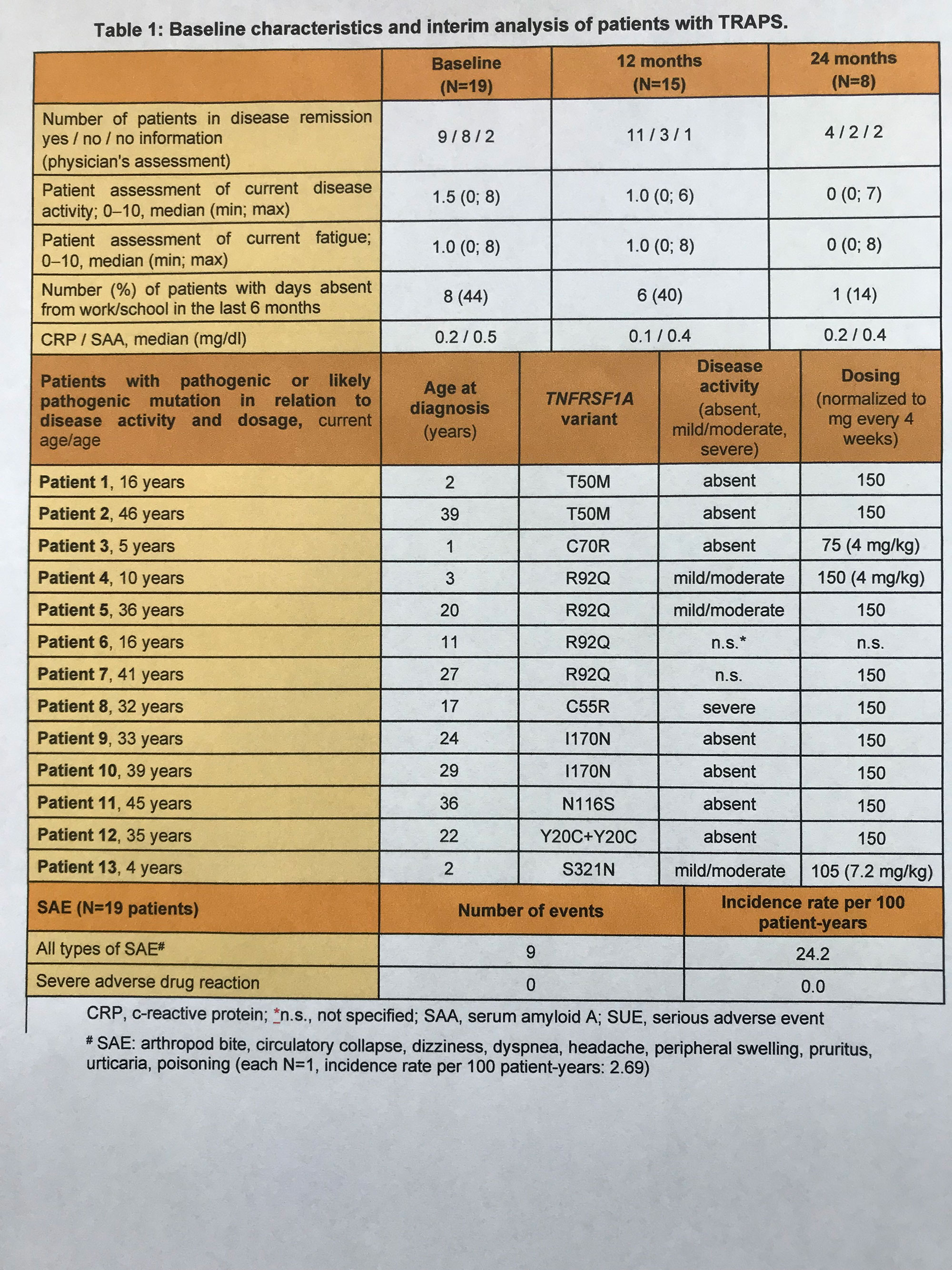
Results: The interim analysis of TRAPS patients enrolled through December 2021 included baseline data (N=19, 1 patient with atypical TRAPS) and preliminary 24-months data. Of these patients, N=12 (63%) were female and the median age at baseline was 16 years (3-43 years), and the median CAN pretreatment time was 1 year (0-4 years).Mutation information was provided for a total of N=13 patients, all of whom were pathogenic or likely pathogenic (Table 1). N=4 patients had dose adjustments (↑ dose increase, ↓ dose reduction): patient 1: ↑, patient 2: ↑↓, patient 3: ↑↑, patient 4: ↑↑↓↑. Preliminary results indicate stable remission according to physician assessment and laboratory parameters. Disease control according to patient assessment showed no significant changes over time (Table 1). Of N=9 SAEs, none occurred in association with therapy. A total of N=7 adverse drug events were observed, all of which were not considered severe.

Conclusion: Baseline and interim data from the RELIANCE trial for TRAPS patients indicate continued good efficacy and safety of various CAN doses.
Supporting image 1

Table 1: Baseline characteristics and interim analysis of patients with TRAPS.


Disclosures: N. Blank, Novartis, SOBI, Lilly, Pfizer, AbbVie/Abbott, Bristol-Myers Squibb(BMS), Merck/MSD, Actelion, UCB, Boehringer-Ingelheim, Roche; C. Schuetz, Novartis; J. Henes, Boehringer Ingelheim; T. Kallinich, Roche; P. Oommen, Novartis; M. Borte, Pfizer, Shire; M. Hufnagel, Novartis; A. Janda, None; J. Weber-Arden, Novartis; J. Kuemmerle-Deschner, AbbVie/Abbott, Novartis, SOBI.

To cite this abstract in AMA style:

Blank N, Schuetz C, Henes J, Kallinich T, Oommen P, Borte M, Hufnagel M, Janda A, Weber-Arden J, Kuemmerle-Deschner J. Canakinumab in Patients with Tumor Necrosis Factor Receptor-associated Periodic Syndrome (TRAPS) – Long-term Efficacy and Safety Data from a RELIANCE Registry Interim Analysis [abstract]. Arthritis Rheumatol. 2022; 74 (suppl 9). https://acrabstracts.org/abstract/canakinumab-in-patients-with-tumor-necrosis-factor-receptor-associated-periodic-syndrome-traps-long-term-efficacy-and-safety-data-from-a-reliance-registry-interim-analysis/. Accessed .

ACR Meeting Abstracts - https://acrabstracts.org/abstract/canakinumab-in-patients-with-tumor-necrosis-factor-receptor-associated-periodic-syndrome-traps-long-term-efficacy-and-safety-data-from-a-reliance-registry-interim-analysis/

My Favorites

Save and print abstracts during your browser session by clicking the “Favorite” button at the bottom of any abstract (must have cookies enabled in browser). See saved favorites.

Abstract Policies

  • ACR Convergence Abstract Embargo Policies
  • ACR Convergence Abstract Permissions & Reprints
  • PRSYM Abstract Policies

ACR Convergence. Where Rheumatology Meets

ACR Convergence 2026

Join us November 6-11 in Orlando, Florida.
See Registration Information

  • Contact ACR
  • Privacy Policy
  • ACR Policies
  • Cookie Preferences

© Copyright 2026 American College of Rheumatology