
Session Information
Session Type: Poster Session A
Session Time: 1:00PM-3:00PM
Background/Purpose:Patients’ post-operative satisfaction with their hospital experience is important to patient care, hospital reimbursement, and comparison between hospitals. The Press Ganey (PG) inpatient survey is commonly administered to assess patient satisfaction with the hospital experience. We aimed to determine whether patients’ PG survey overall assessment scores following primary hip and knee arthroplasty differ by race and payor.
Methods: We retrospectively linked data for patients in large institutional hip and knee arthroplasty registries consisting of surgeries from July 2010–February 2012 to their PG survey responses. Patients undergoing primary unilateral surgery of self-identified black or white race who resided in New York, New Jersey, or Connecticut at the time of surgery were included in the analysis. The primary outcome variable was the PG overall assessment score, calculated as the mean of a patient’s ratings for the three questions in the “Overall Assessment” section of the PG survey which cover how well staff worked together, the likelihood of recommending the hospital to others, and the overall rating of care. We also analyzed questions within the PG survey related to patient satisfaction with physicians and nurses. All scores were dichotomized as either completely satisfied (score of 100) or not completely satisfied (score < 100). Multivariable logistic regression was performed to determine if patient race and primary payor were associated with being not completely satisfied, adjusting for age, sex, and American Society of Anesthesiology (ASA) score as a proxy for overall health.
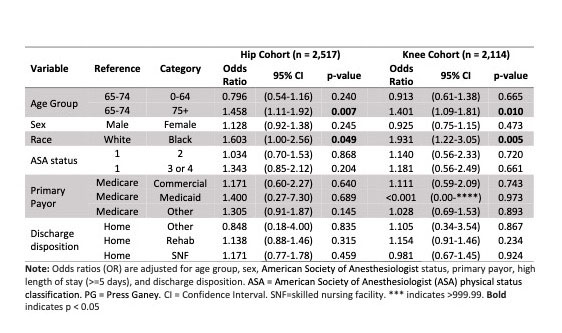
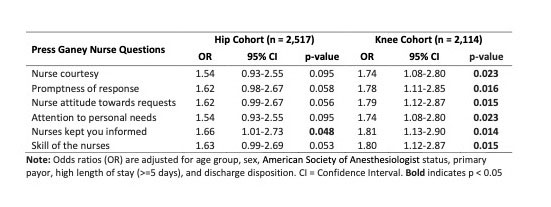
Results: There were 2,517 hip patients and 2,114 knee patients with PG overall assessment scores included in the analyses (Table 1). Black patients were less likely to be completely satisfied than white patients in both the hip cohort (odds ratio (OR)=1.603; p=0.049) and the knee cohort (OR=1.931; p=0.005). Patients over 75 years of age were less likely to be completely satisfied than patients 65-74 in both the hip cohort (OR=1.458; p=0.007) and the knee cohort (OR=1.401; p=0.010). Table 2 shows the results of multivariable logistic regression analysis for the six nurse-related questions. The most significant disparity between black and white patients was seen in the ‘kept you informed’ question in both hip and knee cohorts (OR=1.66; p=0.048 and OR=1.81; p=0.014, respectively). In other questions which address topics such as courtesy, attitude, skill, promptness, and attention to personal needs, only black patients in the knee cohort were less likely to be completely satisfied than white patients (OR ranging from 1.74 to 1.81; p< 0.05) in all questions related to nurses. This difference between black and white patients was not present in the hip cohort, and there were no differences between black and white patients in their likelihood of being satisfied with their physicians.
Conclusion: Black patients were less likely to be completely satisfied compared to white patients following hip and knee arthroplasty, and black patients were less likely to report complete satisfaction regarding nurses. More research is needed to investigate other factors such as baseline pain and function to understand why these disparities exist.
To cite this abstract in AMA style:
Gibbons J, Burke O, do h, Lai E, Mehta B, Bradford L, Parks M, Russell L, Bass A, Figgie M, Goodman S. Black Patients Are Less Satisfied with the Hospital Experience After Primary Hip and Knee Arthroplasty [abstract]. Arthritis Rheumatol. 2022; 74 (suppl 9). https://acrabstracts.org/abstract/black-patients-are-less-satisfied-with-the-hospital-experience-after-primary-hip-and-knee-arthroplasty/. Accessed .« Back to ACR Convergence 2022
ACR Meeting Abstracts - https://acrabstracts.org/abstract/black-patients-are-less-satisfied-with-the-hospital-experience-after-primary-hip-and-knee-arthroplasty/