
Session Information
Date: Sunday, November 17, 2024
Title: Muscle Biology, Myositis & Myopathies – Basic & Clinical Science Poster II
Session Type: Poster Session B
Session Time: 10:30AM-12:30PM
Background/Purpose: The idiopathic inflammatory myopathies (IIMs) constitute a diverse group of acquired muscle disorders, often involving multiple organs such as the skin, heart, and lungs. Interstitial lung disease (ILD) is a common pulmonary manifestation in IIM (IIM-ILD), significantly impacting morbidity and mortality. However, the prognostic implications of autoantibody and radiological profiles in IIM-ILD remain inadequately characterized.
This study aims to investigate the influence of immunological and radiological profiles at baseline on both mortality and the development of ILD in individuals with IIM.
Methods: A retrospective analysis was conducted on a cohort of IIM patients, stratified based on the presence or absence of ILD. The study encompassed a comprehensive evaluation of epidemiological, clinical, immunological, treatment, chest HRCT scans and pulmonary function test at baseline (%FVC and %DLCO). Univariate and multivariate Cox proportional hazards analyses were employed to compare mortality and ILD incidence across distinct autoantibody groups. Logistic regression assessed predictors for ILD and mortality. Kaplan-Meier survival curves were generated and the log rank ratio was used to identify differences
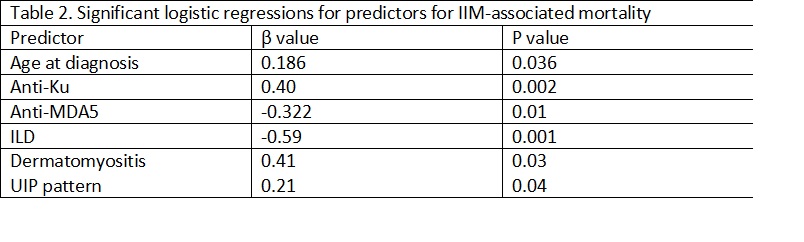
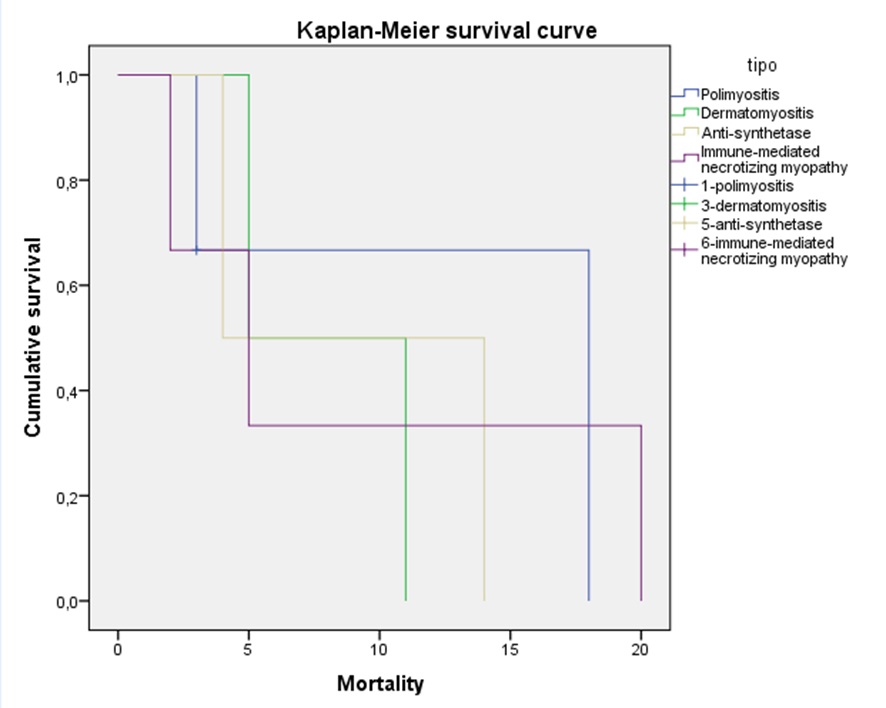
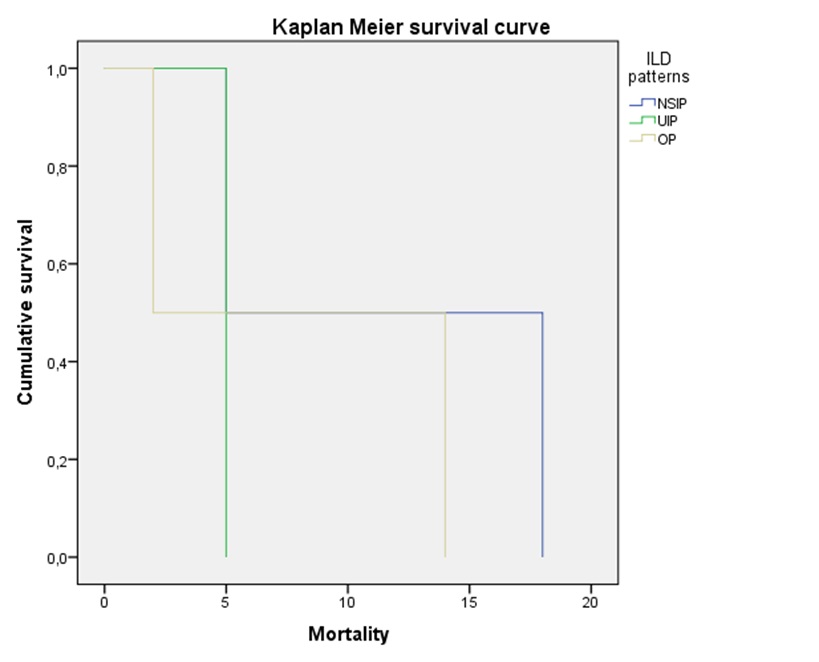
Results: 80 patients diagnosed with IIM (62.5% female) were included. The cohort exhibited a mean age of 62.2±26 years, with a mean duration of 5.6±6 years since diagnosis. 22 patients had ILD (28%) and 10 (12.5%) patients died during follow-up. ILD was associated with Anti-Ro52 (OR 8.42, CI 95% 1.48-12.3, p=0.004), anti-Jo1 (OR 12.7 CI 95% 2.29 – 82.45, p=0.0003) and anti-PL12 (OR 8.62 CI 95% 1.06-16.02. p=0.003) positivity and anti-synthetase syndrome (OR 27, CI 95% 16.2-52.4, p< 0.0001). Mortality was associated with anti-Ku positivity (OR 13.9 CI 95% 1.78 – 8.23, p=0.0003), anti-MDA5 (OR 2.4 CI 95% 1.2-7.53, p=0.03), ILD (OR 10.2 CI 95% 6.24-14.3, p=0.02) and dermatomyositis (OR 12, CI 95% 6.4-21.5, p=0.003). Multiple logistic regression identified as predictors for developing IIM-ILD the presence of respiratory symptoms (β =0.4, p=0.03), smoking (β =0.37, p=0.003), anti-Jo (β =0.52, p=0.013) and anti-PL12 (β =0.76, p=0.013), erythrocyte sedimentation rate (β =0.29, p=0.004), %DLCO at baseline (β =-0.4, p=0.001) and anti-synthetase syndrome (β =0.32, p=0.04) represented in table 1. Age at diagnosis (β =0.48, p=0.004), anti-Ku positivity (β =0.82, p=0.0001) and anti-MDA5 (β =0.30, p=0.03), ILD (β =0.52, p=0.001), usual interstitial pneumonia pattern (β =0.21, p=0.04), dermatomyositis (β =0.41, p=0.03) were identified as predictors for mortality in IIM patients (table 2). Survival rate at 20 years was lower in dermatomyositis patients (log rank test p < 0.001) and in patients with UIP pattern (log rank test p =0.02) (figure 1 and 2).
Conclusion:
Among the different autoantibody profiles in myositis spectrum disorders, anti-PL12 and anti-Jo1 conferred a higher risk of ILD, meanwhile anti-Ku and anti-MDA5 a higher risk of mortality in IIM patients. Survival rate at 20 years was lower in dermatomyositis patients and in patients with UIP pattern.
To cite this abstract in AMA style:
sieiro santos c, Retuerto M, Sierra L, Ordas Martínez J, Pérez García P, Baenas P, Moriano Morales C, Díez Álvarez E. Autoantibody and Radiological Profiles as Prognostic Indicators in Idiopathic Inflammatory Myopathies: Insights into Mortality and Interstitial Lung Disease Development [abstract]. Arthritis Rheumatol. 2024; 76 (suppl 9). https://acrabstracts.org/abstract/autoantibody-and-radiological-profiles-as-prognostic-indicators-in-idiopathic-inflammatory-myopathies-insights-into-mortality-and-interstitial-lung-disease-development/. Accessed .ACR Meeting Abstracts - https://acrabstracts.org/abstract/autoantibody-and-radiological-profiles-as-prognostic-indicators-in-idiopathic-inflammatory-myopathies-insights-into-mortality-and-interstitial-lung-disease-development/