
Session Information
Session Type: Poster Session (Tuesday)
Session Time: 9:00AM-11:00AM
Background/Purpose: To quantify associations between baseline and change in computer-assisted hip quantitative joint space width (qJSW) with incident radiographic (rHOA) or symptomatic (sxHOA) hip OA.
Methods: The Johnston County OA Project (JoCoOA) is a longitudinal study of African American and white men and women. We analyzed individuals with anteroposterior pelvis x-rays from baseline and 3 follow up timepoints, approximately 6 years apart. Per protocol, women < 50 years did not have pelvis radiography. An expert musculoskeletal radiologist (JBR) assigned all hips a Kellgren-Lawrence grade (KLG). At all timepoints, participants reported presence of hip symptoms (On most days, do you have pain, aching, or stiffness in your (right, left) hip?”). Incident rHOA was KLG ≥ 2 at follow up, while incident sxHOA required both rHOA and symptoms in the same hip, among those without baseline rHOA or sxHOA, respectively. An independent reader (JD), blinded to all other data, measured qJSW (at 50 degrees, Figure 1) using a previously validated method. Analyses were in two steps. First, we used latent class modeling to identify clusters of hips with different patterns of qJSW change from baseline. Second, incident rHOA and sxHOA were modelled using logistic regression with generalized estimating equations to account for correlated hips; the independent relationship of baseline qJSW and identified cluster membership by sex with each outcome was estimated using adjusted (for age, race, education, height, body mass index [BMI], weight gain or loss [5% BMI change], and hip injury) odds ratios and 95% confidence intervals.
Results: Of 577 participants with 1154 hips meeting above criteria, 397 participants and 784 hips remained (59% women, 24% African American, average age 56 years) after excluding those missing hip films or with hip replacement. Baseline BMI was 28.6 (5.1) kg/m2; 52% experienced >5% BMI increase over follow-up.
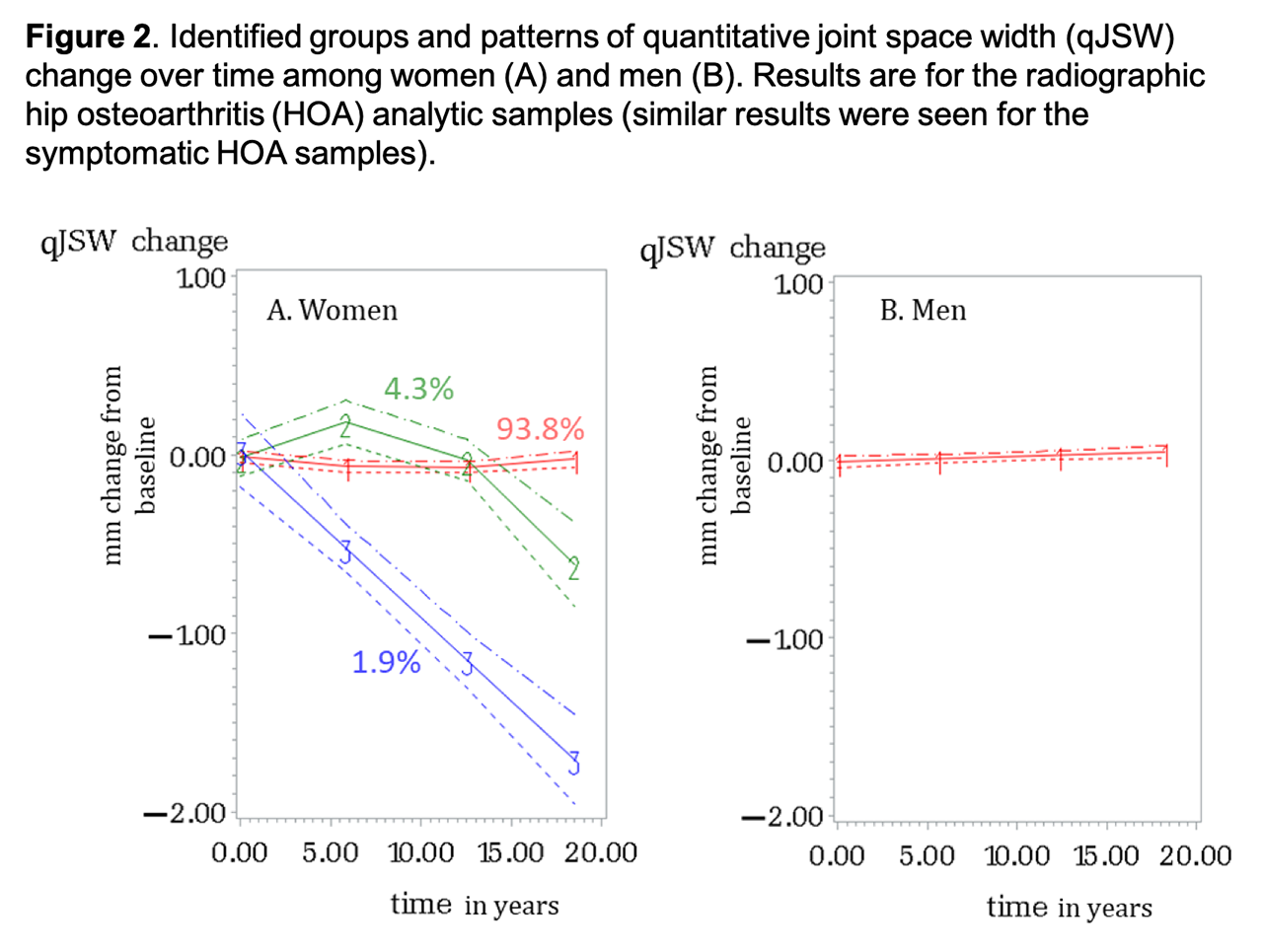
Among women, after exclusions for missing qJSW at 50 degrees and prevalent HOA, 360 and 410 hips were included in the incidence analysis of rHOA and sxHOA, resulting in an overall incidence of 25% and 13%, respectively. Three patterns were seen in qJSW change over time; a constant qJSW group (Figure 2.A=1 red; n=394 [94%]), and two groups with loss over time (Figure 2.A=2 green and 3 blue; n=26 [6%]), combined for analysis. Narrower baseline qJSW and loss of qJSW over time were independently associated with increased odds of incident rHOA and sxHOA (Table 1).
Among men, after exclusions for missing qJSW at 50 degrees and prevalent HOA, 261 and 297 hips were included in the incidence analysis of rHOA and sxHOA, resulting in an overall incidence of rHOA and sxHOA of 21% and 10%, respectively. Men had only one qJSW pattern–constant over time (Figure 2.B red). In adjusted models, narrower qJSW at baseline was associated with increased odds of incident rHOA and sxHOA (Table 1).
Conclusion: Narrower qJSW at baseline predicts incident rHOA and sxHOA in both men and women, although more strongly in women; qJSW loss over time predicted incident HOA only in women. QJSW assessment may identify individuals at increased risk for HOA, allowing for earlier intervention to try to reduce HOA progression.


To cite this abstract in AMA style:
Smith J, Alvarez C, Arbeeva L, Renner J, Murphy L, Jordan J, Golightly Y, Duryea J, Nelson A. Associations Between Baseline and Longitudinal Quantitative Joint Space Width and Incident Hip Osteoarthritis: The Johnston County Osteoarthritis Project [abstract]. Arthritis Rheumatol. 2019; 71 (suppl 10). https://acrabstracts.org/abstract/associations-between-baseline-and-longitudinal-quantitative-joint-space-width-and-incident-hip-osteoarthritis-the-johnston-county-osteoarthritis-project/. Accessed .« Back to 2019 ACR/ARP Annual Meeting
ACR Meeting Abstracts - https://acrabstracts.org/abstract/associations-between-baseline-and-longitudinal-quantitative-joint-space-width-and-incident-hip-osteoarthritis-the-johnston-county-osteoarthritis-project/