
Session Information
Date: Tuesday, October 23, 2018
Title: 5T086 ACR Abstract: Epidemiology & Pub Health III: SLE & SSc, Big Data & Large Cohorts (2802–2807)
Session Type: ACR Concurrent Abstract Session
Session Time: 2:30PM-4:00PM
Background/Purpose: High intake of antioxidants, fruits/vegetables, nuts and legumes and low intake of sodium, sweetened beverages, and red/processed meats may reduce inflammatory biomarkers and decrease risk of chronic inflammatory diseases. Current knowledge remains scarce regarding the association of diet and SLE risk. We prospectively evaluated four dietary quality scores and risk of SLE and its subtypes, dsDNA positive (+) versus negative (-) SLE. We hypothesized that SLE risk would be inversely associated with adherence to healthier dietary quality scores (including the Alternative Healthy Eating Index [AHEI-2010], Alternative Mediterranean Diet Score [aMed], and Dietary Approach to Hypertension [DASH]) and positively associated with an inflammatory dietary pattern, measured by the validated Empirical Dietary Inflammatory Pattern [EDIP]).
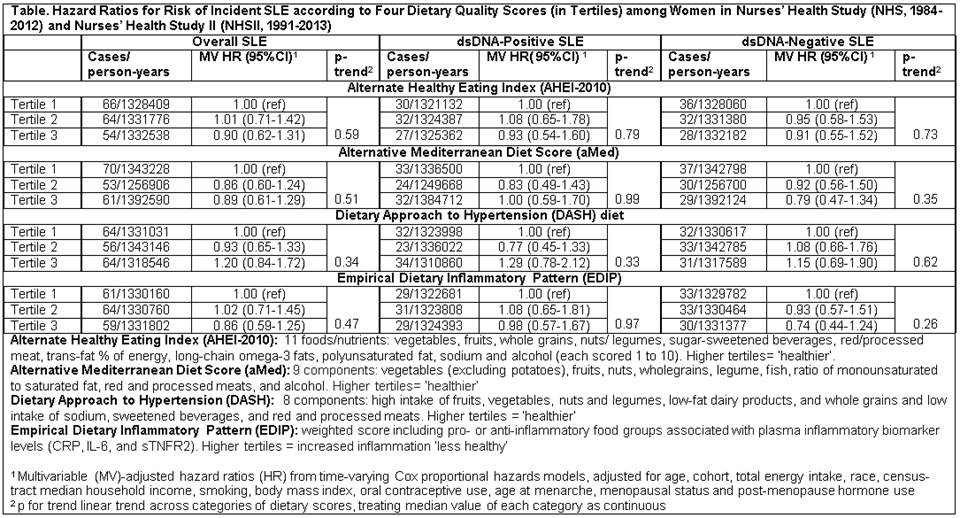
Methods: We included 79,569 female nurses in NHS (1984-2012) and 93,553 in NHSII (1991-2013). Lifestyle, environmental, and medical data were collected on baseline and biennial questionnaires. Incident SLE was confirmed by medical record review. Dietary data were obtained from validated food frequency questionnaires at baseline and approximately every 4 years in follow-up. Four dietary scores, (AHEI-2010, aMed, DASH, and EDIP), were calculated and women were classified according to dietary score use in tertiles. Time-varying Cox regression models estimated multivariable-adjusted hazard ratios (HRs [95% confidence intervals]) of SLE risk, adjusting for potential confounders, overall and by dsDNA subtype, in association with cumulative average dietary scores in tertiles through the 2-year cycle prior to diagnosis.
Results: We identified 184 incident SLE cases (89 dsDNA+ and 95 dsDNA-) from 1984 to 2013. SLE risk was not significantly different among women with dietary patterns in the highest tertile of each dietary score (vs. lowest tertile; AHEI-2010: HR 0.90 [95% CI 0.62-1.31], aMed: HR 0.89 [95% CI 0.61-1.29], DASH: HR 1.20 [95% CI 0.84-1.72], EDIP: HR 0.86 [95% CI 0.59-1.25]). No significant trends across tertiles of dietary patterns were observed and no risk was demonstrated for dsDNA+ or dsDNA- SLE subtype with any dietary score (Table).
Conclusion: No association was demonstrated between long-term adherence to the AHEI-2010, aMed, DASH, or EDIP scores with SLE risk overall or by dsDNA subtype among women. These studies make a large effect of dietary pattern upon the risk of developing SLE among women unlikely.
To cite this abstract in AMA style:
Barbhaiya M, Lu B, Tedeschi SK, Leatherwood C, Sparks JA, Karlson E, Costenbader K. Association of Dietary Quality Scores and Incident SLE in the Nurses’ Health Studies [abstract]. Arthritis Rheumatol. 2018; 70 (suppl 9). https://acrabstracts.org/abstract/association-of-dietary-quality-scores-and-incident-sle-in-the-nurses-health-studies/. Accessed .« Back to 2018 ACR/ARHP Annual Meeting
ACR Meeting Abstracts - https://acrabstracts.org/abstract/association-of-dietary-quality-scores-and-incident-sle-in-the-nurses-health-studies/