
Session Information
Session Type: Abstract Session
Session Time: 4:15PM-4:30PM
Background/Purpose: Individuals with rheumatic conditions are at an increased risk of experiencing cardiovascular events. Social risk factors contribute to disparities in comorbidities and adverse outcomes and may confer higher risk of Major Adverse Cardiovascular Events (MACE) in patients with rheumatic conditions. We aimed to understand whether MACE risk differed by exposure to specific social risk factors including poverty, discrimination and food insecurity.
Methods: We used data from the nationwide NIH All of Us Research Program (V8) and included adults age >18 years with ≥ 2 diagnosis codes ≥30 days apart for lupus (SLE), rheumatoid arthritis (RA), and osteoarthritis (OA) 2 years pre-enrollment. We required participants to have completed Social Determinants of Health-related questionnaires at enrollment. We examined individual answers to social risk factor questions about economic instability, healthcare access challenges, and neighborhood factors, as well as scores on the previously validated Everyday Discrimination Scale and Ross-Mirowsky Neighborhood Disorder Scale. The primary outcome was MACE (myocardial infarction, stroke, intervention for coronary artery disease). Patients were followed from enrollment until their first MACE-related event or end of study period. We used multivariable Cox proportional hazard models to evaluate associations between each social risk factor and MACE, adjusting for age, sex, race, ethnicity, rheumatic disease and Deyo-Charlson Comorbidity index.
Results: We identified 17,121 individuals in All of Us who met our criteria. The mean (SD) age was 65 (11) years, 69% were female, and 75% were white. There were 1,336 outcome events, and the mean (SD) follow up time was 2.6 (1.8) years. After adjusting for covariates, presence vs. absence of several social risk factors was associated with a higher risk of MACE (Figure 1). Specifically, food insecurity (HR 1.35, 95% CI 1.16 – 1.56), delaying medical care due to cost (HR 1.17, 95% CI 1.02 – 1.35), and living in areas with high neighborhood disorder (HR 1.23, 95% CI 1.07 – 1.41) were all associated with increased risk of MACE.
Conclusion: In this national study, we found that the presence vs. absence of most social risk factors was strongly associated with increased risk of MACE among individuals with SLE, RA, and OA. Further studies should determine whether addressing these risk factors reduces the risk of cardiovascular events.
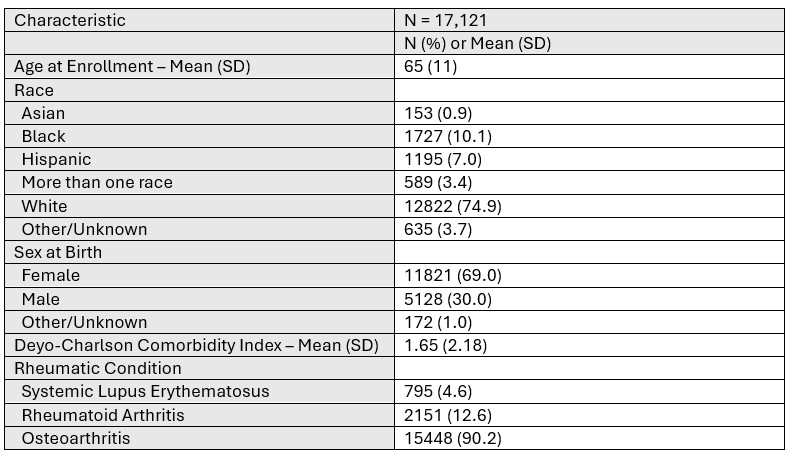 Table 1. Baseline Characteristics of individuals with SLE, RA, and OA in All of Us
.jpg) Figure 1. Hazard ratios for the association between several social risk factors and major adverse cardiovascular events adjsuted by age, sex, race, ethnicity, rheumatic condition and comorbidity index
Figure 1. Hazard ratios for the association between several social risk factors and major adverse cardiovascular events adjsuted by age, sex, race, ethnicity, rheumatic condition and comorbidity index
To cite this abstract in AMA style:
Santacroce L, Yee J, Cui J, Oakes E, Guan H, Costenbader K. Association Between Social Risk Factors and Major Adverse Cardiovascular Events Among Individuals with Rheumatic Conditions [abstract]. Arthritis Rheumatol. 2025; 77 (suppl 9). https://acrabstracts.org/abstract/association-between-social-risk-factors-and-major-adverse-cardiovascular-events-among-individuals-with-rheumatic-conditions/. Accessed .« Back to ACR Convergence 2025
ACR Meeting Abstracts - https://acrabstracts.org/abstract/association-between-social-risk-factors-and-major-adverse-cardiovascular-events-among-individuals-with-rheumatic-conditions/