
Session Information
Date: Monday, November 13, 2023
Title: (1124–1154) Miscellaneous Rheumatic & Inflammatory Diseases Poster II
Session Type: Poster Session B
Session Time: 9:00AM-11:00AM
Background/Purpose: Interstitial lung disease (ILD) is a frequent pulmonary manifestation in idiopathic inflammatory myopathies (IIM) (IIM-ILD) and considerably influences morbidity and mortality. Krebs von den Lungen 6 (sKL-6) has been proposed as a potential biomarker reflecting the severity of ILD in connective tissue diseases. Raynaud’s phenomenon is very frequent and the presence of microvascular changes in IIM have been described however, the role of nailfold videocapillaroscopy (NVC) in diagnosis and prognosis in IIM is not clearly established. We aim to determine if there is any association between NVC findings, sKL-6 levels and pulmonary involvement in patients with inflammatory myopathies.
Methods: We performed a retrospective study of IIM patients followed in a reference center and compared them according to the presence of ILD. Epidemiological, clinical and immunological data, pulmonary function tests, sKL-6 levels and NVC finding were retrieved. NVC findings including loss of capillary density, enlarged and giant capillaries, ramified capillaries, haemorrhages, thrombosis, avascular areas, disorganization of capillary architecture and subpapillary venous plexus presence were recollected, if present. Statistical analysis was performed by T-test and Fisher’s exact test to compare qualitative and/or quantitative variables and multiple logistic regression modelling to identify correlation between pulmonary function tests, NVC findings and sKL-6 levels. Values of p< 0.05 were considered statistically significant
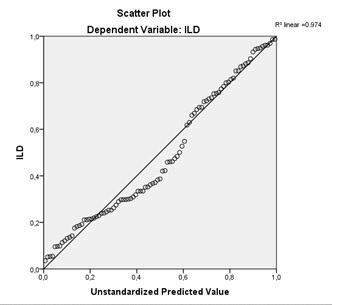
Results: 95 patients were included, 47 patients (49%) with ILD. 34% were male with a median age at inclusion of 55.3±24 years and a median disease duration of 6.8±7 years. Avascular areas and capillary loss showed a significant association with the presence of ILD (OR 2.43, 95% CI 1.3-5.7, p 0.004) and (OR 1.7, 95% CI 1.48-3.1, p 0.04). A negative correlation between capillary loss and enlarged capillaries was also found with FVC% (β=-0.46, p 0.001 and β=-0.57, p <0.0001) and DLCO% (β=-0.32, p 0.04 and β=-0.23, p 0.03), respectively. When we studied the correlation between sKL-6 levels, positive correlations with the presence of ILD (β=0.77, p 0.0004), the presence of hemorrhages (β =0.21, p 0.04) and avascular areas in NVC (β =0.64, p 0.03) and negative correlations with FVC% (β=-0.47, p 0.001) and DLCO% (β=-0.59, p, 0.005) were found. Multiple logistic regression identified as predictors for developing IIM-ILD are summarized in table 1 and represented in the scatter plot in figure 1. Male sex, respiratory symptoms, %FVC and %DLCO, sKL-6 levels, anti-Jo1 positivity and the presence of avascular areas and enlarged capillaries in NVC were identified as IIM-ILD predictors (R²=0.974, p =0.006).
Conclusion: Capillary loss and avascular areas showed a significant association with the presence of ILD, worse FVC and DLCO values and sKL-6 levels. We identified 9 predictors for developing ILD in IIM. NVC assessment and sKL-6 levels can have a predictive role for studying pulmonary function and assessing the prognosis of IIM-ILD.

To cite this abstract in AMA style:
Sieiro Santos C, Tandaipan J, Castillo D, Martínez Martínez L, Codes H, Sainz-Comas L, Magallares-Lopez B, Moya P, Mariscal A, Sang Park H, Millán Arciniegas A, Díaz-Torné C, Laíz Alonso A, Ros S, Fernández S, Corominas H, Díez Álvarez E, Castellvi I. Association Between Nailfold Videocapillaroscopy Findings and sKL-6 Levels in Patients with Idiopathic Inflammatory Myopathies–Related Interstitial Lung Disease [abstract]. Arthritis Rheumatol. 2023; 75 (suppl 9). https://acrabstracts.org/abstract/association-between-nailfold-videocapillaroscopy-findings-and-skl-6-levels-in-patients-with-idiopathic-inflammatory-myopathies-related-interstitial-lung-disease/. Accessed .« Back to ACR Convergence 2023
ACR Meeting Abstracts - https://acrabstracts.org/abstract/association-between-nailfold-videocapillaroscopy-findings-and-skl-6-levels-in-patients-with-idiopathic-inflammatory-myopathies-related-interstitial-lung-disease/