
Session Information
Date: Saturday, November 12, 2022
Title: Vasculitis – ANCA-Associated Poster I: Epidemiology, Outcomes, and Classification
Session Type: Poster Session A
Session Time: 1:00PM-3:00PM
Background/Purpose: Previous classification of childhood vasculitis used 1990 ACR criteria for classifying granulomatosis with polyangiitis (GPA) and eosinophilic granulomatosis with polyangiitis (EGPA),. In 2008, EULAR/PRINTO/PRES (EPP) developed pediatric-specific criteria for GPA. There were no classification criteria for microscopic polyangiitis (MPA) and these patients have been classified according to the European medical agency (EMA) algorithm. In 2022, ACR/EULAR published new criteria for classifying GPA, MPA, and EGPA for adults. We aimed to assess the utility of the 2022 ACR/EULAR criteria among children with small to medium vessel vasculitis
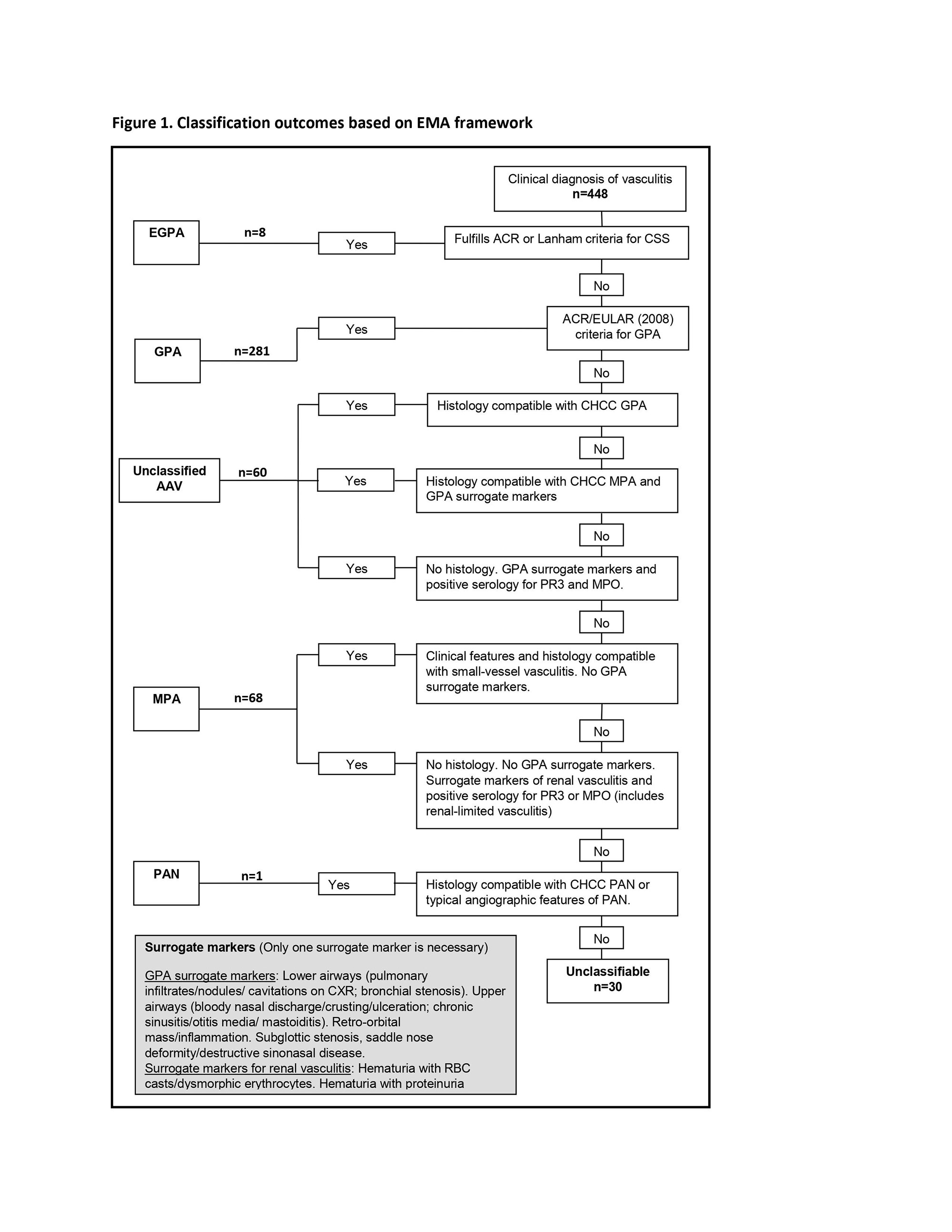
Methods: ARChiVe (A Registry for Childhood Vasculitis) collects clinical data from patients with chronic systemic vasculitis. All patients in ARChiVe with an MD diagnosis of EGPA, GPA, MPA, unclassified AAV, or unclassified vasculitis were eligible for inclusion. Data used for all classification systems are included in the ARChiVe data-set and were used to computationally classify patients as EGPA, GPA, or MPA according to ‘traditional’ systems used for classifying childhood vasculitis. EGPA patients were classified according to either ACR 1990 or Lanham’s Criteria and GPA was defined according ACR 1990 or EPP criteria. In addition, patients that would be classified as GPA according to EMA “disease descriptors” were considered as “unclassified AAV”, and also excluded from being considered as MPA. MPA patients were classified according to the EMA algorithm.
The 2022 ACR/EULAR criteria were also computationally applied to the same patient cohort to define EGPA, GPA, MPA, and unclassified. The results of the two classification strategies were compared.
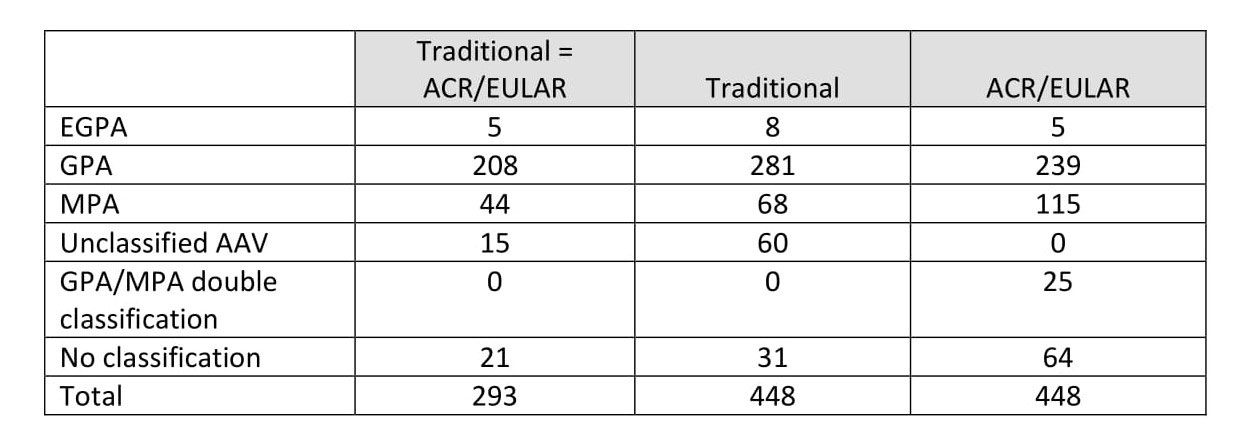
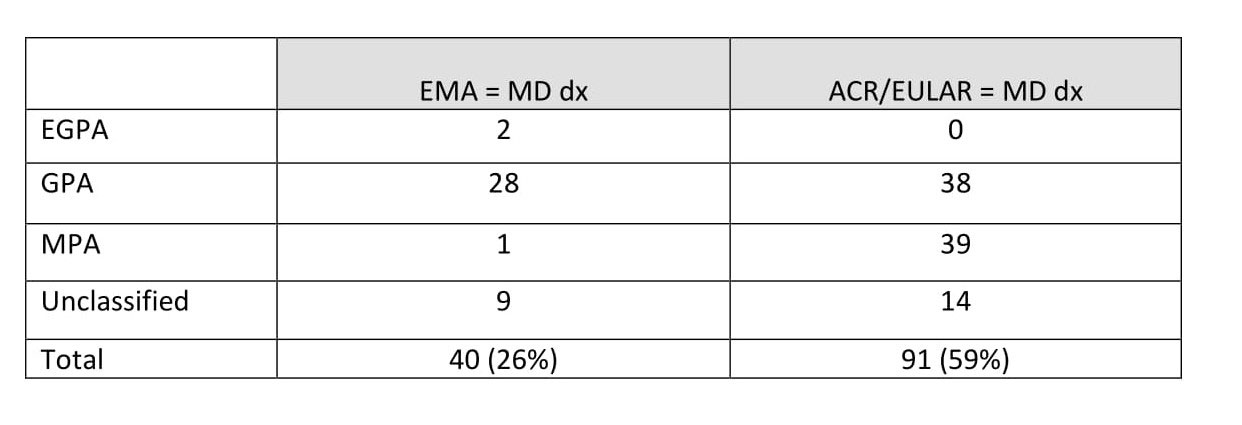
Results: Among 503 ARChiVe patients 448 were diagnosed by submitting physician (MD) as EGPA, GPA, MPA, or unclassified AAV. Pediatric patients were computationally classified sequentially according to an EMA-based algorithm (Figure 1) (Arthritis Rheum 2016 68:2514-2526) and this was compared with the classification according to the ACR/EULAR 2022 criteria. Out of all patients included, 293 (65%) resulted in matching classification (Table 1). From the remaining 154 patients, 40 (26%) had a matching MD diagnosis with the traditional classification method, where 91 (59%) matched with the ACR/EULAR classification criteria (Table 2). Although the ACR/EULAR criteria were deemed mutually exclusive for adult AAV patients, 25 pediatric patients met classification criteria for both GPA and MPA.
Conclusion: Application of the 2022 adult-based AAV ACR/EULAR classification criteria to a large cohort of pediatric vasculitis patients resulted in different classification of one-third of patients compared to the EMA classification algorithm. Compared to traditional classification methods, the ACR/EULAR criteria resulted in a lower percentage of unclassified AAV patients (13.4% vs 5.6%, respectively). Understanding which classification system better achieves the goal of delineating mutually exclusive and meaningful groups of pediatric patients requires further investigation.
To cite this abstract in AMA style:
Bosman E, Morishita K, Cabral D. Application of Adult ACR/EULAR 2022 Classification Criteria in Pediatric Vasculitis Patients [abstract]. Arthritis Rheumatol. 2022; 74 (suppl 9). https://acrabstracts.org/abstract/application-of-adult-acr-eular-2022-classification-criteria-in-pediatric-vasculitis-patients/. Accessed .« Back to ACR Convergence 2022
ACR Meeting Abstracts - https://acrabstracts.org/abstract/application-of-adult-acr-eular-2022-classification-criteria-in-pediatric-vasculitis-patients/