
Session Information
Session Type: Abstract Submissions (ACR)
Background/Purpose:
Impaired apoptotic clearance appears to play a pivotal role in the pathogenesis of SLE leading to the accumulation of nuclear debris, such as nucleosomes, ultimately stimulating the production of autoantibodies. Both nucleosomes and anti-nucleosome antibodies (AN) have been found in serum of patients with SLE and appear to correlate with disease activity. AN have been particularly associated with renal and skin disease. This abstract describes the result of longitudinal studies of AN levels, ethnicity, autoantibody profile, treatment and measures of disease activity in patients with SLE.
Methods:
Longitudinal serum samples (n= 398) were selected retrospectively from a cohort of 49 patients with SLE with a mean of 8 samples per patient (SD 2.16; min 3; max 14) and a mean follow-up of 89 months (SD 46; min 14; max 180). Sera from 40 healthy controls were also tested. OD values were converted to standard absorbance units (AU) by comparison to a positive control serum sample loaded on every plate. AN levels were measured using a direct ELISA and a positive result was defined as mean + 3SD of the healthy controls (0.17). Using the British Isles Lupus Assessment Group (BILAG) index, we categorized the samples by disease activity as follows.
Current activity was defined as high if global BILAG score was ≥5 and low if it was <5. Disease activity over the most recent 4 assessments was characterized as persistently low activity (all systems BILAG C, D or E) or persistently moderate-high activity (A or ≥1 B in any BILAG system on at least 2/4 occasions). 90% of all samples fell into one of those two categories and the rest were excluded.
Anti-dsDNA was defined as high or normal based on a cut-off of 50IU/ml. C3 was defined as low or normal based on a cut-off of 0.9g/l.
Data on the treatment at the time of each individual sample were also obtained, considering prednisolone dose and whether either immunosuppressants (IS) or hydroxychloroquine (HCQ) were used.
Results:
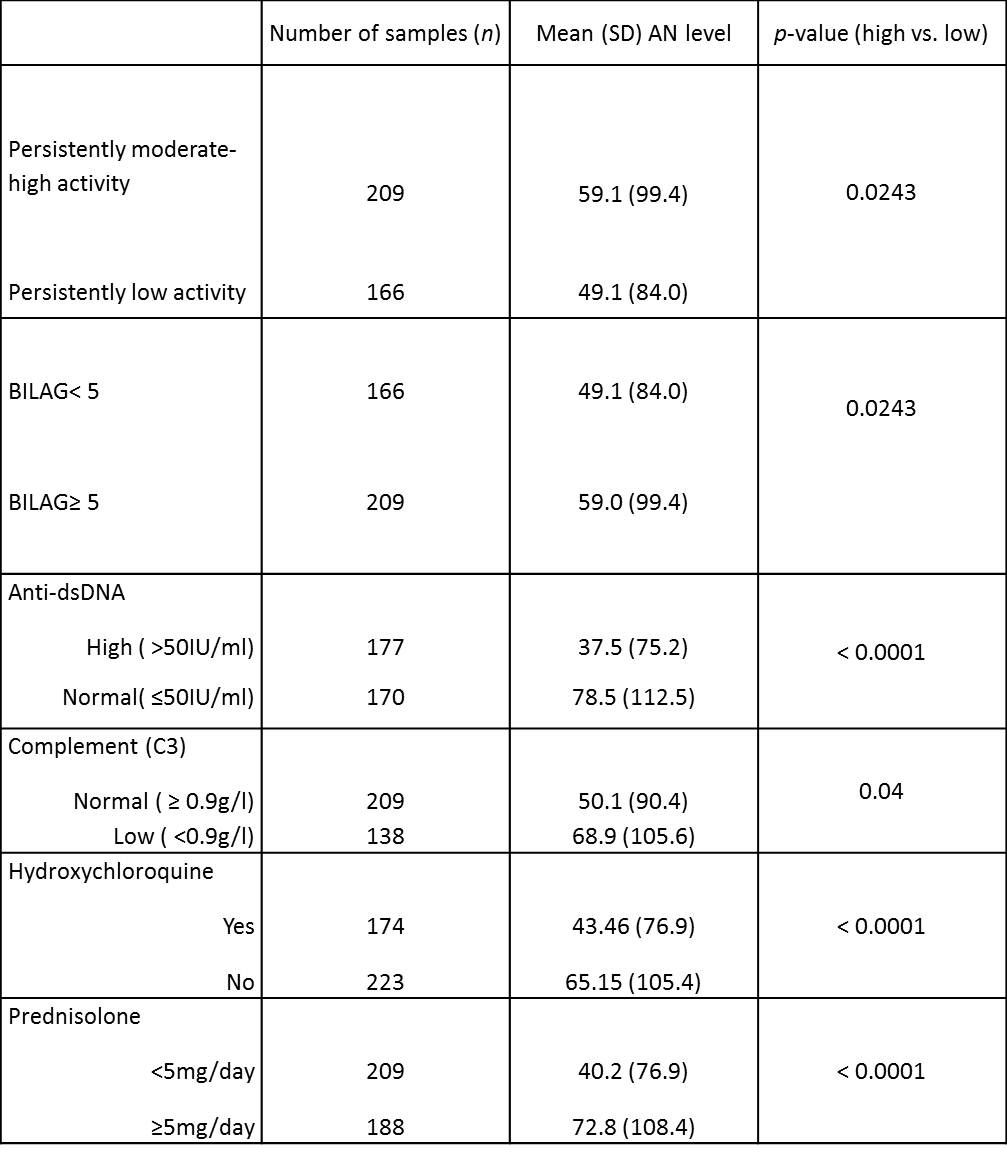
Table 1 shows that higher AN levels were significantly associated with low C3 and high anti-dsDNA levels as well as with higher current or persistent disease activity defined by the BILAG index. We found no association between AN levels and ethnicity, ENA positivity or flares in individual organs. Patients who were taking HCQ and those on low dose steroids (≤5mg/day) had significantly lower AN levels (p< 0.0001). No differences were found with regards to presence or absence of IS.
Conclusion:
AN levels were significantly associated with disease activity assessed both by clinical and serological measures. In addition, it appears that the type of treatment used, namely the use of HCQ may influence the levels of AN.
Disclosure:
S. Croca,
None;
I. Giles,
None;
D. A. Isenberg,
None;
Y. Ioannou,
None;
A. Rahman,
None.
« Back to 2012 ACR/ARHP Annual Meeting
ACR Meeting Abstracts - https://acrabstracts.org/abstract/anti-nucleosome-antibodies-are-associated-with-disease-activity-and-hydroxychloroquine-use-in-patients-with-lupus-a-longitudinal-multivariate-analysis-of-398-samples/