
Session Information
Title: Systemic Sclerosis, Fibrosing Syndromes and Raynaud’s – Pathogenesis, Animal Models and Genetics
Session Type: Abstract Submissions (ACR)
Background/Purpose: High throughput study of metabolic pathways might help identify new biomarkers and therapeutic targets in autoimmune diseases. Systemic sclerosis (SSc) currently lacks prognostic biomarkers and efficacious and specific treatments. We therefore assessed serum levels of 40 metabolites in patients with SSc and healthy controls using high-resolution magic-angle spinning (HRMAS) proton magnetic resonance spectroscopy.
Methods: The blood samples of 38 successive patients with SSc (median age (range) 62 years (25-85); disease duration 8 years (1-22); limited cutaneous SSc: 62%; diffuse cutaneous SSc: 38%) and 39 healthy controls were analysed in this study. After cryopreservation at -80°C, the samples were studied with HRMAS proton magnetic resonance spectroscopy (1H-MRS). Spectra were recorded on a Bruker Avance III 500 spectrometer operating at a proton frequency of 500 MHz. The speed revolution of the tube was 3000 Hz. The 1D MR spectra were acquired during 15 min (between 0.5 and 4,7 ppm). Unsupervised clustering was performed using principal component analysis (PCA).
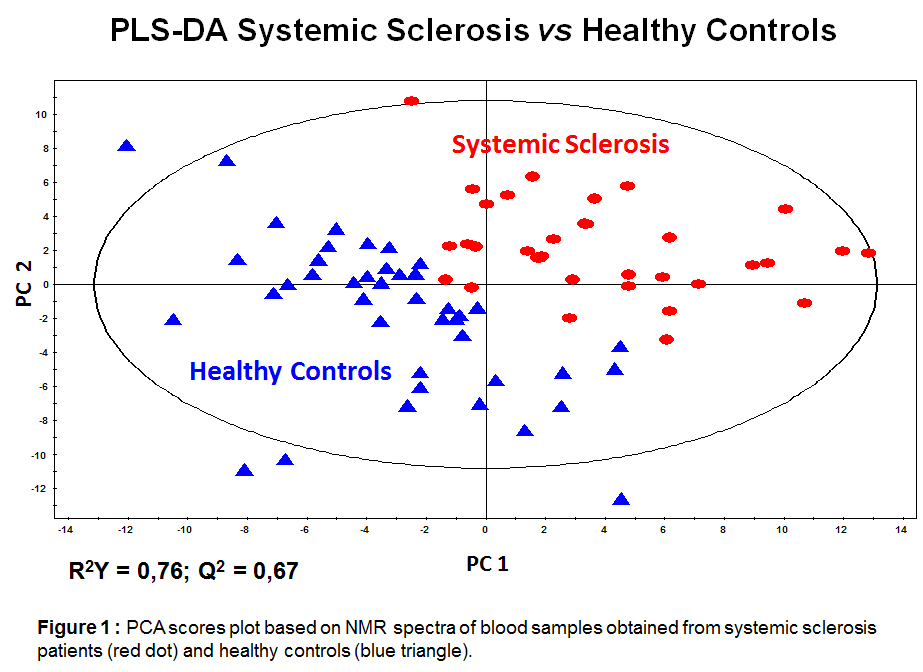
Results: Unsupervised clustering of the 38 samples allowed to discriminate all patients with SSc from healthy controls (R2Y=0.76 and Q2=0.67 (figure 1)). Interestingly, 3 metabolites were significantly more expressed in SSc blood samples than in healthy controls: acetone, acetate and formate (median 10.7 vs 8.1 µmol/l, p<0.05; 21.8 vs 5.4 µmol/l; p<0.05; 28.6 vs 7.9 µmol/l, p<0,05 respectively).
Conclusion: This first high-throughput analysis of metabolic pathways disclosed a specific metabolomic signature of SSc allowing to discriminate all patients from controls. This new and very potent means of metabolic analysis may help to increase our knowledge on the pathogenesis of SSc, identify biomarkers, and new therapeutic targets.
Disclosure:
E. Chatelus,
None;
J. E. Gottenberg,
None;
F. M. Moussallieh,
None;
C. Sordet,
None;
A. Theulin,
None;
A. Meyer,
None;
J. F. Kleimann,
None;
J. Sibilia,
None;
I. J. Namer,
None.
ACR Meeting Abstracts - https://acrabstracts.org/abstract/altered-regulation-of-metabolic-pathways-in-systemic-sclerosis-evidenced-by-metabolomics/