
Session Information
Date: Monday, October 27, 2025
Session Type: Abstract Session
Session Time: 10:45AM-11:00AM
Background/Purpose: Giant cell arteritis (GCA), a large-vessel granulomatous vasculitis, has been considered as a T cell-dependent condition. Interestingly, tertiary lymphoid structures, B cell and plasma cell infiltrates have been observed in the inflamed GCA arteries, together with an altered B cell homeostasis. This suggests that B cells can also play a role in GCA pathogenesis. Therefore, our objective was to examine the frequencies of circulating B cell subpopulations in the peripheral blood of patients with newly diagnosed GCA (nGCA).
Methods: Prospective non-interventional study on consecutive patients referred to our ultrasound (US) GCA fast track clinic, in whom newly diagnosed GCA (nGCA) was clinically confirmed (2022 ACR/EULAR criteria) over a period of 36 months. Peripheral blood was drawn immediately upon initial diagnosis and after obtaining written informed consent. For each patient, an age and gender-matched healthy control (HC) was also studied. PBMCs isolated by Ficoll- Hypaque were stained with antibodies to CD19, CD20, CD27, CD24 and CD38, and examined by flow cytometry. Patients were treated with standard therapy according to the updated 2018 EULAR recommendations.
Results: As compared with HC (n=88), nGCA patients (n=88) demonstrated significantly decreased numbers of circulating CD19+ B cells. These B cells demonstrated an altered subpopulation profile, with augmented proportions of CD19+CD27-IgD+ naïve, CD19+CD27- IgD- double negative and CD19+CD27+CD20-CD38hi plasmablasts; at the same time, the proportions of CD19+CD27+IgD+ unswitched memory and CD19+CD27+IgD- switched memory B cells were significantly decreased whereas the proportion of circulating CD19+CD24hiCD38hi transitional B cells was not different to that observed in HC. All of these B cell population frequencies were comparable among the nGCA subgroups [cranial, large vessel or mixed (cranial + large vessel)], and in patients with or without associated polymyalgia rheumatica. Fourty-four nGCA patients donated blood for a second time, 6 months after treatment initiation. At that time, a rise in the circulating total B cell numbers, above that observed at baseline, was detected. In parallel, significant reductions in the proportions of circulating naïve B, transitional B cells and plasmablasts were apparent, together with an increase of CD27+ unswitched and switched memory B cells. Among the 46 patients who could be followed-up for 12 months, 19 experienced a relapse. Strikingly, the baseline numbers of circulating total CD19+ B cells had been significantly lower in patients who did not relapse as compared with those who relapsed; moreover, when examining separately the time-course evolution of these two groups, it was evident that only patients who did not experience a relapse demonstrated a rise of their CD19+ B cell numbers, whereas these numbers did not vary in those who relapsed.
Conclusion: Patients with nGCA demonstrate a profoundly altered B cell profile at baseline that dynamically varies along the course of the disease. This points to the implication of B cells in GCA pathogenesis and may contribute to the design of personalized therapeutic strategies.
 Figure 1. Absolute numbers of circulating CD19+ B cells in nGCA patients and HC.
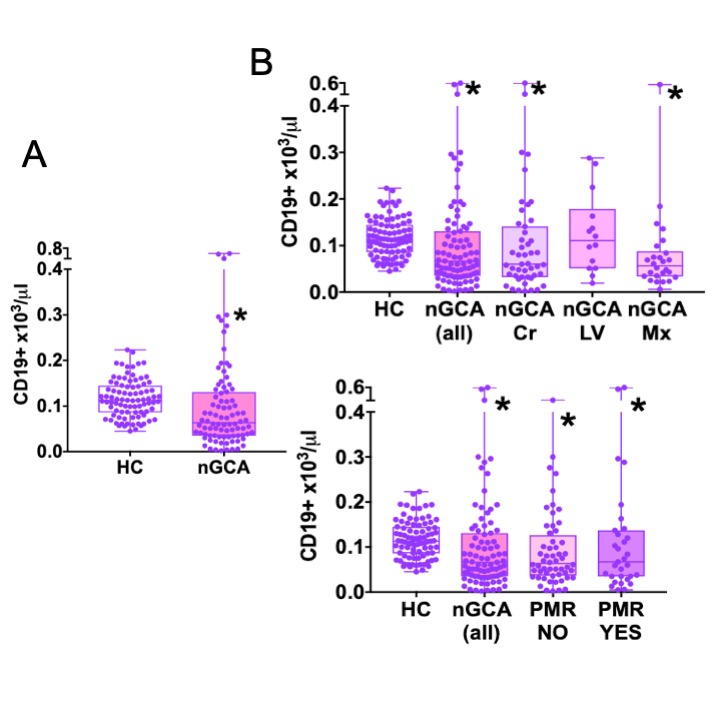 Figure 2. Frequency of circulating B cell subpopulations in nGCA patients and HC
To cite this abstract in AMA style:
Miranda-Carus M, Nieto-Carvalhal B, Monjo Henry I, García-Carazo S, de Miguel E. Altered B cell subpopulations in Giant Cell Arteritis [abstract]. Arthritis Rheumatol. 2025; 77 (suppl 9). https://acrabstracts.org/abstract/altered-b-cell-subpopulations-in-giant-cell-arteritis/. Accessed .ACR Meeting Abstracts - https://acrabstracts.org/abstract/altered-b-cell-subpopulations-in-giant-cell-arteritis/