
Session Information
Date: Monday, November 9, 2020
Session Type: Poster Session D
Session Time: 9:00AM-11:00AM
Background/Purpose: Scientific research is at the core of evidence-based medicine, and is transforming medical care at an increasingly rapid pace. The ability of students to engage with science as life-long learners is an important goal of undergraduate medical education and critical for practicing rheumatologists. However, there has been a trend towards shortening pre-clinical science curricula and less than 25% of medical schools incorporate science education in the clerkship years and beyond. We developed and evaluated the Advanced Integrated Science Courses (AISCs), a novel approach to teaching science in the post core-clerkship phase of the new Pathways curriculum at Harvard Medical School.
Methods: Following a 14 month pre-clinical curriculum that teaches foundational science concepts, the AISCs in contrast focus on frontier research and how it influences medical care. Students choose from a menu of basic, translational and population science courses in order to personalize the experience and align it with their anticipated career path (Table 1). Courses such as Immunology, Medications and Evidence as well as Health Systems Science are particularly relevant to rheumatology.
The AISCs aim to develop students’ ability to engage with science by focusing on teaching four generalizable skills: 1) find and critically evaluate research information, 2) communicate science to peers or patients, 3) evaluate how research influences patient care, and 4) formulate questions and ideas for research and innovation. In addition to common learning objectives, the AISCs have common elements such as an experiential component to explore the bi-directional relationship between science and medicine, allocated time for self-directed learning, reliance on active learning techniques, required projects to facilitate student inquiry and a shared student evaluation method. The focus of the curriculum is on gaining skills rather than memorizing content.
Results: Over the first two years of the Pathways curriculum, of the 351 students enrolled in an AISC, 301 completed the course evaluation (86% response rate). Overall students rated the AISCs highly, 1.80 in 2018 and 1.49 in 2019 on a 1-5 scale with 1 being the highest score (Table 2). Most students felt that the AISCs improved their ability to accomplish each of the four course objectives. Free-text responses demonstrated that students valued the generalizable skills gained in the AISCs, exposure to cutting edge research, integration of clinical experiences, and the opportunity to interact with experts in the field as particular strengths of the curriculum.
Conclusion: We describe a novel spiral science curriculum with AISCs designed to engage students in the dialogue between medicine and frontier research, at a developmentally appropriate stage following the core clerkships. The focus of the curriculum on a common skill set to engage productively with frontier science, rather than content delivery, was a key factor in facilitating the development of a unified curriculum across multiple disciplines. Personalization and experiential learning components enabled the curriculum to be well received by the students and successfully engaged science faculty in undergraduate medical education.
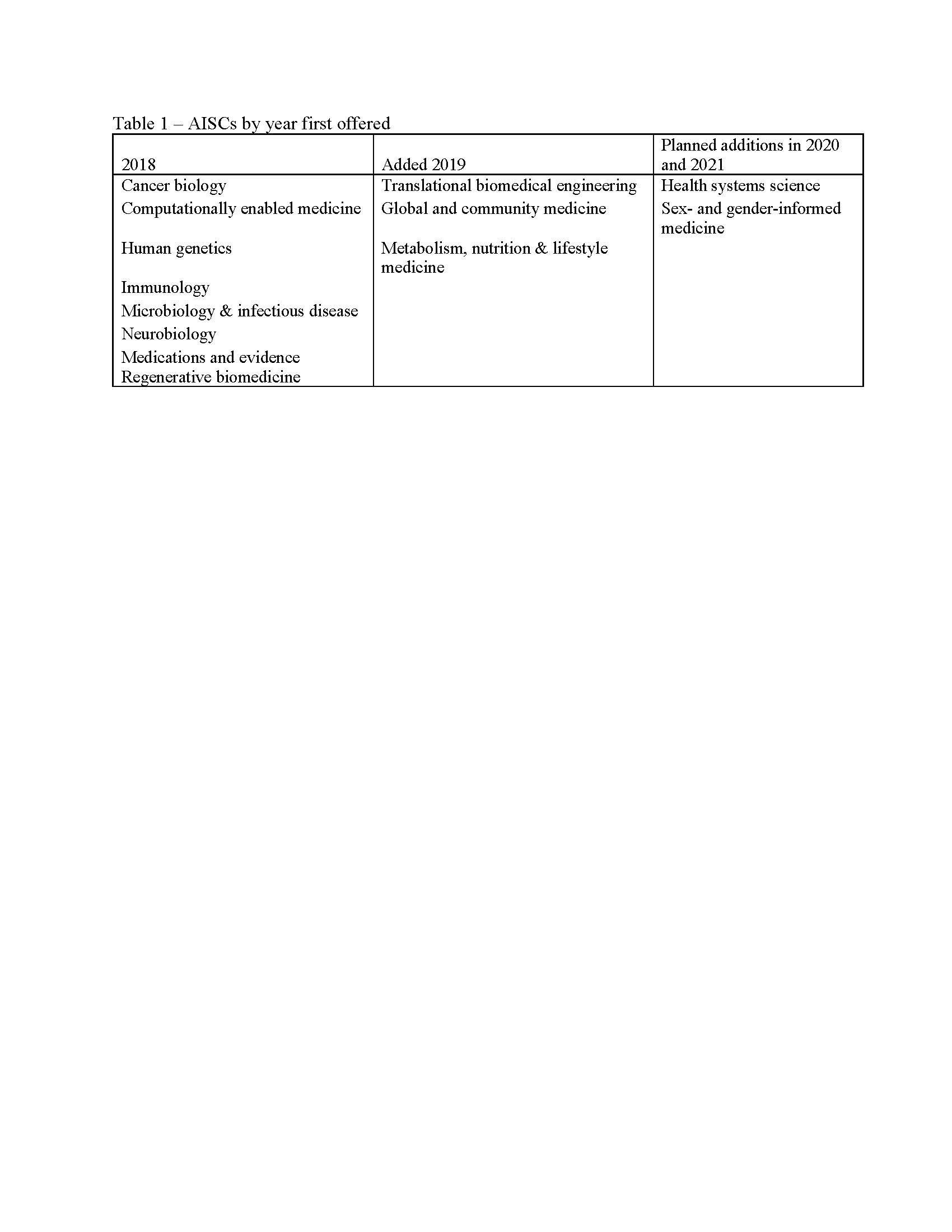 AISCs by year first offered
 Student course ratings
To cite this abstract in AMA style:
Miloslavsky E, Besche H, Flanagan J. Advanced Integrated Science Courses: A Novel Approach to Medical Student Science Education [abstract]. Arthritis Rheumatol. 2020; 72 (suppl 10). https://acrabstracts.org/abstract/advanced-integrated-science-courses-a-novel-approach-to-medical-student-science-education/. Accessed .« Back to ACR Convergence 2020
ACR Meeting Abstracts - https://acrabstracts.org/abstract/advanced-integrated-science-courses-a-novel-approach-to-medical-student-science-education/