ACR Meeting Abstracts

ACR Meeting Abstracts

  • Meeting Abstracts
    • All Meetings
    • PRSYM 2026
    • ACR Convergence 2025
    • Download Abstract Supplements
  • Keyword Index
  • My Favorites
    • View & print my favorites
  • Search

Home » Meeting Abstracts » ACR Convergence 2022

Abstract Number: 1256

A Machine Learning Pipeline for Prediction of Bone Marrow Oedema Along the Sacroiliac Joints on Magnetic Resonance Imaging

Joris Roels1, Ann-Sophie Kathleen De Craemer2, Thomas Renson3, Manouk de Hooge4, Arne Gevaert1, Lennart Jans3, Nele Herregods3, Thomas Van Den Berghe3, Philippe Carron3, Filip Van den bosch5, Yvan Saeys1 and Dirk Elewaut6, 1Center for Inflammation Research, UGent-VIB, Ghent, Belgium, 2Ghent University Hospital, Gent, Belgium, 3Ghent University Hospital, Ghent, Belgium, 4Ghent University Hospital, Luxembourg, Luxembourg, 5Department of Internal Medicine and Paediatrics, Ghent University and VIB Centre for Inflammation Research, Ghent, Belgium, 6Department of Rheumatology, Ghent University Hospital, Belgium, VIB-UGent Center for Inflammation Research, Ghent University, Heusden, Belgium

Share on X (Twitter) Share on Facebook Share on LinkedIn Share on Email
Print

Meeting: ACR Convergence 2022

Keywords: Imaging, Magnetic resonance imaging (MRI), spondyloarthritis

Session Information

Date: Sunday, November 13, 2022

Title: Imaging of Rheumatic Diseases Poster

Session Type: Poster Session C

Session Time: 1:00PM-3:00PM

Background/Purpose: Detection and semi-quantitative assessment of bone marrow oedema (BMO) on magnetic resonance imaging (MRI) of the sacroiliac (SI) joints is essential for the diagnosis and follow-up of spondyloarthritis (SpA) patients. A machine learning (ML) algorithm could address intra- and inter-reader variability and the time-consuming nature of these assessments.

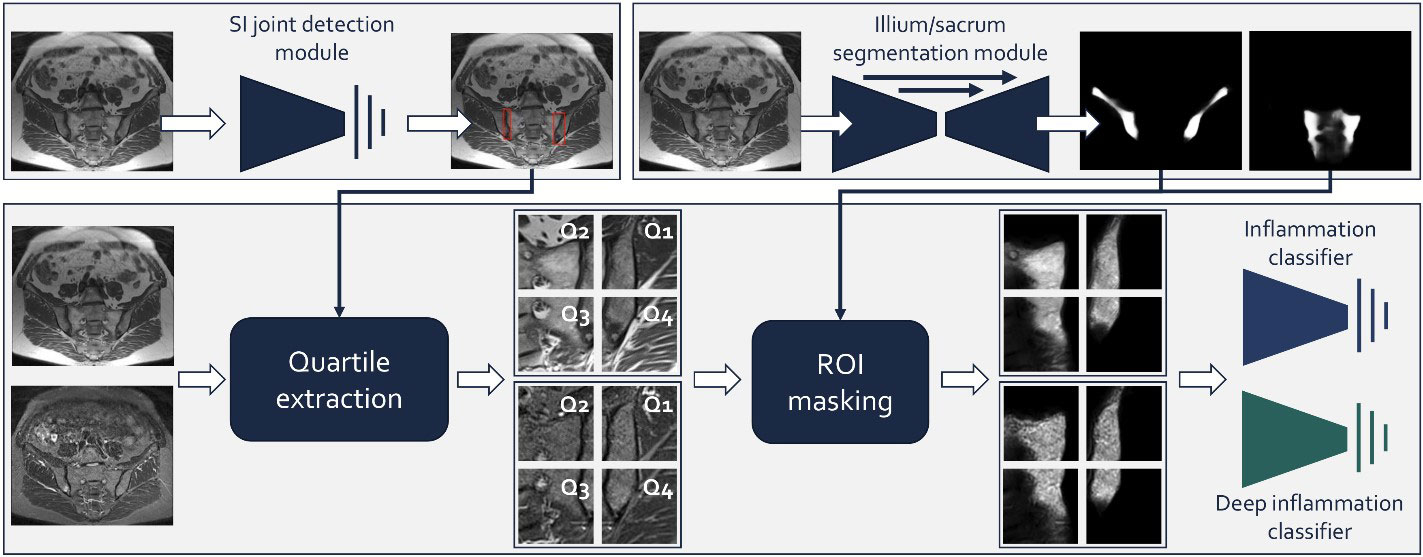
Methods: We developed a deep learning workflow that automatically locates the SI joints, segments regions of interest (ilium and sacrum), performs quadrant extraction and predicts presence of BMO, suggestive of inflammatory lesions, on a quadrant-level in semi-coronal slices of T1/T2 weighted MRI scans (Figure 1). Using a ResNet18 backbone, the inflammation classifier was trained and tested (5-fold cross-validation) on scans of SpA patients (n=279), postpartum women (n=71), and healthy individuals (n=114); while 243 SpA MRIs served as external validation. Patient-level predictions were derived from aggregating quadrant-level predictions, i.e. at least one positive quadrant.

Results: The proposed method automatically detects the SI joints and segments the ilium and sacrum. An area under the receiver operating characteristics curve (ROC AUC) score of 94.7%, balanced accuracy (B-ACC) of 82.2% and an F1 score of 62.1% is reported for the proposed inflammation prediction algorithm in cross validation. In the external validation dataset, ROC AUC was 88.2%, B-ACC 72.1% and F1 score 50.8%. On a patient-level, the model achieved an accuracy of 81.6% and 81.4% in the cross validation and external validation dataset, respectively.

Conclusion: We propose a fully automated ML pipeline for detection of BMO on MRI of the SI joints that has the potential to assist clinicians in early diagnosis and reliable quantification of inflammatory lesions in patients with (suspected) SpA.
Supporting image 1

Figure 1: Proposed pipeline for automated scoring of the MRI data. The T1-weightes sequence is used for locating the SI joints and segmentation of the ilium/sacrum. Based on this, the SI regions of interest (ROI) are extracted, and (optionally) masked with the ilium/sacrum segments. These ROIs are then fed to a convolutional neural network to predict presence of (deep) inflammatory lesions.


Disclosures: J. Roels, None; A. De Craemer, None; T. Renson, None; M. de Hooge, None; A. Gevaert, None; L. Jans, None; N. Herregods, None; T. Van Den Berghe, None; P. Carron, Biogen, AbbVie/Abbott, Eli Lilly, Fresenius Kabi, Galapagos, Merck/MSD, Pfizer, Sanofi, UCB; F. Van den bosch, AbbVie, Lilly, Galapagos, Janssen, Merck, Novartis, Pfizer, UCB, Amgen, Bristol-Myers Squibb(BMS), Celgene; Y. Saeys, None; D. Elewaut, AbbVie, Eli Lilly, Galapagos, Novartis, UCB Pharma.

To cite this abstract in AMA style:

Roels J, De Craemer A, Renson T, de Hooge M, Gevaert A, Jans L, Herregods N, Van Den Berghe T, Carron P, Van den bosch F, Saeys Y, Elewaut D. A Machine Learning Pipeline for Prediction of Bone Marrow Oedema Along the Sacroiliac Joints on Magnetic Resonance Imaging [abstract]. Arthritis Rheumatol. 2022; 74 (suppl 9). https://acrabstracts.org/abstract/a-machine-learning-pipeline-for-prediction-of-bone-marrow-oedema-along-the-sacroiliac-joints-on-magnetic-resonance-imaging/. Accessed .

ACR Meeting Abstracts - https://acrabstracts.org/abstract/a-machine-learning-pipeline-for-prediction-of-bone-marrow-oedema-along-the-sacroiliac-joints-on-magnetic-resonance-imaging/

My Favorites

Save and print abstracts during your browser session by clicking the “Favorite” button at the bottom of any abstract (must have cookies enabled in browser). See saved favorites.

Abstract Policies

  • ACR Convergence Abstract Embargo Policies
  • ACR Convergence Abstract Permissions & Reprints
  • PRSYM Abstract Policies

ACR Convergence. Where Rheumatology Meets

ACR Convergence 2026

Join us November 6-11 in Orlando, Florida.
See Registration Information

  • Contact ACR
  • Privacy Policy
  • ACR Policies
  • Cookie Preferences

© Copyright 2026 American College of Rheumatology