
Session Information
Session Type: ACR Abstract Session
Session Time: 4:30PM-6:00PM
Background/Purpose: Fluctuations in weight (weight cycling) occur in rheumatoid arthritis (RA) in association with severe disease features and comorbidity. In the general population, weight fluctuation has been linked to the development of metabolic and cardiovascular disease. Accurate prediction of cardiovascular events is an important challenge in patients with RA. We aimed to determine if fluctuations in weight can help to predict cardiovascular events this population.
Methods: We studied patients with RA from the Corrona registry enrolled from October 2001 to March 2018 with least three recorded visits. The exposure was the time-varying percent change in weight from the prior visit (standardized to a per-year rate of change). Weight change was categorized as loss of >10%, loss of 5-10%, stable weight, gain of 5-10%, and gain of >10% based on prior definitions of important weight change. We also categorized patients by quintile of variability in weight in all prior observation periods as previously described (operationalized as the average absolute difference of weight change over all prior intervals). Incident cardiovascular events were identified and adjudicated in a subset. Sequential Cox proportional hazard models explored independent associations between weight change and variability in weight and the risk of CV events before and after adjusting for baseline characteristics and CV risk factors, RA disease features, and disability as time-varying covariates. We tested for interaction to determine if associations between weight change and CV events were modified by current body mass index (BMI).
Results: Among 31,381 participants, there were 2,277 events in 135,395 person-years. It was common for participants to lose (10% of observations) or gain (13%) at a rate of 10% per year between observations. Both weight loss and weight gain were associated with greater disease activity, disability, smoking, and use of corticosteroids (Table 1). In models adjusting for demographics, BMI, and calendar year, a greater risk of CV events was observed in those that experienced 10% weight loss [HR: 1.34 (1.17, 1.53) p< 0.001] or 10% weight gain [HR: 1.31 (1.14, 1.51) p< 0.001]. In adjusted models, these associations were slightly attenuated (Table 2). There were significant interactions with current BMI suggesting that the risk of weight loss or gain was greatest in non-overweight participants (BMI < 25 kg/m2). Patients with greater variability in weight over prior observation periods were at higher risk of CV events compared to those with the most stable weight over time, independent of their current BMI (Figure).
Conclusion: Fluctuations in weight (both weight gain and weight loss) predict a greater risk of cardiovascular events in RA over time. The association is observed primarily among non-overweight patients and is independent of traditional risk factors. These findings suggest that weight fluctuation may be a marker of metabolic disturbances that may help in risk prediction in this group. Further study is necessary to determine if fluctuations in weight have direct adverse cardiometabolic consequences by promoting cardiometabolic disease.

Weight Fluctuation Abstract _Table 1
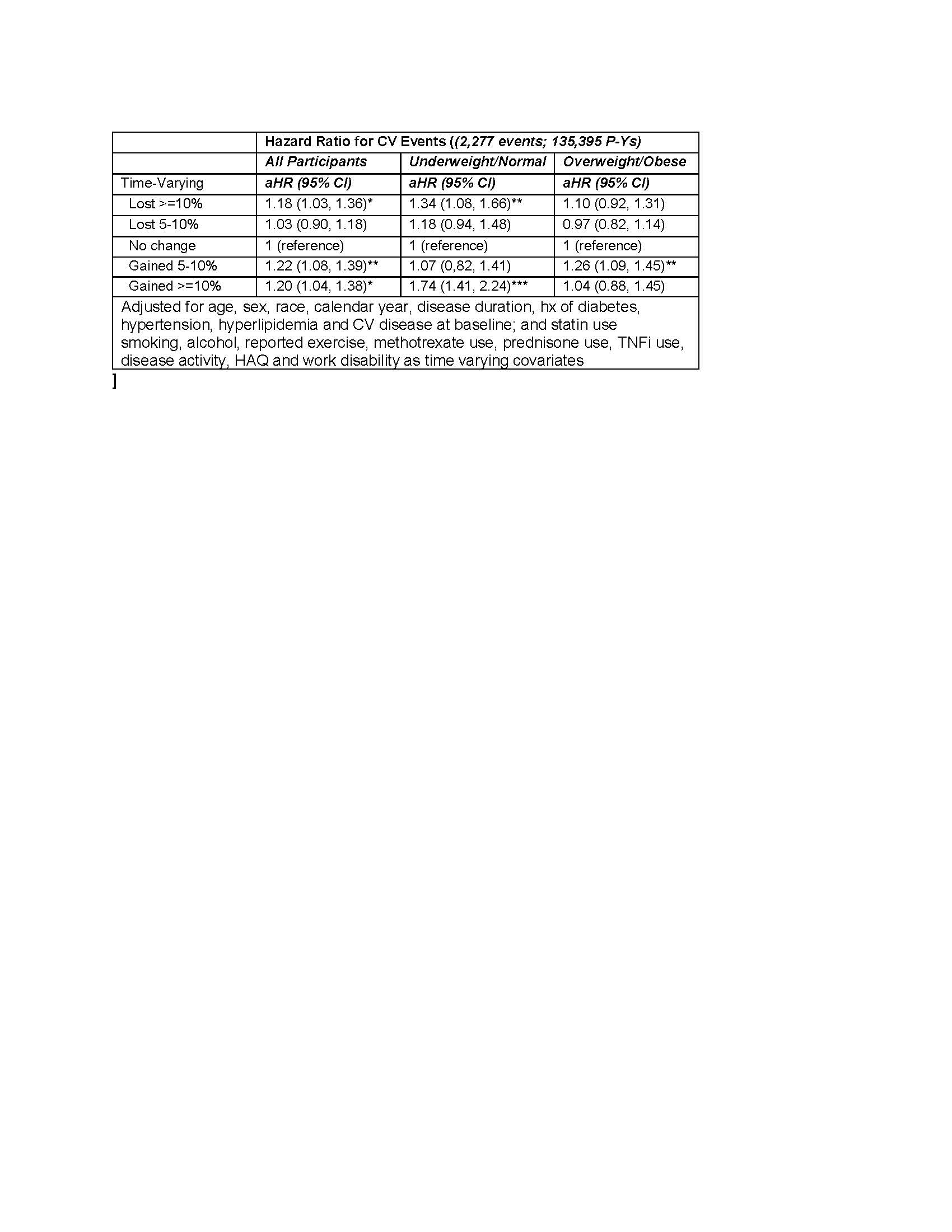
Weight Fluctuation Abstract _Table 2

weight fluctuation figures
To cite this abstract in AMA style:
Baker J, Reed G, Kremer J. Weight Fluctuation and Risk of Cardiovascular Events in Patients with Rheumatoid Arthritis [abstract]. Arthritis Rheumatol. 2019; 71 (suppl 10). https://acrabstracts.org/abstract/weight-fluctuation-and-risk-of-cardiovascular-events-in-patients-with-rheumatoid-arthritis/. Accessed .« Back to 2019 ACR/ARP Annual Meeting
ACR Meeting Abstracts - https://acrabstracts.org/abstract/weight-fluctuation-and-risk-of-cardiovascular-events-in-patients-with-rheumatoid-arthritis/