
Session Information
Session Type: ACR Poster Session C
Session Time: 9:00AM-11:00AM
Background/Purpose: Full-thickness rotator cuff tears (FTT) can be a debilitating cause of shoulder pain and loss of function. Delay in surgical evaluation may result in inoperable changes of the cuff. Advanced imaging involving MRI is often required for diagnosis and provides additional description of the true acuity of the FTT – those with changes of tendon retraction, fatty infiltration, or atrophy are more likely to have a chronic FTT (cFTT) resulting in less successful surgical repair. An acromiohumeral interval (AHI) of < 7mm identified on shoulder x-ray has also been associated with cFTT and less successful surgical treatment. The aim of this study was to determine if x-ray findings of AHI < 7mm was associated with inoperable cFTT in our clinical setting, and could thus be used in place of the more expensive MRI study in triaging initial evaluation of potential FTT into surgical referral vs. medical management.
Methods: Shoulder MRIs performed at the Salt Lake City Veterans Affairs Hospital from March 2017 to March 2018 were identified. Those with a shoulder x-ray within 12 months preceding the MRI were included for review. MRIs were categorized by type of FTT – those potentially repairable without chronic changes (rFTT) and those with changes suggesting inoperability (cFTT). X-rays were then viewed and AHI was calculated. A chi-square analysis was performed on MRI results and AHI > or < 7mm. Finally, charts were reviewed to identify those who received surgical intervention and the type of surgery performed – rotator cuff repair (RCR), reverse total shoulder arthroplasty (RTSA), or other.
Results: 315 shoulder MRIs were identified as having an associated x-ray and included for review. Of those, 87 (28%) had a FTT. Type of FTT and surgery performed are presented in Table 1. There was a significant association between AHI and rFTT or cFTT (chi-square 10.96, p<0.005).
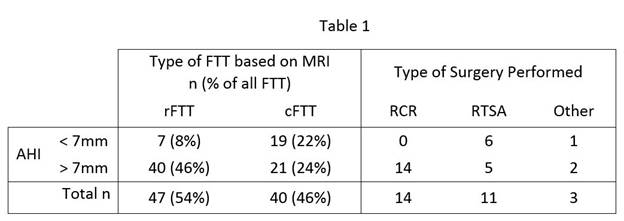
Conclusion: Our findings are consistent with previous reports, where an AHI < 7mm was associated with a FTT that is likely inoperable. Only patients with an AHI > 7mm underwent RCR. We suggest when a FTT is suspected based on clinical exam, the AHI should be measured and if < 7mm, conservative management should be pursued over advanced imaging and surgical referral. This point of triage will hopefully limit unnecessary and expensive imaging where results are unlikely to change initial management, thus improving access to MRI when a delay in care could be detrimental to the patient.
To cite this abstract in AMA style:
Hoggan R, Barker A, Liu Z, Koening CL, Battistone MJ. Usefulness of Shoulder Radiographs to Aid in Determining Need for Advanced Imaging to Detect Operable or Inoperable Full-Thickness Rotator Cuff Tears [abstract]. Arthritis Rheumatol. 2018; 70 (suppl 9). https://acrabstracts.org/abstract/usefulness-of-shoulder-radiographs-to-aid-in-determining-need-for-advanced-imaging-to-detect-operable-or-inoperable-full-thickness-rotator-cuff-tears/. Accessed .« Back to 2018 ACR/ARHP Annual Meeting
ACR Meeting Abstracts - https://acrabstracts.org/abstract/usefulness-of-shoulder-radiographs-to-aid-in-determining-need-for-advanced-imaging-to-detect-operable-or-inoperable-full-thickness-rotator-cuff-tears/