
Session Information
Session Type: Poster Session A
Session Time: 10:30AM-12:30PM
Background/Purpose: Current recommendations advocate maintaining pregnancy-compatible bDMARDs during pregnancy (mainly TNF inhibitors) and monitoring disease activity before conception to improve disease and pregnancy outcomes. Recently, the Spanish BIOBADASER1 registry showed low use of bDMARDs during pregnancy, but data from patients followed in dedicated pregnancy clinics is lacking. Our objective was to describe the current use of bDMARDs in a specialized pregnancy clinic and the impact of preconception counseling (PC) on disease activity and pregnancy outcomes.
1. Membrive-Jiménez C, Sánchez-Piedra C, Martínez-González O, et al. Safety and effectiveness of bDMARDs during pregnancy in patients with rheumatic diseases: Real-world data from the BIOBADASER registry. Reumatol Clin (Engl Ed). 2023;19(9):500-506.
Methods: Our objective was to describe the current use of bDMARDs in a specialized pregnancy clinic and the impact of preconception counseling (PC) on disease activity and pregnancy outcomes.
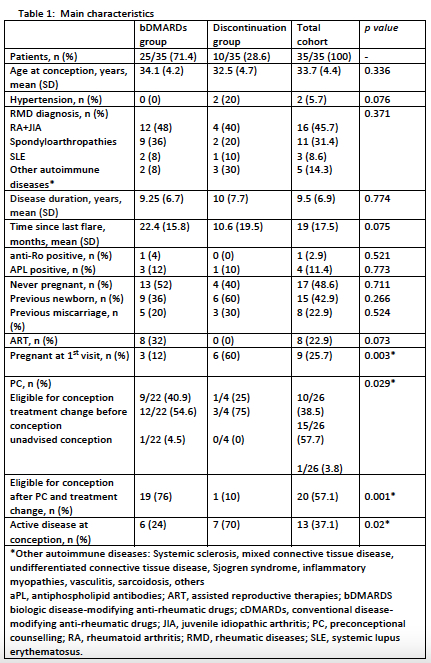
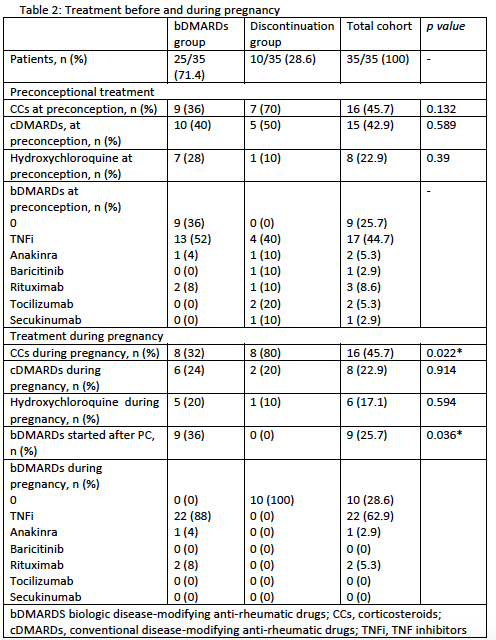
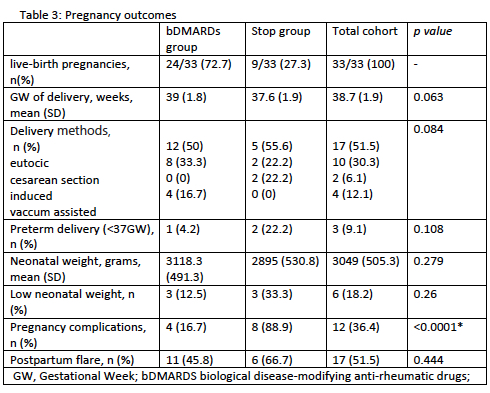
Results: 41 pregnancies in 30 patients were included. Five (12.2%) pregnancies ended with miscarriage and 1 (2.4%) with voluntary pregnancy interruption. The remaining 35 pregnancies in 28 patients were analyzed. Main characteristics are reported in table 1. 71.4% of patients continued bDMARDs during pregnancy, 9 (36%) had started a bDMARD after PC. There were no differences regarding age at conception, disease diagnosis and duration, comorbidities and obstetric history. 8 (22,9%) patients became pregnant after assisted reproductive therapies, all in the bDMARDs group. PC was most frequent among bDMARDs group (88%), since 60% of the group that dropped out were pregnant on the first visit. Treatment before and during pregnancy is reported in table 2. After treatment adjustments, 76% of the bDMARD group were considered suitable for pregnancy compared to 10% of the discontinuation group ( p=0.001).Treatment before and during pregnancy is reported in Table 2. There were 17 flares (37.8%), 13 (76.5%) were articular flares, 2 (11.8%) vasculitis flare, 1 (5.9%) uveitis and 1 (5.9%) worsening of thrombocytopenia. 90% (9/10) of discontinuation group flared during pregnancy compared to 32% (8/25) in bDMARDs group (p=0.003), with a mean of 17.4 (8.1) GW, requiring restart of bDMARDs in 2 (11.8) pregnancies and increased dose of glucocorticoids in 88.2%. Two ( 2/35; 5.7%) patients are currently pregnant. Data about the 33 pregnancies ended with live-birth are reported in table 3. Discontinuation group had non-statistical significant shorter pregnancies, a higher proportion of preterm deliveries and smaller babies. Overall, they had more complications during pregnancy, 88,9% compared to 16.7%, mainly gestational diabetes (37.5%) and preterm delivery (37.5%). There was one case of preeclampsia and one case of intrauterine growth restriction, both in the discontinuation group.
Conclusion: Up to 71.4% maintained bDMARDs during pregnancy, mainly TNF-i. Maintenance of DMARDs was more frequently after PC in a specialized pregnancy clinic, improving disease control and pregnancy outcomes.
To cite this abstract in AMA style:
Garcia Fernandez A, Rengifo-Garcia F, Senosiain-Echarte R, Álvaro Navidad M, Gonzalez-Gay M, Martínez - López J. Use of bDMARDs During Pregnancy After Preconceptional Counseling in Spanish Patients with Rheumatic Diseases [abstract]. Arthritis Rheumatol. 2024; 76 (suppl 9). https://acrabstracts.org/abstract/use-of-bdmards-during-pregnancy-after-preconceptional-counseling-in-spanish-patients-with-rheumatic-diseases/. Accessed .« Back to ACR Convergence 2024
ACR Meeting Abstracts - https://acrabstracts.org/abstract/use-of-bdmards-during-pregnancy-after-preconceptional-counseling-in-spanish-patients-with-rheumatic-diseases/