
Session Information
Session Type: Abstract Submissions (ACR)
Background/Purpose:
The non resolving character of synovial inflammation in rheumatoid arthritis (RA) is a conundrum. To identify the contribution of fibroblast-like synoviocytes (FLS) to the perpetuation of synovitis, we investigated the molecular mechanisms that govern the TNFa-driven inflammatory program in human FLS.
Methods:
FLS obtained from synovial tissues of patients with RA or osteoarthritis were stimulated with TNFa and assayed for gene expression and cytokine production by qPCR and ELISA. NF-kB signaling and chromatin accessibility were evaluated using Western blotting and restriction enzyme accessibility (REA) assays.
Results:
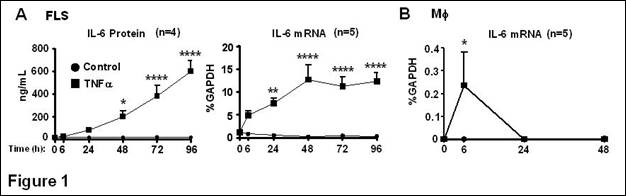
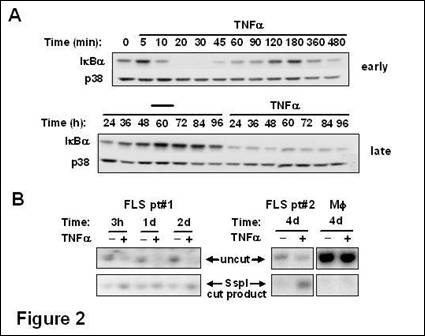
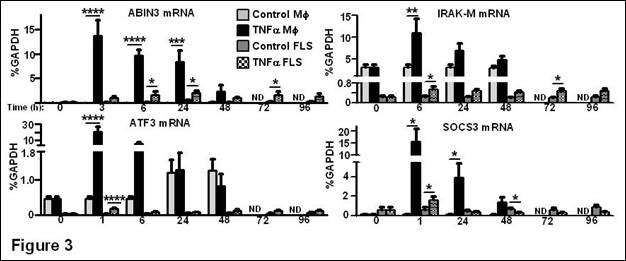
In FLS, TNFa induced prolonged transcription of IL-6 and progressive accumulation of IL-6 protein over four days (Figure 1A). Similarly, induction of IL-8, CCL5, MMP1 and MMP3 mRNA, after TNFa stimulation, was sustained for several days (data not shown). This contrasted with the macrophage response to TNFa, which characteristically involved a transient increase in the expression of pro-inflammatory genes (Figure 1B). In FLS, TNFa induced prolonged activation of NF-kB signaling (Figure 2A) and a sustained increase in chromatin accessibility at the IL-6 promoter (Figure 2B). Furthermore, FLS expressed low levels of the feedback inhibitors ABIN3, IRAK-M, ATF3 and SOCS3 that terminate inflammatory responses in macrophages (Figure 3).
Conclusion: TNFa signaling is not effectively terminated in FLS, leading to an uncontrolled inflammatory response. The results suggest that prolonged and sustained inflammatory responses by FLS, in response to synovial TNFa, contribute to the persistence of synovial inflammation in RA.
Disclosure:
A. Lee,
None;
G. Grigoriev,
None;
J. Chen,
None;
L. B. Ivashkiv,
None;
G. D. Kalliolias,
None.
« Back to 2012 ACR/ARHP Annual Meeting
ACR Meeting Abstracts - https://acrabstracts.org/abstract/tnf%ce%b1-induces-sustained-signaling-and-a-prolonged-and-unremitting-inflammatory-response-in-synovial-fibroblasts/