
Session Information
Session Type: ACR Abstract Session
Session Time: 4:30PM-6:00PM
Background/Purpose: Bone marrow edema on MRI of the sacroiliac joints (SIJ) plays an important role in the ASAS (Assessment of Spondyloarthritis International Society) classification criteria for axial spondyloarthritis (axSpA). However, these lesions can also be seen in other conditions1 2. Structural SIJ MRI lesion characteristics may be of importance for differentiating patients with axSpA from other diagnostic entities with buttock/pelvic pain. The aim of this study was to investigate the diagnostic utility of the presence of fat lesions (FAT) in close relation to the joint space and other structural MRI lesions in order to differentiate patients with axSpA from other conditions.
Methods: This prospective cross-sectional study of 204 participants, included patients with axSpA (n=41), lumbar disc herniation (n=25), and women with postpartum buttock/pelvic pain (n=46) and a group of healthy participants consisting of women without postpartum buttock/pelvic pain (n=14), persons with hard physical work defined as hospital cleaning staff (n=26), long-distance runners (n=23) and healthy men (n=29). Participants with pain should all have VAS pain >2 (0-10) for ≥2 months. Non-axSpA participants were not allowed to have any clinical SpA features or rheumatological conditions. Participants underwent clinical, laboratory and MRI examination (semi-coronal STIR and T1W sequences) of the SIJs. MRIs were evaluated according to the SPARCC MRI definitions of lesions1 2 by two independent readers. Analyses were based on “concordant reads”, i.e. where both readers agreed on presence of the assessed pathology. In nine slices covering the entire cartilaginous compartment, each SIJ was separately assessed for the presence of FAT in relation to joint space (FAT@joint space), erosion (FAT@erosion), sclerosis (FAT@sclerosis) and ankylosis (FAT@ankylosis), respectively. Each of these “relation scores” had a total score range of 0-18 per patient.
Results: Table 1 shows the clinical characteristics of each group and table 2 shows the mean MRI FAT relation scores and the frequency of scores above various cut-off levels for each MRI relation score (concordant reads). FAT@joint space and FAT@sclerosis were seen in most groups, but higher scores were found in the axSpA group. FAT@erosion was almost only, and FAT@ankylosis exclusively, found in the axSpA group. A score above or equal to 1 (cut-off score ≥1) FAT@joint space was present in nearly all groups, however most frequent in the axSpA group followed by the group of healthy men. FAT@joint space was even present in both groups at high (≥10) cut-off scores. FAT@sclerosis was present in axSpA, women with postpartum pain and healthy men, however, at higher thresholds, above ≥2, only in axSpA group.
Conclusion: Fat lesions in relation to other structural lesions were rarely recorded in the non-axSpA groups, in contrast to fat lesions in relation to the joint space. Assessment of structural sacroiliac joint lesions in anatomical relation to each other may be useful for differentiating axSpA from other conditions.
Referencer:
- Weber et al. AR 2010;62(10):3048-58.
- Seven et al. annrheumdis-2018-eular.2586
- Maksymowych et al. AR 2005;53(5):703-9.
- Maksymowych et al. J Rheumatol. 2015;42(1):79-86.
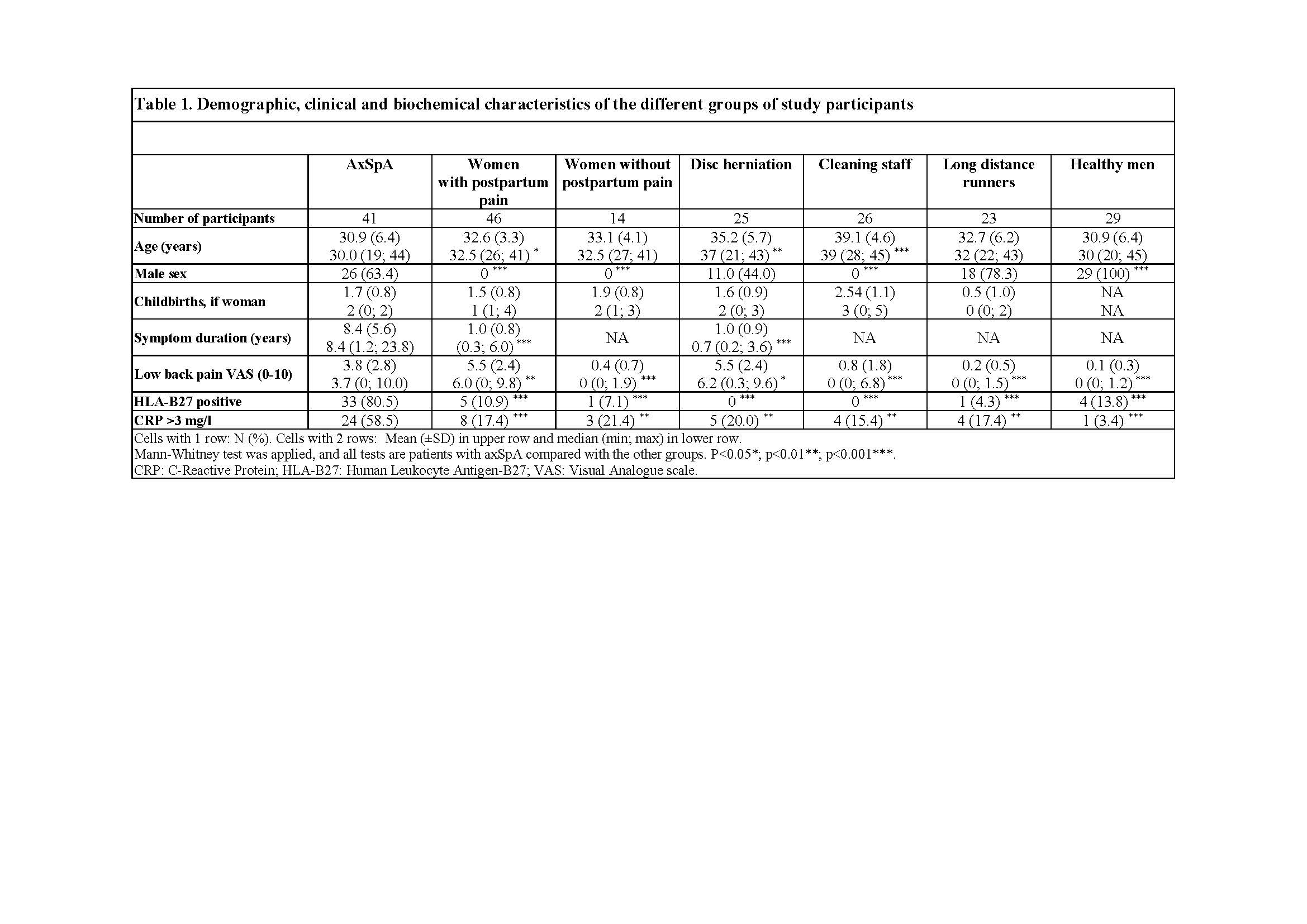
ACR19_abstract_Table1_20190603
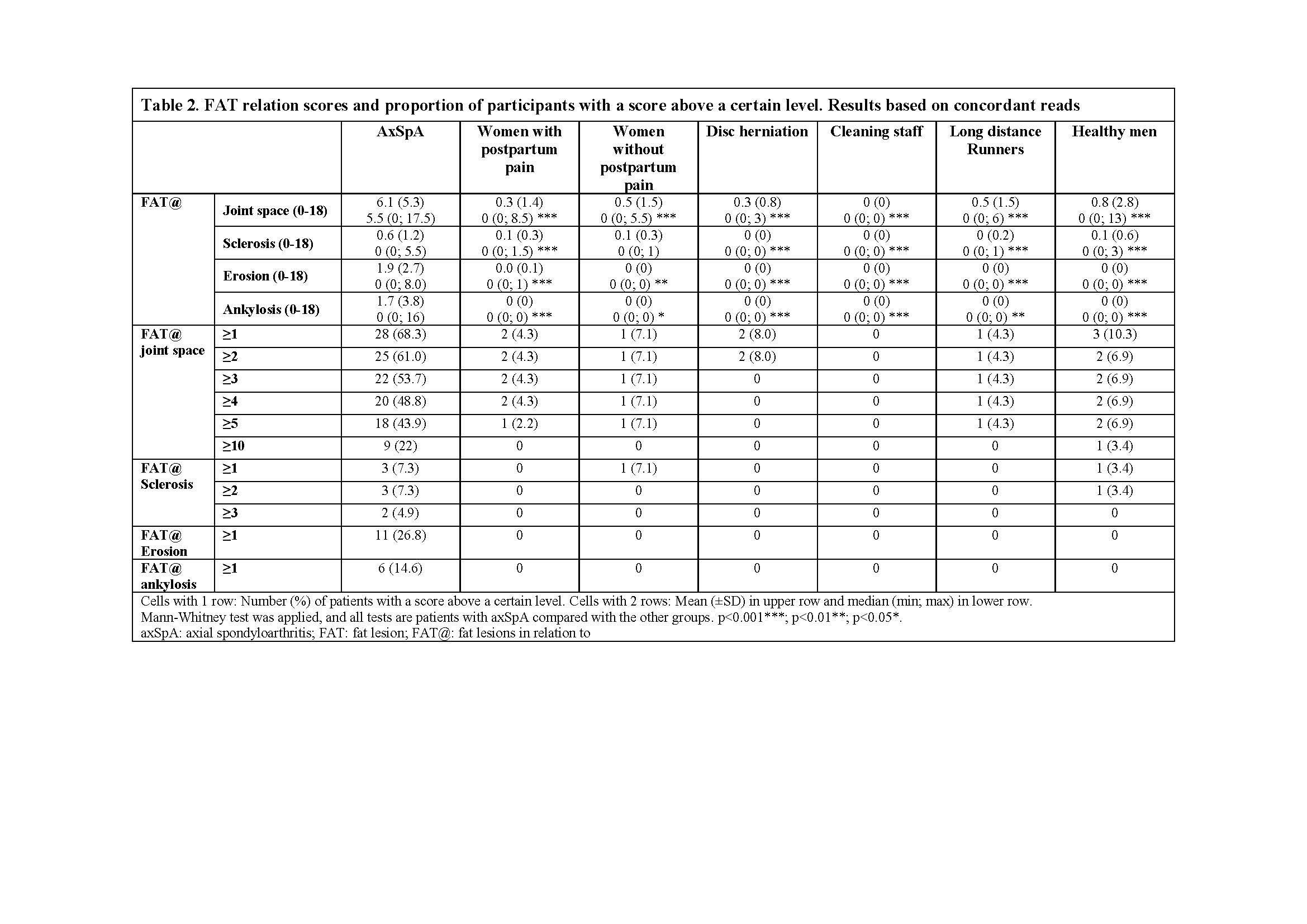
ACR19_abstract_Table2_20190603
To cite this abstract in AMA style:
Seven S, Østergaard M, Morsel-Carlsen L, Sørensen i, Bonde B, Thamsborg G, Lykkegaard J, Hendricks O, Jørgensen N, Juhl Pedersen S. The Utility of Fat Lesions in Close Relation to Other Structural MRI Lesions in the Sacroiliac Joints for Diagnosing Patients with Axial Spondyloarthritis [abstract]. Arthritis Rheumatol. 2019; 71 (suppl 10). https://acrabstracts.org/abstract/the-utility-of-fat-lesions-in-close-relation-to-other-structural-mri-lesions-in-the-sacroiliac-joints-for-diagnosing-patients-with-axial-spondyloarthritis/. Accessed .« Back to 2019 ACR/ARP Annual Meeting
ACR Meeting Abstracts - https://acrabstracts.org/abstract/the-utility-of-fat-lesions-in-close-relation-to-other-structural-mri-lesions-in-the-sacroiliac-joints-for-diagnosing-patients-with-axial-spondyloarthritis/