
Session Information
Date: Tuesday, November 10, 2015
Title: Epidemiology and Public Health IV: Risk Factors and Comorbidities for SLE and Psoriatic Arthritis
Session Type: ACR Concurrent Abstract Session
Session Time: 4:30PM-6:00PM
Background/Purpose: Smoking is a strong risk factor of psoriasis,
but a previous study has suggested that smoking protects
against the development of psoriatic
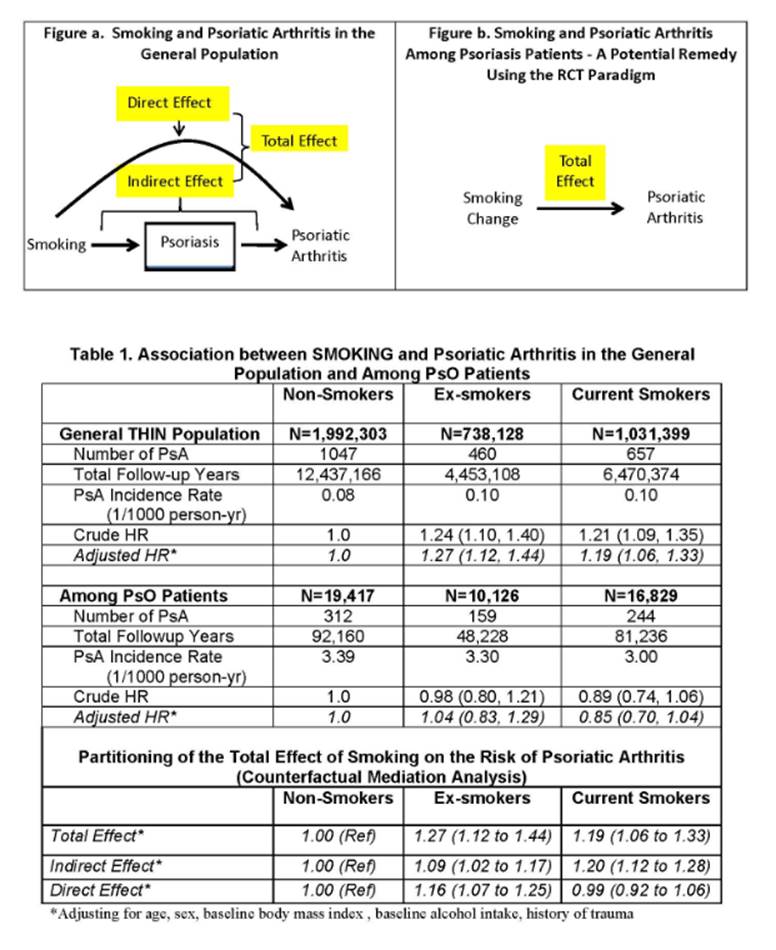
arthritis (PsA) among psoriasis (PsO) patients. These paradoxical findings
occur because of two possibilities. First, a type of selection bias called
index event bias arises from selecting a group of patients (e.g. PsO) on the
causal pathway (e.g., between smoking and PsA). Second, the causal net effect
(i.e., total effect) of
smoking cannot be validly estimated using conventional methods (Figure a).
We sought to evaluate the impact of smoking on the risk of PsA among PsO
patients (index population), and clarify the paradox using a counterfactual
mediation analysis.
Methods: We used 1995-2015 data from The
Health Improvement Network (THIN), an electronic medical records database
representative of the UK general population. We analyzed data from adults (age
≥ 20 years), free of PsO and PsA after at least 1 year of enrollment into
the THIN database, and with available data on factors of interest. Follow-up
began with first record of smoking status (exposure) after the 1-year
enrollment period and ended at time of PsA diagnosis, death, disenrollment
in THIN, or the end of the study period, whichever
came first. Using Cox regression, we assessed the effect of smoking on incident
PsA in the general population, and restricting on incident PsO patients. We
then clarified the paradox using marginal structural models (MSM) for mediation
analysis to partition the total effect of smoking on PsA into its indirect
effect (via its effect on PsO) and its direct
effect not through PsO. All analyses were
adjusted for known confounders.
Results: There were ~3.7 million
subjects without PsO and PsA at baseline (mean age 47 years; 54% females; 27%
current smokers, and 20% ex-smokers). Of those, 46,372 developed incident PsO
of which 715 developed incident PsA. The adjusted hazard ratio (HR) for smoking
and the risk of PsA among PsO patients was 0.85 (95%CI: 0.70, 1.04), but the
corresponding HR for PsA in the general THIN population was 1.19 (95%CI: 1.06,
1.33) (Table). Using MSM, the indirect effect of current smoking
compared with non-smoking on risk of PsA was 1.20 (95%CI: 1.12, 1.28); the direct
effect was 0.99 (95%CI: 0.92, 1.06) and the total effect was 1.19
(95%CI: 1.06, 1.33) (Table).
Conclusion: We showed that
conditioning on PsO can reverse the association between smoking and PsA, and
that the effect of smoking on the risk of PsA may be mediated almost entirely
through smoking’s effect on PsO. Conditioning on an index event may bias
conclusions about the contribution of modifiable risk factors; therefore
investigators should consider study designs that are free of such bias (Figure b, analysis assessing the impact
of exposure status change or analogous randomized trials in the index
population).
To cite this abstract in AMA style:
Nguyen USDT, Zhang Y, Lu N, Louie-Gao Q, Niu J, Felson DT, Lavalley MP, Love T, Dubreuil M, Sparks JA, Karlson EW, Choi HK. The Smoking Paradox in the Development of Psoriatic Arthritis Among Psoriasis Patients [abstract]. Arthritis Rheumatol. 2015; 67 (suppl 10). https://acrabstracts.org/abstract/the-smoking-paradox-in-the-development-of-psoriatic-arthritis-among-psoriasis-patients/. Accessed .« Back to 2015 ACR/ARHP Annual Meeting
ACR Meeting Abstracts - https://acrabstracts.org/abstract/the-smoking-paradox-in-the-development-of-psoriatic-arthritis-among-psoriasis-patients/