
Session Information
Session Type: Abstract Submissions (ACR)
Background/Purpose: The prevalence of asymptomatic carotid plaque (a-CP) is high in patients with inflammatory joint disease (IJD). Patients with a-CP should receive intensive lipid lowering (LL) treatment in cardiovascular prevention. Our aim was to evaluate presence of a-CP, if CV risk calculators predict presence of a-CP in patients with IJD and if optimizing cut off points in various risk calculators will improve this prediction.
Methods: We performed CV risk stratification in patients with IJD (n= 345), [rheumatoid arthritis (RA)(n=210), ankylosing spondylitis (AS)(n=87) and psoriatic arthritis (PsA)(n=49)] by using SCORE, Framingham and Reynolds CV risk algorithms with recommended cut off points at 5%, 10% and 10% respectively. Ultrasound of the carotid arteries was performed. Cross-tabulations, Chi2 and ROC curves were used to calculate sensitivity/specificity, odds- and likelihood ratio (LR) for identifying a-CP. The ROC closest point (0.1) and 80% sensitivity was used for optimizing the identification of a-CP.
Results: A-CP was present with similar frequency in RA, AS and PsA (48.3%, 41.4% and 41.7% (p=0.46). Two hundred and eleven patients had SCORE<5% indicating no need for LL prevention (Table 1). However, 72 (34.1%) of these patients had a-CP and should receive intensive LL treatment. In patients with SCORE ≥5% (n=124), indicating a need for moderate LL prevention, 81 (65.3%) had a-CP and should therefore be categorized to intensive LL treatment. The sensitivity for identifying a-CP was 0.53, the specificity: 0.76 and LR+: 2.24. Optimizing the cut off value by using closest point (0, 1) (SCORE: 4%: specificity: 0.65, specificity: 0.72, LR+:2.33) or 80% specificity (SCORE: 2.65: sensitivity: 0.80 specificity: 0.56 LR+:1.83) did not improve the ability of SCORE to identify a-CP. According to the new guidelines for prevention of CV disease (2011)1, the sensitivity, specificity and LR+ for identifying a-CP was 0.47, 0.77 and 2.05 respectively. The associations between a-CP and cut off values for other risk calculators are shown in Table 2.
Conclusion: Carotid ultrasound will assist in the correct classification of patients with IJD into intensive LL in about 1/3 of patients with SCORE<5% and 2/3 of patients with SCORE≥5%. The CV risk calculators are poor predictors of a-CP in patients with IJD.
Table 1. European heart SCORE according to presence of symptomatic carotid plaque
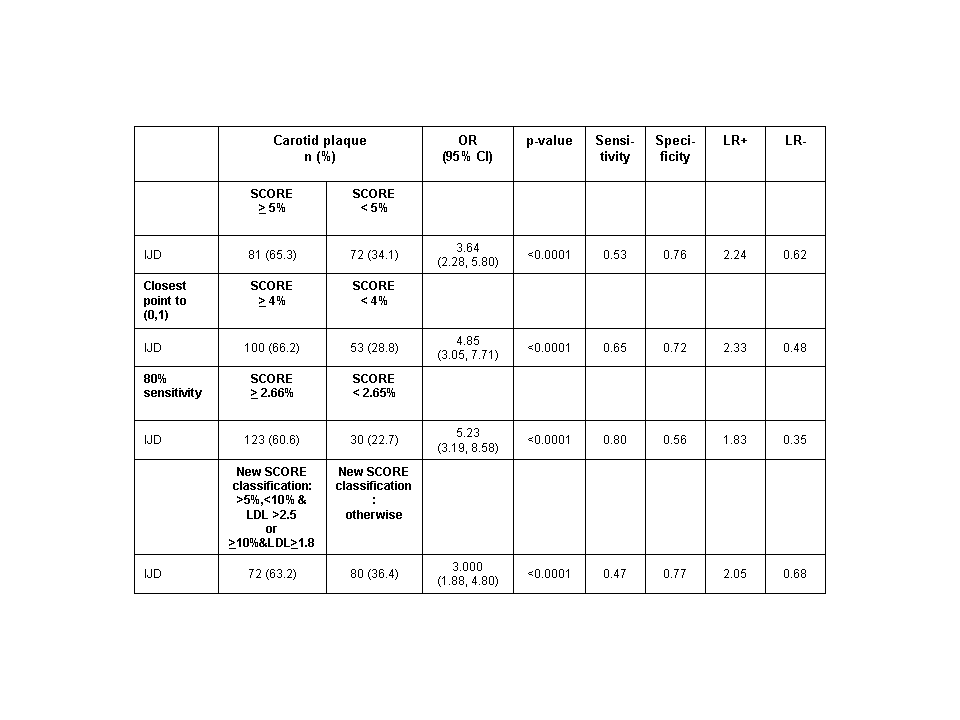
Table 2. Framingham and Reynolds cardiovascular risk scores

Ref
1. Catapano AL et al. ESC/EAS Guidelines for the management of dyslipidaemias. Atherosclerosis 2011;217S:1-44
Disclosure:
A. G. Semb,
None;
S. Rollefstad,
None;
I. C. Olsen,
None;
D. van der Heijde,
None;
T. K. Kvien,
Abbott Immunology Pharmaceuticals,
8,
AstraZeneca,
8,
Merck Pharmaceuticals,
8,
NiCox, S.A.,
8,
Pfizer Inc,
8,
Roche Pharmaceuticals,
8,
UCB,
8,
BMS,
5,
Abbott Immunology Pharmaceuticals,
5,
Merck Pharmaceuticals,
5,
NiCox, S.A.,
5,
Pfizer Inc,
5,
Roche Pharmaceuticals,
5,
UCB,
5,
Abbott Immunology Pharmaceuticals,
2,
Bristol-Myers Squibb,
2,
Merck Pharmaceuticals,
2,
Pfizer Inc,
2,
Roche Pharmaceuticals,
2,
UCB,
2.
« Back to 2012 ACR/ARHP Annual Meeting
ACR Meeting Abstracts - https://acrabstracts.org/abstract/the-presence-of-asymptomatic-carotid-plaques-in-patients-with-inflammatory-joint-disease-results-in-inadequate-treatment-to-lipid-targets-in-cardiovascular-disease-prevention/