
Session Information
Date: Monday, November 18, 2024
Title: Vasculitis – Non-ANCA-Associated & Related Disorders Poster III
Session Type: Poster Session C
Session Time: 10:30AM-12:30PM
Background/Purpose: Interferon-free Direct Acting Antiviral (DAA) treatments proved to be effective for the treatment of HCV-induced Cryoglobulinemic Vasculitis (HCV-Cryovas). Some reports showed relapses of HCV-Cryovas despite a sustained viral response (SVR) after DAA. Renal involvement in cryoglobulinemia is difficult to understand and diagnose since it is uncommon, serological testing is complex and prone to artifacts, and its appearance is similar to other renal disorders, leading to a range of differential diagnoses. We aimed in our study to describe the spectrum of renal involvement in relapsing cryoglobulinemic vasculitis.
Methods: We analyzed 750 cases with HCV-Cryovas, fulfilling the validated 2014 classification criteria. They represented the collective registries of the Nephrology, Rheumatology, and Clinical Immunology units, at the Internal Medicine Department, Cairo University, Egypt. We excluded cases with hepatitis B or HIV, as well as cases that received IFN (Interferon)-based protocols. From 2015 to 2020, patients received the following DAA protocols: Sofosbuvir + either Simeprevir, Daclatasvir, Ledipasvir, or Ribavirin.
298 (39.7%) cases had renal involvement (active sediments and proteinuria and a kidney biopsy was done). They were followed over 24 months after viral eradication. 95 (31.8%) cases with kidney involvement relapsed after initial improvement and SVR and other kidney biopsies were done.
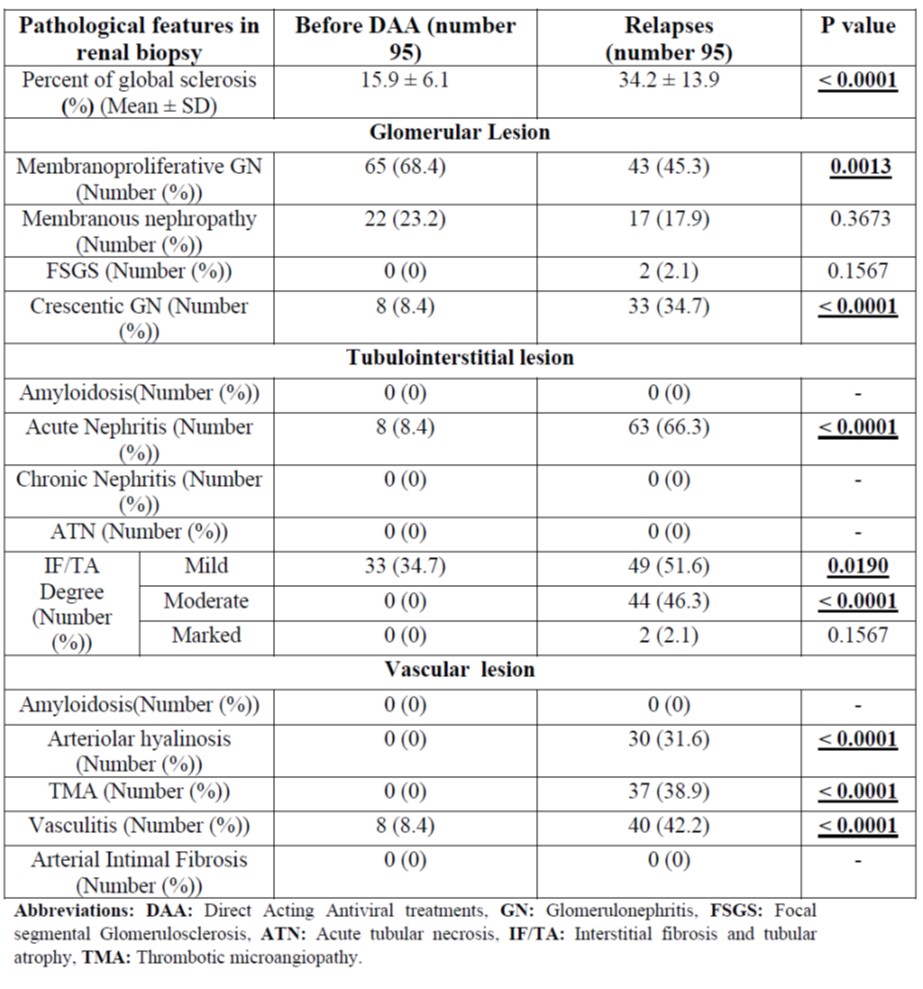
Results: The 95 relapsed cases with kidney involvement were 53 (55.8%) males & 42 (44.2%) females. The average age was 38.3 ±5.8 (27-48) years old. The average BMI was 24.9 ± 1.7 (22-28) kg/m2. 47 cases (49.5%) were smokers. The average Duration of HCV was 18.1 ± 7.9 (7 – 42) months. All cases were CHILD A (100%). The main clinical presentation initially was Purpura, with constitutional manifestations in all cases while 3 (3.2%) cases had neuropathy & 2 (2.1%) cases had Raynaud’s. After relapse there was aggressive clinical presentation; where 80 (84.2%) cases had neuropathy, 57 (60%) cases had constitutional manifestations, 42 (44.2%) cases had joint affection, and 26 (27.4%) cases had Raynaud’s. The onset of Renal relapse after the end of treatment was 16.3 ± 1.9 (13 – 20) months. The average serum creatinine was 2.4 ± 0.7 (1.6-3.9) mg/dl. 43 (45.3%) cases had granular cast in their urine analysis while 28 (29.6%) cases had red cell cast. The average 24 urinary protein was 3.2 ± 0.6 (1.8- 4.5) gm/24hrs. All cases had positive Cryoglobulins, rheumatoid factor & consumed C4 (complement). The Pathological features in renal biopsy before starting DAAs and after relapses are shown in Table 1.
Conclusion: Relapsing cases were associated with more aggressive clinical and pathological renal manifestations. Membranoproliferative & Crescentic GN were the most common glomerular lesions in relapsing cases. There was significant global sclerosis, vascular and tubulointerstitial involvement in the relapsing cases.
To cite this abstract in AMA style:
Hegazy M, Fayed A, Ragab G. The Pattern of Renal Involvement in Relapsing Cryoglobulinemic Vasculitis After Successful Sustained Viral Response by Direct-Acting Antiviral Treatments [abstract]. Arthritis Rheumatol. 2024; 76 (suppl 9). https://acrabstracts.org/abstract/the-pattern-of-renal-involvement-in-relapsing-cryoglobulinemic-vasculitis-after-successful-sustained-viral-response-by-direct-acting-antiviral-treatments/. Accessed .« Back to ACR Convergence 2024
ACR Meeting Abstracts - https://acrabstracts.org/abstract/the-pattern-of-renal-involvement-in-relapsing-cryoglobulinemic-vasculitis-after-successful-sustained-viral-response-by-direct-acting-antiviral-treatments/